MP doctor arrest: flawed justice: reminiscent of Hammurabi’s era of medical regulation


A doctor has been arrested in Madhya Pradesh’s Chhindwara after a toxic batch of Coldrif cough syrup allegedly caused the deaths of 18 children across two states, exposing alarming lapses in drug quality control.

 Strangely enough, when the drug manufacturer and the drug controller are responsible for the quality of drug, the doctors are the one who is arrested.  Does that imply that doctors should now stop expecting justice from courts and Government?

 The whole process appeared flawed from the root. Blame for the poor quality of drugs manufactured is passed on the prescribing doctor.

  Even for complexities of medical science and uncertainties of the outcome, blame can conveniently be passed on doctors due to application of average wisdom.

 This strange kind of justice delivery has unmasked the everyday struggle of the doctors in the present era.  The unjustified arrest just for prescribing a medicine has depicted the plight of doctors- being undervalued and demonized, forced to work as a sub-servant, irresponsible policing, blackmail by goons and vulture journalism-all have become an accepted form of harassment.  This incident has unveiled the despondency, moral burden, and injustice that doctors work with.

 An effort to govern or regulate the medical profession is not new. Hammurabi had initiated to write the rules of the game. This single professional species was managed with cruel regulation around 5000 years ago, that initiated a change in the global perception and regulatory system in radical and unprecedented ways.

Hammurabi 5000 years ago,  was  not even at the   doorstep of medical science, but he promulgated some rules. It is difficult to say whether he was naive or brilliant enough to make it more mathematical. He fixed heavy prize for saving lives and used to cut the hands of physicians for death or untoward incident. But he was still wise enough to pay heavily if life was saved.   After thousands of years, with some scientific advancements, our regulation has remained more or less similar in basics. It is still based on principles of revenge and punishments. Now clearly knowing well the limitation of medical science and the uncertainties and complexities of human body in better way, it still remains somewhat  unfair to doctors.  In other words, it has not attained enough evolution and maturity. 

Hammurabi at the start of civilization believed that doctors needed to be punished in case there was poor prognosis. He failed to understand the complexity of human body and the limitations of medical science, most of which was unknown at that time. By an application of average wisdom, doctor can be easily blamed for poor outcome, because he is always a common link between treatment and poor prognosis. Stricter punishments were imposed to regulate medical profession, even  when the medical science was not even developed enough to deal with most of diseases.  Children are always taught in school that medical profession is a noble one. But they are never told, about the cruelty this profession has faced since ancient times.  Almost universally, the earlier work or contribution of a doctor to society is not taken into account.  Even for complexities of medical science and uncertainties of the outcome, blame can conveniently be passed on doctors due to application of average wisdom.

    Hammurabi’s Codex specified the harshest form of deselection of health providers possible. If the physician erred through omission or commission, his fingers or hands were cut off, immediately stopping his practice. Therefore, a single mistake can undo all the good work of past or the future good work that could have been accomplished.

Problem here is that who can differentiate with certainty the real cause of sufferings of patient, a poor prognosis or a mistake.  Such harsh regulatory systems will dissuade other good people joining the profession, again resulting in further inhibition and flourishing of profession for the good.  Obviously, harsher penalties will discourage a physician surplus.

Today the global system of medical regulation, is becoming somewhat similar, to those ancient regulations in terms of punishment and revenge. Differential payment system for health care also resembles the Code of Hammurabi in some respects. And this is even though now we are very well conversant with the known uncertainty and complexity of the human body and despite cognizance of the poor prognosis in many disease states.

Fear factors of injustice to  doctors and impact of present legal complexities is already at par with that of Hammurabi’s era.

Advantages-Disadvantage of being a doctor

25 factors- why health care is expensive

REEL Heroes Vs Real Heroes

 21 occupational risks to doctors and nurses

Covid paradox: salary cut for doctors other paid at home

Medical-Consumer protection Act- Pros and Cons

Expensive Medical College  seat- Is it worth it?

NEET- Not so Neat- percentile system

The  Myth  of  cost of  spending  on  medical  education needs to be made  transparent.

Cough syrup tragedy. Responsible:  doctor-pharma-drug regulator?


A doctor has been arrested in Madhya Pradesh’s Chhindwara after a toxic batch of Coldrif cough syrup allegedly caused the deaths of 18 children across two states, exposing alarming lapses in drug quality control. Of the total deaths, 14 were reported from Chhindwara alone,    A special team from Kotwali police arrested Dr Soni from Rajpal Chowk in Chhindwara late Saturday night after the FIR was registered against him, the SP said.

      The doctor has been booked for negligence and prescribing the medicine even after its adverse effects on children for nearly a month. The manufacturer had been charged as it was supplying contaminated syrup, as per the test report, Pandey told PTI.

        Here doctor who prescribed was arrested, whereas who manufactured the cough syrup is primarily responsible.

 What is the role of ‘Drug regulator’ and ‘drug quality regulator’ in such cases?

Do they carry any accountability or responsibility?  

Strangely doctors are invariably the easy scape-goats.  It is time to treat pharmaceutical malaise. The rise in “falsified and substandard medicines” has become a “public health emergency.” A surge in counterfeit and poor-quality medicines means that thousands of patients a year are thought to die after receiving shoddy or outright fake drugs intended to treat ailments. Most of the deaths are in countries where a high demand for drugs combines with poor surveillance, quality control, and regulations to make it easy for criminal gangs and cartels to infiltrate the market.

   If deep investigations are not done in such cases, poor quality medicines will continue to be marketed and doctors would be held responsible for the adverse reactions and deaths. Strict regulations for quality of pharmaceutical agents are need of the hour.

    Usually, every problem related to health is called medical malaise, but that is a misnomer.  In fact, health care comprises tens of different industries.  Complex interplay of various industries like pharmaceutical, consumable industry and other businesses associated with health care remain invisible to patients. Various important components for example pharma industry, suppliers, biomedical, equipment, consumables remain largely unregulated. Collective malaise of all these is conveniently projected as medical problems as blame is conveniently passed on to doctors, as they are only visible component of mammoth health business.  Rest all remain invisible, earn money and doctors are blamed for the poor outcome of the patient, as doctor is the only universal link that is visible with patient. By an average application of wisdom, it is easier to blame doctors for everything that goes wrong with patient.

     In routine, if patient gets fake or low-quality medicines and does not get well, gets side effects, doctor will face harassment. Whereas people involved and industry will be sitting pretty and make money.

The government on Sunday also suspended Dr Soni from service. He has been attached to the health department regional officer in Jabalpur, as per an order.

MP Chief Minister Mohan Yadav on Saturday said strict action will be taken against those responsible.

The Tamil Nadu drug control authorities, in their report dated October 2, declared the Coldrif syrup sample (Batch No SR-13; Mfg: May 2025; Exp: April 2027) manufactured by Sresan Pharmaceuticals, Kancheepuram, as adulterated because it contained diethylene glycol (48.6% w/v), a poisonous substance “which may render the contents injurious to health”.

Following the report, the Madhya Pradesh Food and Drug Administration issued instructions to stop further sale and distribution of Coldrif statewide and immediately seize any available stock for investigation under the Drugs and Cosmetics Act, 1940. It also ordered that other products manufactured by Sresan Pharmaceuticals be removed from sale pending testing.

The Tamil Nadu government on Friday banned Coldrif following reports of deaths in Madhya Pradesh and at least three similar fatalities in Rajasthan due to suspected kidney infections.

  Advantages-Disadvantage of being a doctor

     25 factors- why health care is expensive

REEL Heroes Vs Real Heroes

 21 occupational risks to doctors and nurses

Covid paradox: salary cut for doctors other paid at home

   Medical-Consumer protection Act- Pros and Cons

Expensive Medical College  seat- Is it worth it?

NEET- Not so Neat- percentile system

The  Myth  of  cost of  spending  on  medical  education needs to be made  transparent.

Doctor’ Revolt- a Mutiny long due globally- for  professional dignity #RTH


 Administrators’ wish to govern or regulate the medical profession cruelly is not new.  Hammurabi 5000 years (King of Babylonia) ago had initiated to write the rules of the game. Although he was not even at the   doorstep of medical science, but he  promulgated some rules. It is difficult to say whether he was naive or brilliant  enough to make it more mathematical. He fixed  heavy prize for saving lives   of rich people and used to  cut the hands of physicians for death or untoward incident. But he was still wise enough to pay heavily if life was saved. 

     No one really knows how to regulate this difficult area, which encompasses life and death, deals with extremes of poverty and riches, mortality and morbidity, pain and relief , sadness and happiness, smiles and sorrows and uncountable emotions, intertwines with financial aspects. Most difficult part is  amalgamation of  intricacies of science with minds of  patient and doctor’s skill in  newly evolved milieu of financial complexities.  Results are not encouraging for the medical profession.

    With the evolution of medical science and medical care intertwined with  medical business, braided changes in  medical  regulation is not an far off expectation. But reticulation of evolution to modern medicine  and health care has not happened  in  isolation. Simultaneously there has been  progressively complex emerging trends in medical business and changing patterns of health investments along with an era of corporate investments in health care  has also ushered.  Every one now wishes  to live longer  and  dreams of better quality of life with support of progressive medical care.  That kind of perception has given patients a hope in lieu of some money. With rich people willing to spend more, the insurance sector and investors putting money into health care, which was unthinkable few decades back in the  past.  

    This reticulation of business and  health care allowed health care to be controlled  in some way by administrators and investors. These people actually controlling health care are away from the health providers, who treated the patients.   The rulers are unaware of the limitation of medical science and the uncertainties and complexities of human body,  so the regulation  remains  somewhat  unfair to doctors.

   Today the global  system of medical regulation, is becoming somewhat  similar, to those ancient codes  in  terms of punishment and revenge. Differential payment system for health care also resembles the Code of Hammurabi in some respects.

       Fear factors on doctors and impact of present legal complexities is already at par with that of Hammurabi’s era. Aggrieved health care consumers may welcome a move toward harsh penalties in the name of justice and simply for revenge, but  the law has failed to   keep in mind the  poor outcomes in complex diseases, limitation of science and of course the idiosyncrasies of the human body.

    In such unfavourable and hostile circumstances, opting for a medical career is like  getting into a trouble zone and getting  entrapped into a system of exploitation and may be a self-bought disaster.  It looks like  as an absurd thought  and  highly ill advised.

       Doctors and nurses have been reduced to no more than moral and economical slaves either by industry or administrators, not infrequently pulled by legal bridle in their noses.   

 Doctors have been left with  only two ways either to persist, fight or perish. Silently quitting their beloved profession is going on for some time all over the world. Even in developed countries, there has been a fading enthusiasm to be a doctor

     Increasing cruelty and unreasonable regulation is leading to doctors’ revolt. For example   #NO-TO-RTH-AGITATION is a movement, the result of failure of Government to create public health system, but it has potential to fail the existing private doctors’ system as well. Smaller hospitals are already on verge of closure, will be forced to shut down.

    It is a cry for survival for the doctors, if short-sighted bureaucracy can understand the real problem.

Slow or acute revolt is long due globally-  no less than mutiny- a struggle for  professional dignity.

     Advantages-Disadvantage of being a doctor

     25 factors- why health care is expensive

REEL Heroes Vs Real Heroes

 21 occupational risks to doctors and nurses

Covid paradox: salary cut for doctors other paid at home

   Medical-Consumer protection Act- Pros and Cons

Expensive Medical College  seat- Is it worth it?

NEET- Not so Neat- percentile system

The  Myth  of  cost of  spending  on  medical  education needs to be made  transparent.

Exorbitantly expensive medical education and lowered merit

Struggle for professional independence: #RTH-Rajasthan doctors are global leaders


  In the present era, Doctors are  ebbed from all sides,  need to earn back the dignity of profession and resist oppression. The phenomenon of oppression in the name of medical- regulation is a global issue. The oppressive schemes in the  misleading names like  #RTH  Rajasthan (RIGHT TO HEALTH) are prevalent everywhere globally in  some form or another.

       Doctors and nurses  have been  reduced to no more than moral and economical slaves either by industry or administrators, not infrequently pulled by legal bridle in their noses.

      Doctors in Rajasthan India have shown  first of its kind revolt, that is just waiting to happen  globally at some stage.

Will Rajasthan’s Right to health bill do more harm than Good?

    It is not easy to practice as doctor these days. Media  full of  doctors bashing, credibility crisis and regulators perpetually hounding doctors, who are forced to work  under imposed medico-legal sword. There is no day that passes when system does not perpetuate negativity against medical profession.

 By certain  laws and  Acts like RTH, an effort is on to place   medicine   under State control.  Acquiring kind of skill , the years of passionate, merciless  excruciating  medical learning   is placed  at the disposal of  administrators, who themselves have already failed to develop a good health care system in real sense.  

Doctors  have become soft targets for populist attention mongering and transforming  social  nuisance into messiah of the deprived  by administrators -by sprouting the fraudulent generalities.

   All the calculations that usually precede the enslavement of medicine, everything gets discussed by administrators and industry – except the well-being of the doctors and nurses.

Doctors have often wondered at the smugness with which administrators assert their right to enslave them, to control their work, to force their will, to violate their conscience, to stifle their mind. Irony is that while administrators do this, still they depend on the same doctors for saving lives -whose life they have throttled, who resent   the treatment meted out to the health care workers.  Like the failed medical system, administrators have failed to realize that all the negativity perpetuated against doctors, who are working with the burden of mistrust under medico-legal sword is going to make them less safe. 

 Administrators, who have never treated a patient in their lifetimes, not only try to control treatment of thousands of patients, but project themselves messiah by demonizing doctors. Lowly educated celebrities and administrators have found a new easy way to project themselves on higher pedestrian by publicly insulting highly educated but vulnerable doctors. The biggest tragedy to the medical profession in the present era is the new fad of administrators to discourage and demonize  the  medical profession for their popularity gains.
          Being  so distant from the ground reality, their role should not have been more than facilitators, but they have become medical  administrators. To control the health system, administrators have a tendency to pretend that shortcomings in the patient care can be rectified by punishing the doctors and nurses.

   Slow or acute revolt is long due. Doctors have only two ways- either to persist, fight or perish. Silently quitting their beloved profession is going on for some time all over the world. Even in developed countries, there has been a fading enthusiasm to be a doctor. But doctors of Rajasthan have shown the way. The way to persist and resist the indignity handed over to medical profession.   The have shown that the struggle was not that difficult that  it looked  to be. They have chosen the correct path of struggle for Independence (Professional).  That makes them global leaders without any doubt.

     Advantages-Disadvantage of being a doctor

     25 factors- why health care is expensive

REEL Heroes Vs Real Heroes

 21 occupational risks to doctors and nurses

Covid paradox: salary cut for doctors other paid at home

   Medical-Consumer protection Act- Pros and Cons

Expensive Medical College  seat- Is it worth it?

NEET- Not so Neat- percentile system

The  Myth  of  cost of  spending  on  medical  education needs to be made  transparent.

Exorbitantly expensive medical education and lowered merit

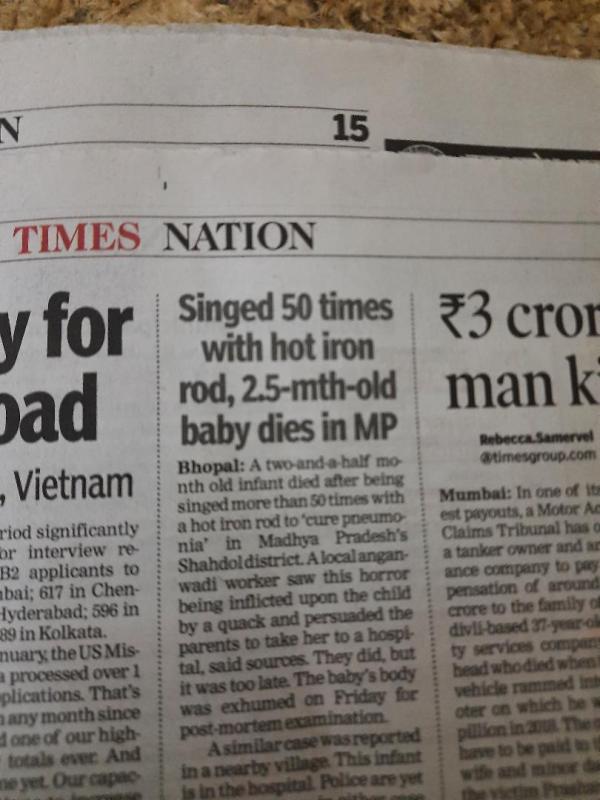
Singed with hot rod to ‘cure pneumonia’- the child dies: Illogical distribution of health care


         In a heart wrenching and unfortunate incident from Bhopal (Madhya Pradesh), a 2.5 month child was singed with hot iron 50 times by a quack for treatment of pneumonia.  He died and   the incident appeared in newspapers, but similar kind of  treatments must be going on at many places and  gullible patients keep on suffering .The suffering is of two types; one, that they are deprived of correct treatment and other is the tremendous suffering because of such nature of cruel practices in the garb of  treatment.    

         That brings to the fore the basic question; why such type of treatments are being practiced and allowed to be conducted in 21th century. Why people allow  and consent for such treatments by quacks?

     These incidents simply reflect that the health system has not been able to travel  the last mile and  has failed to  touch the last man.

         Most important reason for such disparity is illogical distribution of health care.  Corporatization of health care has projected medicine as a purchasable commodity and consequently resulted in an Illogical distribution of health care

 People, who can afford, spend millions in the last few days of their life, just to have only a few more days to live. Resources spent in such a futile quest are equivalent to  thousands of times the money for food and medicines for the poor who lose lives for fraction of that expense.

It seems humanity has legalized the hoarding of medical care; give it to the rich, bundled with consumerism though not necessarily the needy. It is the same as hoarding of the food that is sold to rich, letting the poor die somewhere in the world without food, which remains invisible to all.

          Another worrisome aspect of the incident is  that  avoidance of people to  seek treatment from appropriate  clinics and hospitals. Anganwadi worker was there in the village, so it was possible  to seek help from the health system. Is the mistrust and malice  generated  by media towards  doctors and  medical professionals is the reason to  avoid seeking help from them?

BHOPAL: A newborn has died after being singed more than 50 times with a red hot iron rod in a bizarre ritual to ‘cure pneumonia’ in MP’s Shahdol district. A local anganwadi worker saw this horror being inflicted upon the child by a quack and persuaded the parents to take her to a hospital, say sources. They did, but it was too late. The baby’s body was exhumed on Friday evening for post-mortem examination. Even as police were grappling with this horror, a similar case was reported in a nearby village. This infant is in hospital. Police are yet to arrest anyone in either case and it’s not yet known if the same quack, a woman, was behind singeing both babies. The Child Welfare Committee has written to police to take action under section 75 of Juvenile Justice Act, but nothing has been done. When TOI spoke with Singhpur police, they said they were taking legal opinion on how to proceed with the case. An officer said they are waiting for the autopsy report to see what charges can be pressed. The baby who died was two and a half months old and suffering from pneumonia. Her parents live in Kathotiya village, around 520km from Bhopal and close to Chhattisgarh. “The infant was ‘torched’ as a method of ‘treatment’ on January 10.” Singhpur police station in charge, MP Ahirwar told TOI. The second incident happened in Samtapur villagee. The baby’s parents deny they put the girl through the burning ritual.

     Advantages-Disadvantage of being a doctor

     25 factors- why health care is expensive

REEL Heroes Vs Real Heroes

 21 occupational risks to doctors and nurses

Covid paradox: salary cut for doctors other paid at home

   Medical-Consumer protection Act- Pros and Cons

Expensive Medical College  seat- Is it worth it?

NEET- Not so Neat- percentile system

The  Myth  of  cost of  spending  on  medical  education needs to be made  transparent.
Budget outlay on medical insurance up, public health infrastructure down


       Whether it is better to buy fish for years or provide people with fishing net? This applies to public health care system in India.  Times of India analysis points out the need to build and strengthen   the public health care system. Building of infrastructure for massive population requires funds, but ultimately the investment will bring down the cost of treatment and better delivery of health care to the country.

                     NEW DELHI: The health budget is good news for the private health sector as there has been a substantial increase in allocation for health insurance schemes such as the Central Government Health Scheme (CGHS), treatment for CGHS pensioners and the Ayushman Bharat scheme. Government’s own data has shown that the private health sector corners the bulk of the spending under these schemes, which saw a nearly 22% jump in allocation in the 2023-24 budget.

          In contrast, the allocation for schemes aimed at improvement in public health infrastructure has declined when adjusted for inflation. These include the National Health Mission (NHM), Pradhan Mantri Ayushman Bharat Health Infrastructure Mission (PMABHIM), human resources for health and medical education and Pradhan Mantri Swasthya Suraksha Yojana (PMSSY).

The overall allocation for health after rising during Covid, has come down in real terms though it seems like an increase in nominal terms from Rs 83,000 in the budget estimates (BE) for the current year to Rs 86, 175 crore in BE 2023-24. The revised estimates (RE) for the current year indicate a 9% decline from the BE to Rs 76,370 crore. The allocation for insurance schemes, however increased substantially in RE 2022-23; more than 75% hike in allocation for CGHS pensioners from Rs 2,645 crore to Rs 4,640 crore and for the first time since the launch of Ayushman Bharat scheme, the RE is the same as the BE at Rs 6,400 crore. In the past, only about half the budgeted amount for Ayushman was getting spent. However, the allocation for all the public infrastructure schemes put together has been slashed by 16% in the RE for the current year. In comparison to the Rs 13,266 crore allocated for insurance schemes, which cover only a section of the population, about Rs 30,000 crore has been allocated for the National Health Mission and a separate Rs 6,500 crore for human resources for health and medical education, which was earlier part of the NHM budget.

         Most of the allocation for the insurance schemes usually ends up in the coffers of the private sector. Despite private hospitals accounting for only 46% of empanelled hospitals under Ayushman Bharat, for instance, they accounted for 54% of hospitals admissions and since private healthcare is more expensive, that could account for a much higher proportion of the money spent. Most CGHS beneficiaries too go to private hospitals as noted by Dr Rakesh Sarwal, who was advisor health in Niti Aayog, in a study of the scheme. Dr Sarwal stated that CGHS had a higher cost of service because of its greater reliance on private facilities. Incidentally, though the finance minister announced a mission to eliminate sickle cell anaemia, there is no separate budget line for it. Thus even the money for a totally new scheme might have to come from within the NHM budget, further eating into the allocation. The tertiary care programme, which provides for transfer to states for implementing national programmes on control of blindness, tobacco control, capacity building for trauma centres and for prevention and control of non-communicable diseases such as cancer, diabetes, cardiovascular diseases and stroke, has had its allocation slashed to just Rs 290 crore, less than the actual spending of Rs 300 crore in 2020-21, and 42% less than the allocation of Rs 500 in the last budget.

The budget for the establishment and strengthening of the branches of the National Centre for Disease Control and for preparation and control of zoonotic and other neglected tropical diseases and for diseases surveillance, which had gone up during Covid, has been slashed from Rs 71.6 crore to just Rs 55.6 crore, despite the WHO asking countries to prepare for future pandemics by strengthening surveillance. Even the budget for the Indian Council for Medical Research, which played a crucial role during Covid, has been slashed along with a cut in the overall allocation for health research.

Advantages-Disadvantage of being a doctor

     25 factors- why health care is expensive

REEL Heroes Vs Real Heroes

 21 occupational risks to doctors and nurses

Covid paradox: salary cut for doctors other paid at home

   Medical-Consumer protection Act- Pros and Cons

Expensive Medical College  seat- Is it worth it?

NEET- Not so Neat- percentile system

The  Myth  of  cost of  spending  on  medical  education needs to be made  transparent.

 Supreme Court agrees to make Passive Euthanasia & Living Will rules workable


SC to tweak 2018 verdict to make passive euthanasia rules workable

NEW DELHI: The Supreme Court on Tuesday decided to “tweak” its 2018 verdict on passive euthanasia to make the procedure and guidelines fixed by it workable, and said that it may fix a time frame within which medical boards would have to submit reports to remove life-support systems from a terminally ill patient. Admitting that the procedure prescribed by the apex court in 2018 was very onerous and time consuming, a five-judge constitution bench of Justices K M Joseph, Ajay Rastogi, Aniruddha Bose, Hrishikesh Roy and C T Ravikumar sought suggestions from the Centre and senior advocates Arvind Datar and Prashant Bhushan to make it workable without compromising with the safeguards put in place by the court four years ago while legalising passive euthanasia. The process prescribed in 2018 not only involves family members and doctors but also judicial magistrates and collectors. Besides, two medical boards need to be constituted before life-support system can be withdrawn. The verdict said the living will, or advance directive for not putting a person on artificial life-support system, has to be made in the presence of two attesting witnesses and countersigned by the jurisdictional judicial magistrate of first class (JMFC). In the event of a person becoming terminally ill, the treating physician shall ascertain the living will’s authenticity from the JMFC. If the physician is satisfied, the hospital shall then set up a medical board consisting of the head of the treating department and at least three expert doctors. If the medical board recommends removal of life support, the hospital shall inform the collector, who shall then constitute another medical board comprising the chief district medical officer and three expert doctors. If the board allows withdrawing treatment, it shall convey the decision to the JMFC before allowing life support to be withdrawn. JMFC shall visit the patient and, after examining all aspects, may permit implementation of the directive.

      Seeking modification in the procedure, lawyers contended that time was crucial for terminally ill patients and the whole purpose of passive euthanisa was defeated due to the time taken by the process. That was the reason why there has not been a single case of passive euthanasia in the last four years despite it being legalised, they added.

Agreeing with their contention, the bench observed that dying in peace was dying with dignity, and suffering of a patient should not be prolonged due to the lengthy process. It said that the court could set a time limit for completion of the two-tier procedure without delay and also consider that a living be prepared like normal will without the mandatory presence of a judicial officer. The bench sought response from the Centre on whether it intended to frame a law for its regulation as the court had said in 2018. Paving the way for passive euthanasia, the apex court had in 2018 said, “It has to be stated without any trace of doubt that the right to live with dignity also includes the smoothening of the process of dying in case of a terminally ill patient or a person in PVS (persistent vegetative state) with no hope of recovery. A failure to legally recognise advance medical directives may amount to non-facilitation of the right to smoothen the dying process and the right to live with dignity.”

Supreme Court agrees to not involve judicial officers, collectors in ‘living will’ process

NEW DELHI: Amidst divergent opinions evading consensus on various points to make 2018 verdict on passive euthanisa workable on ground, the Supreme Court on Wednesday agreed in principle to keep judicial officer and district collector out of the process for making living will and setting up of medical board for removing life support system for terminally ill patients. Facing the onerous task to tweak 2018 verdict without modifying it and to continue with the safeguard put in place four years back, Justices KM Joseph, Ajay Rastogi Aniruddha Bose, Hrishikesh Roy and Justice CT Ravikumar are exploring ways to build consensus among parties, including the Centre, to make the process of making and executing living will or advance directive practical and less cumbersome for the patient. As the petitioner, represented by advocate Arvind Datar and additional solicitor general KM Nataraj, agreed that there was no need to involve judicial magistrate of first class (JMFC) in the process of preparation of will, the bench agreed that the living will can be attested by notary or a gazetted rank officer. As per 2018 verdict, the living will or advance directive, for not putting on artificial life support system, has to be made in the presence of  two attesting witnesses and countersigned by the jurisdictional JMFC. The court also in principle agreed that collectors be kept out of the process and will take a call on who should be entrusted with the task to constitute secondary medical board.

Advantages-Disadvantage of being a doctor

     25 factors- why health care is expensive

REEL Heroes Vs Real Heroes

 21 occupational risks to doctors and nurses

Covid paradox: salary cut for doctors other paid at home

   Medical-Consumer protection Act- Pros and Cons

Expensive Medical College  seat- Is it worth it?

NEET- Not so Neat- percentile system

The  Myth  of  cost of  spending  on  medical  education needs to be made  transparent.
Deaths due to Low Quality Medicine- Pharma Industry Needs Strict Regulation


It is  time to treat Pharmaceutical malaise.

    Take example for cough syrup related  66 deaths at Gambia or  Injection Propofol related deaths at PGI Chandigarh. If deep investigations are not done, poor quality medicines will continue to be marketed and doctors would be held responsible for the adverse reactions and deaths. Strict regulations for quality of pharmaceutical agents is need of the hour.

    Usually every problem related to health is called medical malaise, but that is a misnomer.  In fact health care comprises tens of different industries.  Complex interplay of various industries  like pharmaceutical, consumable industry and other businesses associated with  health care  remain invisible to patients. Various important components for example pharma industry, suppliers, biomedical, equipment, consumables remain largely unregulated. Collective malaise of all these is conveniently projected as medical problems  as blame is conveniently passed on to doctors, as they are only visible component of mammoth health business.  Rest all remain invisible, earn money and  doctors are blamed for the poor outcome of the patient, as doctor is the only universal link that is visible with patient. By an average application of wisdom, it is easier to blame doctors for everything that goes wrong with patient.

      Cough syrup related deaths at Gambia or  Injection Propofol related deaths at PGI Chandigarh – two examples are only a tip of the iceberg.  In routine, if patient gets fake or low quality medicines and does not get well, gets side effects, doctor will face harassment. Whereas people involved and industry will be sitting pretty and  make money.

Therefore strict administration and quality check  is required   to correct Pharma malaise. It may be a complex issue because of complexity involved in implementation and execution of policies. But recognition and beginning to think of the problem is also an important step.

Red alert over deaths after Propofol injection- PGI CHANDIGARH

WHO warns over deaths of 66 children in The Gambia (Indian Pharmaceutical Cough syrup).

WHO warns over deaths of 66 children in The Gambia (Indian Pharmaceutical Cough syrup)

The WHO has issued an alert over four cough and cold syrups made by Maiden Pharmaceuticals in India, warning they could be linked to the deaths of 66 children in The Gambia

The World Health Organization (WHO) on Wednesday issued a warning over four cough and cold syrups made by an Indian company, saying that they could be linked to the deaths of 66 children in The Gambia. The WHO said that the cough and cold syrups, made by Maiden Pharmaceuticals in Haryana, could be the reason for serious kidney injuries. “Please do not use them,” the WHO said in its advisory.

The four cough and cold syrups that have been linked to the deaths of 66 children in The Gambia are Promethazine Oral Solution, Kofexmalin Baby Cough Syrup, Makoff Baby Cough Syrup and Magrip N Cold Syrup. In a release, the WHO has said that the Indian company has not yet provided guarantees on the safety and quality of these products.

“Laboratory analysis of samples of each of the four products confirms that they contain unacceptable amounts of diethylene glycol and ethylene glycol as contaminants,” the WHO said in a medical product alert. The WHO also warned that while the products had so far been found in The Gambia, they could have been distributed to other countries.

According to the WHO, diethylene glycol and ethylene glycol are toxic to humans when consumed and can prove fatal. Toxic effects can include abdominal pain, vomiting, diarrhoea, inability to pass urine, headache, altered mental state, and acute kidney injury which may lead to death, the WHO said.

New Delhi-based Maiden Pharmaceuticals declined to comment on the matter.

The World Health Organization also said that it was conducting further investigation with the company and regulatory authorities in India regarding the cough syrup linked to deaths of 66 children.

Last month, Gambia’s government said that it has also been investigating the deaths. The government statement came as a spike in cases of acute kidney injury among children under the age of five was detected in late July.

“While the contaminated products have so far only been detected in the Gambia they may have been distributed to other countries,” WHO Director General Tedros Adhanom Ghebreyesus said at a press conference on Wednesday.

The WHO Director General added that WHO recommends all countries detect and remove these products from circulation to prevent further harm to patients.

Meanwhile, the DSCO has already taken up an urgent investigation into the matter with the regulatory authorities in Haryana.

Red alert  over  deaths after Propofol injection- PGI  CHANDIGARH

CHANDIGARH: Five patients had died after they were sedated before surgeries on a single day last week at PGI, prompting doctors to sound a red alert to Central Drugs Standard Control Organisation (CDSCO)on Propofol injection – an anesthetic given before any major surgery. In this case, the drug was taken from the chemist shop in the hospital emergency. “Following a complaint from PGI doctors, we came with a CDSCO team to collect samples. The samples have been sent to Central Drugs Laboratory, Kolkata,” said Sunil Chaudhary, senior drug control officer, UT. He said, “The suspected batch of drugs has been stopped for supply till reports are received.” Sources said test analysis will take around two-three weeks and final report will be submitted by the CDSCO team. The five patients had to undergo orthopaedic and neurosurgeries. On deliberating the cause of deaths, doctors found Propofol injection as the common thread.

Advantages-Disadvantage of being a doctor

     25 factors- why health care is expensive

REEL Heroes Vs Real Heroes        

 21 occupational risks to doctors and nurses

Covid paradox: salary cut for doctors other paid at home

   Medical-Consumer protection Act- Pros and Cons              

Expensive Medical College  seat- Is it worth it? 

CCI investigates India’s largest hospital chains’ Practices


The potential penalty by India’s fair trade regulator could be steep. The CCI  (The Competition Commission of India)  investigation is the first such action against exorbitant prices of medicines and services fixed by hospitals, which have operated free of regulation so far.

A four-year investigation by India’s fair-trade regulator has concluded that some of India’s largest hospital chains abused their dominance through exorbitant pricing of medical services and products in contravention of competition laws.

The Competition Commission of India (CCI) will soon meet to weigh in on the responses by Apollo Hospitals, Max Healthcare, Fortis Healthcare, Sir Ganga Ram Hospital, Batra Hospital & Medical Research and St. Stephen’s Hospital. It will then decide whether to impose penalties, said people familiar with the matter.

The CCI can impose a penalty of up to 10 percent of the average turnover for the past three preceding financial years of an enterprise that has violated competition laws. The penalties could be steep. Apollo Hospitals posted an average turnover of Rs 12,206 crore and Fortis Rs 4,834 crore in the past three financial years.

The CCI’s director-general found that 12 super-speciality hospitals of these chains that operate in the National Capital Region abused their positions of dominance by charging “unfair and excessive prices” for renting rooms, medicines, medical tests, medical devices, and consumables, according to a copy of the summary report that Moneycontrol reviewed.

Some hospital room rents exceeded those charged by 3-star and 4-star hotels, according to the findings by the DG, who examines anti-competitive practices.

Significance of the investigation

The CCI investigation is the first such action against exorbitant prices of medicines and services fixed by hospitals, which have operated unencumbered by regulation so far. The watchdog’s action could potentially rein in the prices of medicines and healthcare equipment, or at the very least, bring transparency in the way hospitals sell these items, according to competition lawyers.

Of the 12 hospitals that faced CCI scrutiny, six belonged to Max  and two to Fortis.

The CCI and the hospital chains had no comment for this article.

Overcharging without checks

Exorbitant pricing is a common thread running through the CCI investigation report. The hospitals were found to charge more for certain medical tests as well as for X-rays, MRI and ultrasound scans than rates offered by other diagnostic centres. For consumables such as syringes and surgical blades, hospitals charged rates that were higher than those of other consumable makers, according to the CCI report.

The only exception was medicines, which hospitals sold at the maximum retail price, although they earned significant profits by procuring them at lower prices.

The CCI selected the hospitals for investigation on the basis of the number of doctors, paramedics, beds, and turnover for the period 2015-2018. The investigation found that these hospitals do not allow the use of purchase of consumables, medical devices, medicines and medical test results from outside, adding that patients use the service of in-house pharmacy and laboratories for ease of convenience.

Investigative reports pertaining to each of the hospital chains were submitted by the DG to the CCI on December 24, 2021. The CCI forwarded a copy of these reports to the hospitals on July 12, 2022, and sought their responses, according to the people, who did not want to be identified.

The CCI has been examining the pharmaceutical sector in India for years, scrutinising the pricing of medicines by healthcare companies. On April 19, 2020, it cautioned businesses, including healthcare companies, against taking advantage of Covid-19 to contravene competition laws.

     Advantages-Disadvantage of being a doctor

     25 factors- why health care is expensive

REEL Heroes Vs Real Heroes

 21 occupational risks to doctors and nurses

Covid paradox: salary cut for doctors other paid at home

   Medical-Consumer protection Act- Pros and Cons

Expensive Medical College  seat- Is it worth it?

Most Unethical Medical Study Ever- Tuskegee Study for Syphilis


One of the ugliest and unethical human studies in the history, Tuskegee Study raised a host of ethical issues such as informed consent, racism, paternalism, unfair subject selection in research, maleficence, truth telling and justice, among others.   It is really unbelievable to understand the heinous nature of the Tuskegee study.

    The Public Health Service started the study in 1932 in collaboration with Tuskegee University (then the Tuskegee Institute), a historically Black college in Alabama. In the study, investigators enrolled a total of 600 impoverished African-American sharecroppers from Macon County, Alabama.

Tuskegee syphilis study

     Tuskegee syphilis study

The goal was to “observe the natural history of untreated syphilis” in black populations. But the subjects were unaware of this and were simply told they were receiving treatment for bad blood. Actually, they received no treatment at all. Even after penicillin was discovered as a safe and reliable cure for syphilis, the majority of men did not receive it.

In 1932, the USPHS, working with the Tuskegee Institute, began a study to record the natural history of syphilis. It was originally called the “Tuskegee Study of Untreated Syphilis in the Negro Male” (now referred to as the “USPHS Syphilis Study at Tuskegee”).

The study initially involved 600 Black men – 399 with syphilis, 201 who did not have the disease. Participants’ informed consent was not collected. Researchers told the men they were being treated for “bad blood,” a local term used to describe several ailments, including syphilis, anemia, and fatigue. In exchange for taking part in the study, the men received free medical exams, free meals, and burial insurance.

By 1943, penicillin was the treatment of choice for syphilis and becoming widely available, but the participants in the study were not offered treatment.

The purpose of the study was to observe the effects of the disease when untreated, though by the end of the study medical advancements meant it was entirely treatable. The men were not informed of the nature of the experiment, and more than 100 died as a result.

None of the infected men were treated with penicillin despite the fact that, by 1947, the antibiotic was widely available and had become the standard treatment for syphilis.

    .

Of these men, 399 had latent syphilis, with a control group of 201 men who were not infected. As an incentive for participation in the study, the men were promised free medical care. While the men were provided with both medical and mental care that they otherwise would not have received,  they were deceived by the PHS, who never informed them of their syphilis diagnosis and provided disguised placebos, ineffective methods, and diagnostic procedures as treatment for “bad blood”.

The men were initially told that the experiment was only going to last six months, but it was extended to 40 years.  After funding for treatment was lost, the study was continued without informing the men that they would never be treated.

The study continued, under numerous Public Health Service supervisors, until 1972, when a leak to the press resulted in its termination on November 16 of that year.  By then, 28 patients had died directly from syphilis, 100 died from complications related to syphilis, 40 of the patients’ wives were infected with syphilis, and 19 children were born with congenital syphilis.

The 40-year Tuskegee Study was a major violation of ethical standards, and has been cited as “arguably the most infamous biomedical research study in U.S. history.”  Its revelation has also been an important cause of distrust in medical science and the US government amongst African Americans.

Later in 1973, a class-action lawsuit was filed on behalf of the study participants and their families, resulting in a $10 million, out-of-court settlement in 1974.

On May 16, 1997, President Bill Clinton issued a formal Presidential Apology for the study.

On May 16, 1997, President Bill Clinton formally apologized on behalf of the United States to victims of the study, calling it shameful and racist. “What was done cannot be undone, but we can end the silence,” he said. “We can stop turning our heads away. We can look at you in the eye, and finally say, on behalf of the American people, what the United States government did was shameful and I am sorry.”

     Advantages-Disadvantage of being a doctor

     25 factors- why health care is expensive

REEL Heroes Vs Real Heroes        

 21 occupational risks to doctors and nurses

Covid paradox: salary cut for doctors other paid at home

   Medical-Consumer protection Act- Pros and Cons

Expensive Medical College  seat- Is it worth it?

Blog at WordPress.com.

Up ↑