How to achieve “Effective Lock-Down” to prevent community spread @Corona pandemic


  To identify communities at  risk

“Battle of Corona” Only people can win this war, not doctors or Governments

         Preventing Community spread at this time  is the key to  control  the  Corona pandemic.  Strict  Lock down needs to be effective to achieve the desired objectives. Therefore it is necessary to identify the communities at  risk, where lock-down is not complete and hence these may be need to identify the weak points to achieve effective lock-down.

   These communities can be:

  1.    Surveillance in high population density zones: India  and specially large cities have areas with thick population density.  There is a tendency to come out of houses for  informal chatting.  People need to understand that effective lockdown is more than just not attending to the office work.  Such collections of people can be  prevented by strict enforcement:

A.   Police patrolling in thickly populated residential or good administrative control.

B.   Drone surveillance

C.   Camera surveillance and administrative control

  • Medical needs: people may come out of houses for medical needs. This can be minimized by
  1. Online consultations
  2. Telephonic consultations

These tele-consultations to be used  to differentiate whether it is an emergency or not. The emergencies should be guided to attend hospital, that may be different from Covid 19. So these consultations will help to segregate these patients from  Covid patients.

3.Strengthening of Ambulance service- Network of ambulances can be used to assess at homes and hence  the need for hospitalization may be minimized.  Besides it may help in preventing gathering of relatives and guiding the patient  to appropriate hospital.

4. Providing PPE’s to doctors to prevent loss of work force.

  • Need for essentials: System for community delivery  or   decongestion at market places need to be checked and gathering to be discouraged.

                   Effective Lock-down  can be a key  for winning the “Battle of Corona”. Only people can win this war, and not doctors or Governments.

History of Major Pandemics


Disease and illnesses have always been  catastrophe to  humanity since ancient times. The magnitude of the illnesses and death rates have shown a  marked shift. The more civilized humans became – with larger cities, more exotic trade routes, and increased contact with different populations of people, animals, and ecosystems – the more likely pandemics would occur.

Despite the persistence of disease and pandemics throughout,   one trend that has emerged over time is the gradual reduction in the death rate. As the germ theory is discovered and there is a better understanding of the causative agents has led to better control. Healthcare improvements and control of infections have been powerful tools in mitigating their impact.

In many ancient societies, people believed that spirits and gods inflicted disease and destruction upon those that deserved their wrath. This unscientific perception often led to disastrous responses that resulted in the deaths of thousands.

Brief timeline for the major known pandemics :

165  AD  –  Antonine plague-  thought to be small pox or measles  and caused

around   5 million deaths.

735 AD –     Variola major virus–  Japanese smallpox  –     around 1 million deaths

541  AD-     Plague of Justinian – Yersinia pestis/ rat, fleas –   30- 50 million deaths

1347 AD-    Black death (Plague) –- Yersinia pestis/ rat fleas –   200 million  deaths

1520 AD-   Smallpox —                  Variola major virus—                  56 million deaths

1665 AD  Great plague of London–- Yersinia pestis/ rat fleas –     One lac deaths

1629 AD-         Italian plague          Yersinia pestis/ rat fleas –     death 30- 50 million

1817  AD– Cholera pandemic (6) – vibrio cholera: over 100 years-death one million

1850 AD – Third plague     –         Yersinia pestis/ rat fleas –              death –12  million

1880 AD-  Yellow fever –           Viral /     mosquitoes                    death 1 lac to 1.5 lac

1889  AD-        Russian flu-                   H2 N2 (bird)                           deaths    10 million

1918 AD–      Spanish flu  –                 H1 N1 (Pigs)                          deaths 30-50 million

1958 AD  –         -Asian Flu                                  H2 N2                                        1 million

1968 AD  –     Hong Kong flu                        H3 N2                                              1 million

1981 AD- continued -HIV/AIDS               viral/  chimpanzees                     30 -40 million

2002 AD-            SARS–                         corona virus  Civets / Bats-                     770

2009 AD              Swine Flu                        H1N1 – (pigs)                                     200,000

2014 AD –           EBOLA                                 Ebola virus  –                                       11000

2015 AD-            MERS                          Corona virus/ bats, Camel         death count 850

2019 AD           -COVID -19                         Corona virus                            -still continued


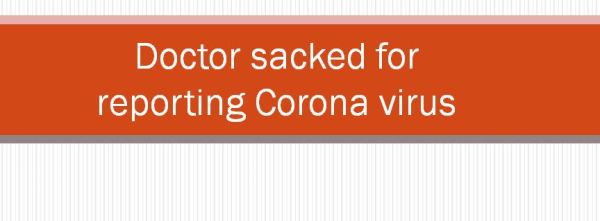
Whistle-blower Doctor who informed about Corona-sacked in Kerala


The ease with which doctors can be punished for doing even the right has finished the independence of the medical profession. The harassment of Chinese whistleblower doctor and now  sacking of the doctor who informed authorities about the coronavirus patient in Kerala are just an example of day to day troubles doctors are facing in every day working. These incidents are just the tip of the ice-berg. The evolving systems in the present era have made it difficult to deliver health care in the right way, as a consequence to routine harassment of doctors. Who will be the ultimate sufferer does not need an Einstein brain to predict.


 Kerala: Doctor who informed authorities about patient with coronavirus symptoms sacked by clinic.. Adoctor in Kerala on Tuesday alleged that she was sacked by the management ofthe private clinic she was working with for informing authorities about an NRI patient who reportedly declined to undergo the mandatory check for coronavirus. Dr Shinu Syamalan said the patient had come to the clinic recently with suspected symptoms of the virus. “When he was asked whether he had visited any foreign countries, he said he was coming from Qatar. But he had not reported to the health department about his foreign trip,” she said. When he was directed to inform about his foreign travel to the state health department, which has been monitoring people coming from abroad for the virus, he refused and said he was going back to Qatar, she told reporters. Concerned over the health of the person who had a high fever, Syamalan informed health and police authorities. “Officials who let the patient go abroad do not have any problem, but I have become jobless,” she posted on social media. 3/10/2020 Kerala: Doctor who informed authorities about patients with coronavirus symptoms sacked by the clinic – Times of India https://timesofindia.indiatimes.com/city/kochi/kerala-doctor-who-tipped-authorities-about-patient-with-coronavirus-symptoms-sacked-by-clinic/articleshowprint/74564864.cms 2/2 She alleged she was sacked by the management of the clinic for reporting the matter to police and informing the public about the incident through social media and through television. “The argument of the management is that no one would turn up for treatment in the clinic if they come to know that it was visited by patients with suspected symptoms of Coronavirus,” she said. There was no immediate reaction from the management of the private health clinic. Official sources said the district medical officer (DMO) at Thrissur has complained to the collector against Shinu Syamalan accusing her of defaming health officials. Sources said the DMO informed the collector that health officials had tried to prevent the patient from traveling abroad immediately after getting information from Syamalan.

corona virus unmasks risk to doctor and nurses

21 occupational risk to doctor and nurses

Novel Coronavirus (2019-nCoV); diagnosis, DO’s and DON’Ts, prevention


2019 Novel Coronavirus (2019-nCoV)-  WHO reported that a novel virus was identified by the Chinese authorities. It is a contagious virus, can transfer from human to human. WHO advisory

The virus is associated with an outbreak of pneumonia in Wuhan City, Hubei Province, China.


Clinical Features
Fever

Tightness of chest

Running nose

symptoms of lower respiratory illness

cough, difficulty breathing

Headache

Feeling unwell

Pneumonia

Kidney failure

Incubation period: 14 days


Mode of Transmission – Human coronaviruses most commonly spread from an infected person to others through

  • the air by coughing and sneezing
  • close personal contact, such as touching or shaking hands
  • touching an object or surface with the virus on it, then touching your mouth, nose, or eyes before washing your hands
  • rarely, faecal contamination

Prevention- How to reduce risk

How to protect yourself

There are currently no vaccines available to protect you against human coronavirus infection. You may be able to reduce your risk of infection by doing the following

  • wash your hands often with soap and water for at least 20 seconds
  • avoid touching your eyes, nose, or mouth with unwashed hands
  • avoid close contact with people who are sick

How to protect others

If you have cold-like symptoms, you can help protect others by doing the following

  • stay home while you are sick
  • avoid close contact with others
  • cover your mouth and nose with a tissue when you cough or sneeze, then throw the tissue in the trash and wash your hands
  • clean and disinfect objects and surfaces


Treatment

There are no specific treatments for illnesses caused by human coronaviruses. Most people with common human coronavirus illness will recover on their own. However, you can do some things to relieve your symptoms

  • take pain and fever medications (Caution: do not give Aspirin to children)
  • use a room humidifier or take a hot shower to help ease a sore throat and cough

If you are mildly sick, you should

  • drink plenty of liquids
  • stay home and rest

If you are concerned about your symptoms, you should see your healthcare provider.


DO’s and DON’Ts

DO’s:

  •   avoid close contact with others
  • cover your mouth and nose with a tissue when you cough or sneeze, then throw the tissue in the trash.
  • wash your hands and clean and disinfect objects and surfaces
  • take pain and fever medications (Caution: do not give Aspirin to children)
  • use a room humidifier or take a hot shower to help ease a sore throat and cough
  • drink plenty of liquids
  • stay home and rest- avoid crowded areas
  • consult a doctor

DON’Ts

-touching eyes, nose and mouth with unwashed hands

-Hugging, kissing, shaking hands while greeting

-spitting in public places

-taking medicines without consulting doctor

-excessive physical exercise

-disposal of used napkins or tissue papers in open areas

-touching surfaces usually used by public (railing, gates, etc)

-smoking in public places

-unnecessary testing.


For doctors and nurses

 CORONAVIRUS – DO’s in case of suspicion 

Obtain a detailed travel history for patients with fever and respiratory symptoms.

Is there a history of travel from Wuhan City, China on or after December 1, 2019?

Are there any Symptoms like runny nose, headache, cough, sore throat, fever and difficulty in breathing?

If yes to any or both questions above, then such patients to wear a surgical mask as soon as they are identified.

Healthcare professionals including doctors, nurses and others to conduct their evaluation in a private room with the door closed, ideally an airborne infection isolation room.

Personnel entering the room should use standard precautions, contact precautions, and airborne precautions and use eye protection (goggles or a face shield).


Recommendations for Reporting, Testing, and Specimen Collection

Interim Guidelines for Collecting, Handling, and Testing Clinical Specimens from Patients Under Investigation (PUIs) for 2019 Novel Coronavirus (2019-nCoV)

Healthcare providers should immediately notify both infection control personnel and administration at their healthcare facility and their local or state health department in the event of a PUI for 2019-nCoV.

To increase the likelihood of detecting 2019-nCoV infection, collection of three specimen types, lower respiratory, upper respiratory and serum specimens for testing is recommended. Additional specimen types (e.g., stool, urine) may be collected and stored. Specimens should be collected as soon as possible once a PUI is identified regardless of time of symptom onset.

For biosafety reasons, it is not recommended to perform virus isolation in cell culture or initial characterization of viral agents recovered in cultures of specimens from a PUI for 2019-nCoV.

For further details on Guidelines for Collecting, Handling, and Testing and Laboratory Biosafety Guidelines refer – Information for Laboratories (https://www.cdc.gov/coronavirus/2019-nCoV/guidance-laboratories.html) This page includes interim guidance for laboratory professionals working with specimens from patients under investigation for human infections with 2019 novel coronavirus (2019-nCoV).


Infection Prevention and Control Recommendations for Patients Under Investigation

Airborne infection isolation

For additional infection control guidance you can visit CDC’s Infection Control webpage.

nurses and doctor at risk from mutated viruses

administrators prefer to refrain from  the risk to health workers

21 occupational risk to doctor and nurses

Blog at WordPress.com.

Up ↑