Protection to Dogs but not to Human Child- Shameful Scenario


A horrifying and frightening video was recorded in Hyderabad, where a four year child was seen running and screaming for his life. 4-5 stray dogs were near him, mauled and   hunted him as a prey. He needed some shield to protect himself which society, government, courts and so called “dog-lovers” failed to provide. 

4-year-old mauled to death by stray dogs in Amberpet

HYDERABAD: In yet another gruesome incident of its kind in Hyderabad, a four-year-old boy was mauled and killed by stray dogs in Amberpet area. Although the attack happened on Sunday, it came to light on Tuesday after CCTV footage of the dogs surrounding the boy and not letting him escape went viral. In the past year alone, the government-run fever hospital in the city has seen at least four cases of people dying after contracting rabies from dog bites. Toddlers have been killed by strays in various parts of the state. According to data submitted in Parliament, Telangana reported about 80,000 cases of dog bite last year. Greater Hyderabad Municipal Corporation (GHMC) officials said the victim, Pradeep, accompanied his father K Gangadhar, a security guard at a car service centre, to his workplace on Sunday. The dogs attacked the boy while he was playing by himself. The 1:07-minute CCTV footage shows the child walking alone in the parking area of the service centre and three dogs rushing towards him. The boy, surrounded by the aggressive canines, looked scared and tried to run away. Soon, a dog pounced on him from the rear, resulting in him falling to the ground. The child gathered himself, got up on his feet and tried to escape, but the dogs attacked him again. Within seconds, all three canines began mauling him. The dogs tried to pull him away in different directions even as three other sub-adult dogs tried to join them. CCTV footage shows that the boy tried to fend off the attack, but gave up after being surrounded by the strays. A few seconds later, as the boy lay limp, the dogs tried dragging him away. Gangadhar, along with other staff members, rushed in and chased away the dogs. They rushed the boy to a hospital, but he succumbed to his injuries on the way and doctors pronounced him dead on arrival. Officials said the boy was carrying food in one hand, which might have attracted the dogs.

An urban jungle-where animals hunt humans

Dog Lover but not for human child

        Courts have also upheld animal rights but failed to formulate and implement policies to ensure safety of humans from these violent strays. Government has not made out any policy to safeguard public from such attacknor have courts come up with any solid guidelines, which can save public, children, women and older people from such bites.

     Danger of stray dogs is increasing every day around us. As the strays population in increasing, now they are grouped and see vulnerable humans as easy prey. Packs of dogs have become dangerous and difficult to control. Protected by Dog lovers and animal right laws, the danger to normal people of being hunted even around their homes is real. Human right of being in a safe environment is being ignored. Is it not hypocritical that you care for a violent stray that is a threat to the society? Problem is not about loving and feeding dogs, but simultaneous apathy towards safety of humans. Such dog lovers most of the time, totally ignore the fact that these dogs are a threat to children and older people. An immediate sense of hatred towards such dog lovers is a consequence and a natural thought.

Animal lovers while pretending of “dog love” have formed NGOs and have donations and accumulate money. But have failed to create shelters for stray dogs. Neither have any steps been taken to save people from dog bites. So consequently, people especially vulnerable are children and older people who are mauled and eaten alive by stray dogs. What responsibility and accountability these animal lovers and NGO bear towards such incidents? Why people who collect money in name of animals do not take care and form shelters for these strays? every single death from such preventable cause raise a question on this issue.

Apathy of these so called dog lovers towards humans is appalling.

SUGGESTION: the Government, NGOs and people who claim to be “animal lovers” should create shelters to save strays “as well as people”. It should be mandatory that all the dog and animal (stray or pet) droppings are properly collected and disposed off. This single step can do wonders as it will reduce infections, people’s suffering, save lives and eventually reduce use of antibiotics. A rationale mind will definitely appreciate the danger due to strays, and can initiate proper steps rather criticizing above said facts in the name of animal rights. An animal has no sense of responsibility, so rights should be limited accordingly.

     Advantages-Disadvantage of being a doctor

     25 factors- why health care is expensive

REEL Heroes Vs Real Heroes

 21 occupational risks to doctors and nurses

Covid paradox: salary cut for doctors other paid at home

   Medical-Consumer protection Act- Pros and Cons

Expensive Medical College  seat- Is it worth it?

NEET- Not so Neat- percentile system

The  Myth  of  cost of  spending  on  medical  education needs to be made  transparent.

 Harm of unregulated Heath Products-Sad Picture of Gym Supplements


While pharmaceuticals and scientific drugs are regulated to some extent, side effects and harms  associated with various  health products   worth billions of market  remain untested and unregulated.  

    It has become a common practice to advertise health products that claim to be panacea for all ailments, enhance immunity, to increase power and health by creating an impression on minds on various platforms. Instead of producing scientific evidence, such products and therapies are sold under disguise of natural  therapies or alternate medicines. Needless to say, the objective evidence or global neutral trial for the claimed efficacy or about real side effects is always missing.

     No one can deny that the knowledge circulated through various media plays an important role in reframing the narrative in patient’s or people’s mind. These can be in form of advertisements in television or articles in newspapers. The subjectivity of such advertisements  creating new impressions and replacing previous ones, right or wrong cannot be denied.

A youth with a history of taking excessive gym supplements and protein powder

    Companies have created huge fortunes based on circulation of such pedagogic narratives and social knowledge. But in real sense, these are actually chemical and have biological actions and reactions. Chemical derived from natural sources can have side effects and contain impurities.  Global neutral trials to validate effects and side effects remain an urgent need of the hour for all health products.

    A frightening scenario is emerging as there seems to be an epidemic about fake or substandard medicines, spurious drugs and heightened belief in marketed therapies by advertisements.  An epidemic of ignorance that causes people to believe in pseudoscience or merely in projected promise of cure. A hope of miracle is flashed to patients, who have been given a ‘no hope’ by scientific medicine. Such patients are an easy prey for such fraudsters. It is not uncommon that lethal substances like steroids, hormones and heavy metals are given in dangerous doses.

       In the absence of strict Government control, all kinds of dubious assertions are available about curing all types of ailments.  These alleged remedies, and the belief systems they are based on, are based on the facts that can neither be proved nor disapproved. They are dangerous to life of patients, which is why it is necessary to fight them and refute them.  But who should fight? Patients themselves are blinded by a projected faith and false belief about definite cure.

NEW DELHI: A youth with a history of taking excessive gym supplements and protein powder was brought to the emergency ward of  Hospital in south Delhi in a comatose and critical condition. Doctors said the unconscious 22-year-old youth had extremely low oxygen levels, necessitating ventilatory support. He was immediately shifted to intensive care, where he stayed for almost a week. The patient was eventually discharged with no neurological deficit of any kind, said doctors at the  hospital.

Citing the youth’s case, doctors caution against excessive use of fitness supplements and said that this can cause serious neurological damages besides proving fatal in some cases. He was found to be suffering from multiple severe metabolic derangement, including very high level of muscle enzymes, creatine phosphokinase, suggesting breakdown of muscle tissue. Further investigations revealed extremely low calcium levels which were also responsible for his deteriorating state. The patient was diagnosed as having toxic encephalopathy (brain dysfunction caused by toxic exposure) and rhabdomyolysis (a serious medical condition that can be fatal or result in permanent disability) which, occurred after excessive consumption of gym supplements. After stabilising the patient in the ICU, the youth was treated for correction of these medical issues, leading eventually to his recovery. The patient had no history of substance abuse and the toxicology screening of his urine also returned negative. After regaining consciousness after two days, the 22-year-old confessed to excessive intake of gym supplements and various types of protein powders. The case highlighted the hazards of use of body-building supplements, which could have catastrophic consequences. There was a strong possibility that significant muscle breakdown resulted in depletion of calcium levels which manifested with convulsions and altered level of consciousness. This can be labelled as toxic encephalopathy.   

Advantages-Disadvantage of being a doctor

     25 factors- why health care is expensive

REEL Heroes Vs Real Heroes

 21 occupational risks to doctors and nurses

Covid paradox: salary cut for doctors other paid at home

   Medical-Consumer protection Act- Pros and Cons

Expensive Medical College  seat- Is it worth it?

NEET- Not so Neat- percentile system

The  Myth  of  cost of  spending  on  medical  education needs to be made  transparent.

Formula Milk Companies’ Exploitive Tactics to undermine Breastfeeding: Lancet


 In another example of Medical Industry exploiting masses by false projection of Modern Medicine, the formula milk industry uses poor science to suggest, with little supporting evidence, that their products are solutions to common infant health and developmental challenges.

       The CMF industry generates revenues of about $55 billion annually, with about $3 billion spent on marketing activities every year,” stated a Lancet editorial. The series details how marketing practices in violation of the voluntary Code of Marketing of Breast-milk Substitutes, developed by the World Health Assembly in 1981, have continued in nearly 100 countries and in every region of the world since the adoption of the code more than forty years ago.

      A Lancet series on breastfeeding details strategies used by commercial formula manufacturers to undermine breastfeeding to turn the feeding of infants and young children into a multibillion-dollar business generating revenues of about $55 billion each year.

      Lancet has issued an urgent call to protect breastfeeding. Formula milk marketing tactics are exploitative, and regulations need to be urgently strengthened and properly implemented, the three-paper series argued. The authors of the series argue that apart from influencing political organisations, formula milk companies also draw on credibility of science by sponsoring professional organisations, publishing sponsored articles in scientific journals, and inviting leaders in public health onto advisory boards and committees, leading to unacceptable conflicts of interest.

     “The formula milk industry uses poor science to suggest, with little supporting evidence, that their products are solutions to common infant health and developmental challenges. Adverts claim specialised formulas alleviate fussiness, help with colic, prolong night-time sleep, and even encourage superior intelligence. Labels use words like ‘brain’, ‘neuro’ and ‘IQ’ with images highlighting early development, but studies show no benefit of these product ingredients on academic performance or long-term cognition,” stated Professor Linda Richter, Wits University, South Africa. “Breastfeeding has proven health benefits across high-income and low-income settings alike: it reduces childhood infectious diseases, mortality, and malnutrition, and the risk of later obesity; mothers who breastfeed have decreased risk of breast and ovarian cancers, type 2 diabetes, and cardiovascular disease. However, less than 50% of babies worldwide are breastfed according to the WHO recommendations, resulting in economic losses of nearly US$350 billion each year. Meanwhile, the CMF industry generates revenues of about $55 billion annually, with about $3 billion spent on marketing activities every year,” stated a Lancet editorial. The series details how marketing practices in violation of the voluntary Code of Marketing of Breast-milk Substitutes, developed by the World Health Assembly in 1981, have continued in nearly 100 countries and in every region of the world since the adoption of the code more than forty years ago. The series says that voluntary uptake of the Code is not enough and calls for an international legal treaty on the commercial marketing of food products for babies to protect the health and wellbeing of mothers and families. “Only 32 countries have legal measures that substantially align with the Code. A further 41 countries have legislation that moderately aligns with the Code and 50 have no legal measures at all. As a result, the Code is regularly flouted without penalty,” pointed out the editorial. An analysis in the series describes how profits made by the formula milk industry benefit companies located in high-income countries while the social, economic and environmental harms are widely distributed and most harmful in low and middle income countries. The authors stress that breastfeeding is a collective responsibility of society and call for more effective promotion, support and protection for breastfeeding, including a much better trained healthcare workforce and an international legal treaty to end exploitative formula milk marketing and prohibit political lobbying.

     Advantages-Disadvantage of being a doctor

     25 factors- why health care is expensive

REEL Heroes Vs Real Heroes

 21 occupational risks to doctors and nurses

Covid paradox: salary cut for doctors other paid at home

   Medical-Consumer protection Act- Pros and Cons

Expensive Medical College  seat- Is it worth it?

NEET- Not so Neat- percentile system

The  Myth  of  cost of  spending  on  medical  education needs to be made  transparent.

Selling of the Medical Seats near Bubble Burst: lower percentiles #NEET


Lowering NEET Percentile In PG or SS Making seats available at a lower percentile (15 -20) in post graduate and Super specialities courses will jeopardize the already crumbling quality of Medical Education  and will result in bidding for the  seats.

    This potpourri portends to be a travesty of quality, not just of medical education but more seriously, of the quality of doctors. Allotment of medical seats is being left to the vagaries of populism and commercialism, through a false sense ‘the illusion of merit’ secured via NEET. Admission criteria whittled down to mere 10-20 percent, will result in an irreversible and regressive compromise with quality of doctors. Will patients approve such dizzying choice and at what cost?       

       Going by selection of candidates as doctors, if given a choice, by which a patient will like to get treated? A candidate who scored 20 % marks or a person getting 60% or 80% marks.   NEET eligibility getting lower and a candidate getting around 20 % of marks may be able to secure a degree to treat patients.  What will be the deciding factor? The criteria as to why a person with 60% marks not getting a seat and another with 20% marks will be able to secure. It will depend upon, whether a candidate is able to pay the exorbitant fee or not. Present system and mechanism of admission permit and accept such huge variation! That strange equation is acceptable in lieu of money paid!

 Lowering NEET Percentile In PG or SS is an illusion of merit.   Overplayed narrative of fewer doctors in the country, rather than a system  for proper utilization is an effort to increase numbers of doctors is associated with dilution of merit. But this goal needs to be achieved with preserving quality of medical education.  

      Selling the medical seats is heading towards bubble burst, when despite declining demand for poor quality and expensive medical education, new private colleges being approved along with lowering merit to a dismal percentage.   

       Future doctors getting admissions by scoring just 10-20 percent of marks, poor teacher student ratio, seats being awarded to highest bidder are few pointers to the poor quality of medical education. Few years back NEET percent system was changed to percentile and now the bar is lowered further, just to accommodate more ‘bidders’ with less marks, to be able to buy  medical seats.   

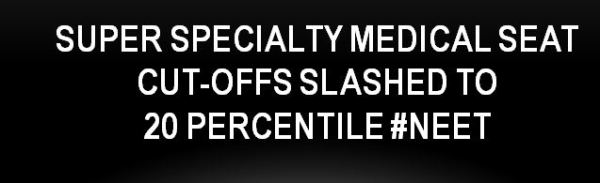
Now, super specialty medical seat cut-offs slashed to 20 percentile

MUMBAI: Post-graduate doctors scoring as low as 20 percentile in NEET-SS will now be eligible for superspecialty seats in the country. Despite two rounds of admissions, over one-fifth of the seats in the courses are lying vacant. To ensure these seats do not go wasted, the National Board of Examinations in Medical Sciences slashed the cut-offs to 20 percentile from 50. In some of the courses, the raw scores for eligibility have dropped even to 188 or 217 out of 600. 2/10/23, 6:39 PM Now, superspecialty medical seat cut-offs slashed to 20 percentile.

On February 8, the board issued a circular announcing the special mop-up round in NEET-SS counselling and also the revised cut-offs in different specialty groups. The schedule for the mop-up round will be released soon. An official from the ministry of health and family welfare said that approximately 1,000 seats are vacant out of close to 5,000 superspecialty seats in the country. The Federation of Resident Doctors’ Association India had requested the Centre to relax the eligibility criteria to ensure there is no wastage of seats, after receiving representations from aspirants, said Dr Kulsaurabh Kaushik, a member. He said sometimes seats go vacant in private colleges because of higher fees. Dr Avinash Supe, former dean of KEM Hospital, said, “Total SS seats in the country have gone up tremendously in recent years and students have become selective. For instance, in the surgical group, many are now preferring urology, gastrointestinal (GI) surgery and surgical oncology, whereas there is not much demand for paediatric, or cardiovascular and thoracic surgery. You need larger set-ups for these, which many cannot invest in. On the contrary, urology and GI surgeries need smaller set-ups and there is a demand too,” said Supe. He added in some courses, supply is higher than demand in the country. For a long time, even KEM did not get students for courses such as paediatric surgery. Last year, the Centre brought down the cut-off to 15 percentile after seats remained vacant in superspecialty courses.

     Advantages-Disadvantage of being a doctor

     25 factors- why health care is expensive

REEL Heroes Vs Real Heroes

 21 occupational risks to doctors and nurses

Covid paradox: salary cut for doctors other paid at home

   Medical-Consumer protection Act- Pros and Cons

Expensive Medical College  seat- Is it worth it?

NEET- Not so Neat- percentile system

The  Myth  of  cost of  spending  on  medical  education needs to be made  transparent.

Violence against doctors: No support – Saviours need to save themselves


More of a law and order issue, the physical assault on doctors reflects that they are serving an uncivilized society.  Such news is viewed by medical community anxiously and is definitely a poor advertisement for younger generation to take medicine as profession. The medical students need to think, why they wish to enter medical profession in such an unsupportive environment?

     Strangely media, courts, prominent people, celebrities, human right commission, right activists are little concerned about the blatant injustice done towards doctors.  This again brings forth the hypocrisy of our society and law enforcement agencies, which otherwise cry hoarse about human rights, but practically doctors (while they save others), need to fend for themselves when ugly situations arise.  

NEW DELHI: The Central government has decided not to enact separate legislation for prohibiting violence against doctors and other healthcare professionals, the Rajya Sabha was informed on Tuesday.

In a written reply, Union Health Minister Dr Mansukh Mandaviya said that a draft of the Healthcare Services Personnel and Clinical Establishments (Prohibition of Violence and Damage to Property) Bill, 2019 was prepared and was also circulated for consultations.

“Thereafter it was decided not to enact a separate Legislation for prohibiting violence against doctors and other health care professionals,” he said to a question on the reasons for the withdrawal of the Bill, which intended to protect healthcare professionals and institutions.

No separate law to prohibit violence against doctors & Health care workers

Mandaviya said that the matter was further discussed with relevant ministries and departments of government as well as all stakeholders, and an ordinance namely The Epidemic Diseases (Amendment) Ordinance, 2020 was promulgated on April 22, 2020.

However, the government, on September 28, 2020, passed the Epidemic Diseases (Amendment) Act, 2020 under which acts of violence against healthcare personnel during any situation were considered cognizable and non-bailable offences.

Speaking with TNIE, Dr Rohan Krishnan, National Chairman, FAIMA Doctors Association, said that there have been many cases of violence against doctors and health professionals in the past few months inside the government hospitals, but the union health ministry has not taken their demand to have a separate law for providing safety and security to healthcare workers and doctors seriously.

“The government needed us during the Covid-19 pandemic and came out with rules and regulations. We also felt safe and secure. But now that Covid-19 is declining and we were able to bring normalcy, the government is showing its true colours. It is shameful,” he said.

“The government is not standing up to its promise of bringing a separate law to prohibit violence against doctors and healthcare professionals,” he added.

“On the one hand, it has failed to provide mental and physical safety and security to the doctors and healthcare professionals; on the other hand, instead of having verbal communication with us regarding this matter, the government is denying any scope of providing a separate law in the future. This is a very serious issue. We will raise this issue at every level,” Dr Krishnan said.

Under the Epidemic Diseases (Amendment) Act, the commission or abetment of acts of violence or damage or loss to any property is punishable with imprisonment for a term of three months to five years, and with a fine of Rs 50,000 to Rs 2,00,000.

In case of causing grievous hurt, imprisonment shall be for a term of six months to seven years and with a fine of Rs 1,00,000 to Rs 5,00,000.

In addition, the offender shall also be liable to pay compensation to the victim and twice the fair market value for damage to property.

Since, law and order is a state subject, State, and Union Territory governments also take appropriate steps to protect healthcare professionals/institutions under provisions under the Indian Penal Code (IPC)/Code of Criminal Procedure (CrPC), the minister said.

To another question on the number of security guards hired/outsourced by government hospitals in the country, the Minister of State for Health Dr Bharati Pravin Pawar said that public health and hospitals are state subjects, therefore no such data is maintained centrally.

     Advantages-Disadvantage of being a doctor

     25 factors- why health care is expensive

REEL Heroes Vs Real Heroes

 21 occupational risks to doctors and nurses

Covid paradox: salary cut for doctors other paid at home

   Medical-Consumer protection Act- Pros and Cons

Expensive Medical College  seat- Is it worth it?

NEET- Not so Neat- percentile system

The  Myth  of  cost of  spending  on  medical  education needs to be made  transparent.

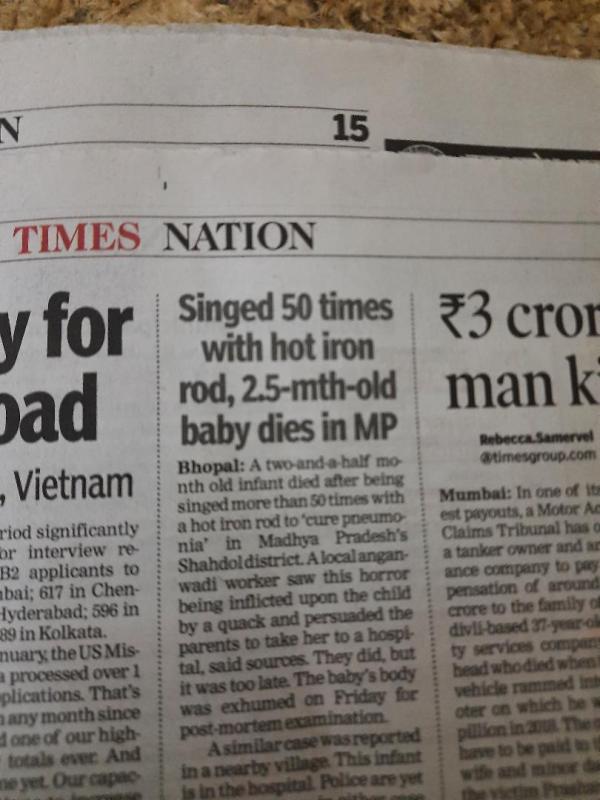
Singed with hot rod to ‘cure pneumonia’- the child dies: Illogical distribution of health care


         In a heart wrenching and unfortunate incident from Bhopal (Madhya Pradesh), a 2.5 month child was singed with hot iron 50 times by a quack for treatment of pneumonia.  He died and   the incident appeared in newspapers, but similar kind of  treatments must be going on at many places and  gullible patients keep on suffering .The suffering is of two types; one, that they are deprived of correct treatment and other is the tremendous suffering because of such nature of cruel practices in the garb of  treatment.    

         That brings to the fore the basic question; why such type of treatments are being practiced and allowed to be conducted in 21th century. Why people allow  and consent for such treatments by quacks?

     These incidents simply reflect that the health system has not been able to travel  the last mile and  has failed to  touch the last man.

         Most important reason for such disparity is illogical distribution of health care.  Corporatization of health care has projected medicine as a purchasable commodity and consequently resulted in an Illogical distribution of health care

 People, who can afford, spend millions in the last few days of their life, just to have only a few more days to live. Resources spent in such a futile quest are equivalent to  thousands of times the money for food and medicines for the poor who lose lives for fraction of that expense.

It seems humanity has legalized the hoarding of medical care; give it to the rich, bundled with consumerism though not necessarily the needy. It is the same as hoarding of the food that is sold to rich, letting the poor die somewhere in the world without food, which remains invisible to all.

          Another worrisome aspect of the incident is  that  avoidance of people to  seek treatment from appropriate  clinics and hospitals. Anganwadi worker was there in the village, so it was possible  to seek help from the health system. Is the mistrust and malice  generated  by media towards  doctors and  medical professionals is the reason to  avoid seeking help from them?

BHOPAL: A newborn has died after being singed more than 50 times with a red hot iron rod in a bizarre ritual to ‘cure pneumonia’ in MP’s Shahdol district. A local anganwadi worker saw this horror being inflicted upon the child by a quack and persuaded the parents to take her to a hospital, say sources. They did, but it was too late. The baby’s body was exhumed on Friday evening for post-mortem examination. Even as police were grappling with this horror, a similar case was reported in a nearby village. This infant is in hospital. Police are yet to arrest anyone in either case and it’s not yet known if the same quack, a woman, was behind singeing both babies. The Child Welfare Committee has written to police to take action under section 75 of Juvenile Justice Act, but nothing has been done. When TOI spoke with Singhpur police, they said they were taking legal opinion on how to proceed with the case. An officer said they are waiting for the autopsy report to see what charges can be pressed. The baby who died was two and a half months old and suffering from pneumonia. Her parents live in Kathotiya village, around 520km from Bhopal and close to Chhattisgarh. “The infant was ‘torched’ as a method of ‘treatment’ on January 10.” Singhpur police station in charge, MP Ahirwar told TOI. The second incident happened in Samtapur villagee. The baby’s parents deny they put the girl through the burning ritual.

     Advantages-Disadvantage of being a doctor

     25 factors- why health care is expensive

REEL Heroes Vs Real Heroes

 21 occupational risks to doctors and nurses

Covid paradox: salary cut for doctors other paid at home

   Medical-Consumer protection Act- Pros and Cons

Expensive Medical College  seat- Is it worth it?

NEET- Not so Neat- percentile system

The  Myth  of  cost of  spending  on  medical  education needs to be made  transparent.
Budget outlay on medical insurance up, public health infrastructure down


       Whether it is better to buy fish for years or provide people with fishing net? This applies to public health care system in India.  Times of India analysis points out the need to build and strengthen   the public health care system. Building of infrastructure for massive population requires funds, but ultimately the investment will bring down the cost of treatment and better delivery of health care to the country.

                     NEW DELHI: The health budget is good news for the private health sector as there has been a substantial increase in allocation for health insurance schemes such as the Central Government Health Scheme (CGHS), treatment for CGHS pensioners and the Ayushman Bharat scheme. Government’s own data has shown that the private health sector corners the bulk of the spending under these schemes, which saw a nearly 22% jump in allocation in the 2023-24 budget.

          In contrast, the allocation for schemes aimed at improvement in public health infrastructure has declined when adjusted for inflation. These include the National Health Mission (NHM), Pradhan Mantri Ayushman Bharat Health Infrastructure Mission (PMABHIM), human resources for health and medical education and Pradhan Mantri Swasthya Suraksha Yojana (PMSSY).

The overall allocation for health after rising during Covid, has come down in real terms though it seems like an increase in nominal terms from Rs 83,000 in the budget estimates (BE) for the current year to Rs 86, 175 crore in BE 2023-24. The revised estimates (RE) for the current year indicate a 9% decline from the BE to Rs 76,370 crore. The allocation for insurance schemes, however increased substantially in RE 2022-23; more than 75% hike in allocation for CGHS pensioners from Rs 2,645 crore to Rs 4,640 crore and for the first time since the launch of Ayushman Bharat scheme, the RE is the same as the BE at Rs 6,400 crore. In the past, only about half the budgeted amount for Ayushman was getting spent. However, the allocation for all the public infrastructure schemes put together has been slashed by 16% in the RE for the current year. In comparison to the Rs 13,266 crore allocated for insurance schemes, which cover only a section of the population, about Rs 30,000 crore has been allocated for the National Health Mission and a separate Rs 6,500 crore for human resources for health and medical education, which was earlier part of the NHM budget.

         Most of the allocation for the insurance schemes usually ends up in the coffers of the private sector. Despite private hospitals accounting for only 46% of empanelled hospitals under Ayushman Bharat, for instance, they accounted for 54% of hospitals admissions and since private healthcare is more expensive, that could account for a much higher proportion of the money spent. Most CGHS beneficiaries too go to private hospitals as noted by Dr Rakesh Sarwal, who was advisor health in Niti Aayog, in a study of the scheme. Dr Sarwal stated that CGHS had a higher cost of service because of its greater reliance on private facilities. Incidentally, though the finance minister announced a mission to eliminate sickle cell anaemia, there is no separate budget line for it. Thus even the money for a totally new scheme might have to come from within the NHM budget, further eating into the allocation. The tertiary care programme, which provides for transfer to states for implementing national programmes on control of blindness, tobacco control, capacity building for trauma centres and for prevention and control of non-communicable diseases such as cancer, diabetes, cardiovascular diseases and stroke, has had its allocation slashed to just Rs 290 crore, less than the actual spending of Rs 300 crore in 2020-21, and 42% less than the allocation of Rs 500 in the last budget.

The budget for the establishment and strengthening of the branches of the National Centre for Disease Control and for preparation and control of zoonotic and other neglected tropical diseases and for diseases surveillance, which had gone up during Covid, has been slashed from Rs 71.6 crore to just Rs 55.6 crore, despite the WHO asking countries to prepare for future pandemics by strengthening surveillance. Even the budget for the Indian Council for Medical Research, which played a crucial role during Covid, has been slashed along with a cut in the overall allocation for health research.

Advantages-Disadvantage of being a doctor

     25 factors- why health care is expensive

REEL Heroes Vs Real Heroes

 21 occupational risks to doctors and nurses

Covid paradox: salary cut for doctors other paid at home

   Medical-Consumer protection Act- Pros and Cons

Expensive Medical College  seat- Is it worth it?

NEET- Not so Neat- percentile system

The  Myth  of  cost of  spending  on  medical  education needs to be made  transparent.

Supreme Court simplifies  rules on passive euthanasia& Living Will


NEW DELHI: The Supreme Court on Tuesday modified its 2018 order on passive euthanasia to make the procedure of removal of (or withholding) life support from terminally ill patients less cumbersome for the patients, their families and the doctors by limiting the role played by government officials. While the requirement of setting up two medical boards — one primary and other review — to examine the medical condition of the patient has been retained, the SC has done away with the rule mandating that the district collector set up the review board. The court said both boards will be constituted by the hospital and there would be one nominee doctor of the district medical officer in the review board. The medical boards must take a decision on such cases preferably within 48 hours, it added.

While the current rules state that the consent of the judicial magistrate is required for conducting passive euthanasia, the new order by a five-judge bench of justices K M Joseph, Ajay Rastogi, Aniruddha Bose, Hrishikesh Roy and C T Ravikumar says the magistrate just needs to be informed. While making the procedure for passive euthanasia less cumbersome, the Supreme Court on Tuesday also simplified the process of making a “living will”, an advance directive by a person wishing not to be put on artificial life support. While the earlier rule stipulated that a living will had to be made in the presence of two attesting witnesses and countersigned by the jurisdictional JMFC, the new order says such a will can be attested by notary or a gazetted rank officer. The process prescribed in2018 was onerous as it not only involved family members and doctors but also a judicial magistrate and collector as well as setting up of two medical boards before removal of life support systems and there was no prescribed time period for medical boards to give their opinion. As per 2018 guidelines, in the event a person became terminally ill with no hope of recovery, the treating physician had to ascertain the authenticity of the case from the JMFC. If the physician was satisfied, the hospital then constituted a medical board consisting of the head of the treating department and at least three expert doctors with 20 years of experience.

If the medical board certified that life support system could be removed, the hospital had to inform the collector who then had to constitute another medical board comprising the chief district medical officer and three expert doctors. If the review board allowed withdrawal of treatment, it had to convey the decision to the JMFC. The JMFC then had to visit the patient and, after examining all aspects, decide on whether the euthanasia directive could be implemented. Modifying the order, the bench said that medical practitioners with five year of experience can be part of the medical board. The court also agreed with the petition that there was no need to involve JMFC in the process of preparation of the living will. Times View: The new guidelines have been issued because the earlier guidelines were proving to be unworkable. It is good that the apex court has taken a relook on the subject. It is entirely possible that even these new guidelines may need to be revised in future. But the principle must be about making things easier for consent-givers without increasing the risk of misuse.

     Advantages-Disadvantage of being a doctor

     25 factors- why health care is expensive

REEL Heroes Vs Real Heroes

 21 occupational risks to doctors and nurses

Covid paradox: salary cut for doctors other paid at home

   Medical-Consumer protection Act- Pros and Cons

Expensive Medical College  seat- Is it worth it?

NEET- Not so Neat- percentile system

The  Myth  of  cost of  spending  on  medical  education needs to be made  transparent.

 Supreme Court agrees to make Passive Euthanasia & Living Will rules workable


SC to tweak 2018 verdict to make passive euthanasia rules workable

NEW DELHI: The Supreme Court on Tuesday decided to “tweak” its 2018 verdict on passive euthanasia to make the procedure and guidelines fixed by it workable, and said that it may fix a time frame within which medical boards would have to submit reports to remove life-support systems from a terminally ill patient. Admitting that the procedure prescribed by the apex court in 2018 was very onerous and time consuming, a five-judge constitution bench of Justices K M Joseph, Ajay Rastogi, Aniruddha Bose, Hrishikesh Roy and C T Ravikumar sought suggestions from the Centre and senior advocates Arvind Datar and Prashant Bhushan to make it workable without compromising with the safeguards put in place by the court four years ago while legalising passive euthanasia. The process prescribed in 2018 not only involves family members and doctors but also judicial magistrates and collectors. Besides, two medical boards need to be constituted before life-support system can be withdrawn. The verdict said the living will, or advance directive for not putting a person on artificial life-support system, has to be made in the presence of two attesting witnesses and countersigned by the jurisdictional judicial magistrate of first class (JMFC). In the event of a person becoming terminally ill, the treating physician shall ascertain the living will’s authenticity from the JMFC. If the physician is satisfied, the hospital shall then set up a medical board consisting of the head of the treating department and at least three expert doctors. If the medical board recommends removal of life support, the hospital shall inform the collector, who shall then constitute another medical board comprising the chief district medical officer and three expert doctors. If the board allows withdrawing treatment, it shall convey the decision to the JMFC before allowing life support to be withdrawn. JMFC shall visit the patient and, after examining all aspects, may permit implementation of the directive.

      Seeking modification in the procedure, lawyers contended that time was crucial for terminally ill patients and the whole purpose of passive euthanisa was defeated due to the time taken by the process. That was the reason why there has not been a single case of passive euthanasia in the last four years despite it being legalised, they added.

Agreeing with their contention, the bench observed that dying in peace was dying with dignity, and suffering of a patient should not be prolonged due to the lengthy process. It said that the court could set a time limit for completion of the two-tier procedure without delay and also consider that a living be prepared like normal will without the mandatory presence of a judicial officer. The bench sought response from the Centre on whether it intended to frame a law for its regulation as the court had said in 2018. Paving the way for passive euthanasia, the apex court had in 2018 said, “It has to be stated without any trace of doubt that the right to live with dignity also includes the smoothening of the process of dying in case of a terminally ill patient or a person in PVS (persistent vegetative state) with no hope of recovery. A failure to legally recognise advance medical directives may amount to non-facilitation of the right to smoothen the dying process and the right to live with dignity.”

Supreme Court agrees to not involve judicial officers, collectors in ‘living will’ process

NEW DELHI: Amidst divergent opinions evading consensus on various points to make 2018 verdict on passive euthanisa workable on ground, the Supreme Court on Wednesday agreed in principle to keep judicial officer and district collector out of the process for making living will and setting up of medical board for removing life support system for terminally ill patients. Facing the onerous task to tweak 2018 verdict without modifying it and to continue with the safeguard put in place four years back, Justices KM Joseph, Ajay Rastogi Aniruddha Bose, Hrishikesh Roy and Justice CT Ravikumar are exploring ways to build consensus among parties, including the Centre, to make the process of making and executing living will or advance directive practical and less cumbersome for the patient. As the petitioner, represented by advocate Arvind Datar and additional solicitor general KM Nataraj, agreed that there was no need to involve judicial magistrate of first class (JMFC) in the process of preparation of will, the bench agreed that the living will can be attested by notary or a gazetted rank officer. As per 2018 verdict, the living will or advance directive, for not putting on artificial life support system, has to be made in the presence of  two attesting witnesses and countersigned by the jurisdictional JMFC. The court also in principle agreed that collectors be kept out of the process and will take a call on who should be entrusted with the task to constitute secondary medical board.

Advantages-Disadvantage of being a doctor

     25 factors- why health care is expensive

REEL Heroes Vs Real Heroes

 21 occupational risks to doctors and nurses

Covid paradox: salary cut for doctors other paid at home

   Medical-Consumer protection Act- Pros and Cons

Expensive Medical College  seat- Is it worth it?

NEET- Not so Neat- percentile system

The  Myth  of  cost of  spending  on  medical  education needs to be made  transparent.

Comparing airline industry & health care is fallacious, an oversimplification; apples to musk-melons


The issue of patient safety has been gaining increased traction year on year and the issue is in right direction.  Hospitals, doctors and administration need to vigorously address shortcomings and strive toward minimum errors and desired goals of safety.   Patient safety is of paramount importance; therefore it is an serious issue. It should be achieved by good ground work and not by sensationalizing and mischaracterizing the real basic issues, transparent safety culture, adequate number of staff and resources.

There is a recurrent old argument and temptation to ask about why healthcare can’t be as safe as airline travel.   There can be many apt comparisons that may be possible between aviation and health care especially taking into account the risk involved. But the doctors who treat critical emergencies,  have  insight looking at life and death situations directly,  know  that comparing both would be just an oversimplification of the real basic issues.

  At most of the points, the comparison is a complete fallacy; and like comparing apples to musk-melons.

It is beyond doubt that air-industry maintains truly an impressive system which is well-designed to achieve the safety results that it does.  But , the kind of  comparison  that  some health care safety leaders make in which they compare the  mortality data of acute hospital care and airline fatal accident rates is more of a word play and not so appropriate. This comparison is dangerous because it misses the key points for improvement. Such comparisons  merely present over-simplified and convenient tool for the health quality experts, who themselves have never been a front line health workers at any point of time, but still pretend to pioneer the  quality in health industry.  For the quality improvement the leaders need to be grounded in the reality of emergency front line medicine to be really effective.

  1. Aircrafts  are engineered to be in the best possible shape before they fly. Patients, on the other hand, patients  are in the worst shape when they enter the emergency of the hospital.

Medicine is by nature, a much more risky work than flying along with vulnerability to death always.

  1. The aircrafts are required to regularly demonstrate that the performance of their critical systems meets or exceeds strict standards. If systems are not operating well the plane will not be allowed to fly.

But all the patients, (aeroplane metaphor) are already sick; doctors are expected to fly such aeroplanes, who are in crashed condition universally. Doctors do not have the luxury to replace any part.  For example, when doctors treat an elderly with heart failure, chronic kidney failure and pneumonia, they try to keep them “flying” despite multiple sub optimally functioning critical systems.

  1.  In other words, doctors have to fly crashed planes always on every day basis, something that never happens even once in aviation industry.
  2. Has any Pilot ever tried to fly  a plane in which engine power is only 25 percent of normal with  other systems are functioning  sub optimally  and  the fuel tank is leaking?  What will be standard procedure (SOP)  for Pilot to fly this plane? But everyday doctors try to fly such planes and they have to fly it no matter how many systems are non-functional.  Moreover, doctors can be sued on some flimsy grounds in case they fail or an accident happens in an effort to keep this plane in the air.  Treating a critical illness is like an effort to keep such planes in air with suboptimal functioning systems.

Obviously the comparison is a bit overzealous.

  1.   What would be chances that a fully checked plane with a trained pilot will crash after flight takes off. Now compare the chances of patient who lands in emergency, and treatment is started.

By a simple common sense, are two situations comparable?

Former has no chance (almost Zero percent) of crash whereas in a critical emergency patient, the chances of crash are 100 % to start with.

  1. Communication of passengers to the pilot about what he should do and what he should not while flying the plane is nil. Whereas doctors are continuously bombarded with google knowledge of patients and interference by relatives and questioned about every action.
  2.   Doctors are expected to make future prediction about what can happen, how he will be able to keep the crashed plane in the air and take consent, based on few assumptions. Doctors can be harassed and dragged to courts if such predictions fail.
  3. Airlines will always have full staff to serve promptly during a flight. The pilot will be totally dedicated to flying the plane, and will not fly without the co-pilot and crew. On the other hand, front line healthcare workers know it well the fact that patient safety incidents and errors tend to occur when they are struggling with staffing levels and feel grossly overworked.

Fatigue and overwork is too common scenario among front line healthcare staff in clinical settings.

  1. A pilot is also only ever going to fly one plane at a time. It is not realistic for a doctor or nurse to be allocated to just one patient, but the workflow is very different, with healthcare tasks frequently interrupted with new clinical issues and emergency situations. Consequently, insufficient staffing can have an acute effect on outcomes and the ability to perform safely.
  2. Aviation industry is too predictable and on the contrary, health care is combination of uncountable unpredictable risk factors, be it allocation of staff or risk of death or resource prediction and complexity of communication.
  3. Aviation is more of mechanical milieu, whereas health care deals with emotion and compassion. The two industries are vastly heterogeneous, and to say that safety in medicine should follow in the path of flying airplanes, grossly oversimplifies a complex problem.
  4.    Last but not the least; health care involves lot of financial uncertainties and arrangements. Needless to say, doctors carry the blame for financial hardship of the patients, even if they are not responsible for costs. The mammoth industry remains hidden and doctors are blamed as they are the only front man visible.
  5. Basic difference lies in the fact that patients are real living people, whereas airplanes are simply machines, whose codes and protocols are well defined and limited to within human capabilities. The importance of human contact, empathy, compassion, interact and listen to concerns, and the ability to spend adequate time with patients,  should be  always be the first pillar of promoting a culture of safety.
  6.   Exhortations by armchair preachers to learn oversimplified improvement examples from aviation can provoke considerable frustration and skepticism among clinicians exposed to the unique challenges, difficult working conditions and everyday complexities.  Patients are not aeroplanes, and hospitals are not production lines.

Most unfortunate part is the assumption that every sick person who dies in a hospital from an adverse event is an example of a truly preventable death rather than clinicians trying their best to keep someone alive and eventually failing.

  1.  Checklists and documentation to improve systems are wonderful in mechanical areas like operative care and inserting central lines, but have limited role and can only go so far without the most important virtues of being a doctor or nurse. It means more than mechanically following protocols and doing paper work in real sense.

In health care merely providing check list and doing extra- paper work may be counterproductive for many reasons.  Increase in time for voluminous documentations will consume time and forces health care workers to focus on paper work and takes them away from patient’s real issues.

Completed paper work and excessive documentation provides a false assurance of quality work, which may or may not reflect true picture of patient care. Even after full documentation,  still  it will be required  to be carried out in a diligent manner, a  task which is different from mechanical  task of mere check list  of other  industries . Learning from other industries seems to offer a simple shortcut to anyone trying to improve healthcare, but its utility is limited only for documentation purposes and not real quality. Caring for patients is radically different from flying aeroplanes. Healthcare is unique in the intimacy, complexity, and sensitivity of the services it provides as well as the trust, compassion, and empathy that underpin it.

Merely completing protocols mechanically and excessive documentation will result in decline in quality actually.  Simply importing and applying a ready-made tool will lead to situation, where quality will exist only on papers and merely  reduced to a number to the satisfaction of so called ‘pioneers’ of quality.

Advantages-Disadvantage of being a doctor

25 factors- why health care is expensive

     REEL Heroes Vs Real Heroes

     21 occupational risks to doctors and nurses

     Covid paradox: salary cut for doctors other paid at home

   Medical-Consumer protection Act- Pros and Cons

Expensive Medical College  seat- Is it worth it?

NEET- Not so Neat- percentile system


The  Myth  of  cost of  spending  on  medical  education needs to be made  transparent.
Blog at WordPress.com.

Up ↑