
Doctors treating anarchic & lawless society # Doctor killed for perceived negligence


   In an act of revenge that took over two years, a doctor with a government hospital in Yavatmal – 650 km from Mumbai – was shot dead, allegedly by a family member of his patient who had died under the doctor’s supervision two years ago.

   Attacks and assaults on doctors is an indicator of a lawless, uncivilized society, poor governance and broken health system.  Unwillingness or failure of government to prevent such attacks on doctors will have deep ramifications on future of medical profession.  The impunity with which criminals can dare to take law into their hands and punish doctors instantly at will is a blatant disrespect to courts and judicial system. In absence of strict laws for protection of doctors, health care workers have become vulnerable to  assaults and revenge.

    Doctors have become punching bags for all the malaise prevalent in the system. A failing system which is unable to provide  health to the people and security to doctors. The rickety system hides behind their hard working doctors and presents them as punching bags. The impunity with which attendant easily and brutally assault doctors is really appalling, should be shameful to law enforcing agencies.

            Role of media, celebrities, film stars and prominent personalities in spreading the hatred against the medical profession and creating an environment of mistrust is unpardonable. They project   single stray incident   as an example and portray poor image of medical profession as generalization just to earn money and fame for themselves.

 Hence by selective projection the blame for deficiencies of inept system, powerful industry, inadequate infrastructure and poor outcomes of serious diseases is shifted conveniently to doctors, who are unable to retaliate to the powerful media machinery.   Role of doctor associations, parent institutes have been spineless and not encouraging.

        The demonstration of the cleft that separates doctors from the actual overpowering controlling medical industry and administrators is not given, in order to maintain the prejudice with its dangerous bias towards doctors, who are in forefront and are visible to public.  

Relatives shot and kill doctor for perceived negligence

Family members of the patient had alleged that it was due to the negligence of Dr Hanumant Dharmakare, medical officer at the R P Uttarwar Kutir Hospital, that their son Arbaz (20), who had met with a bike accident, died in May 2019.

The police are on the lookout for the main suspect, Aifaz Shaikh, the elder brother of Arbaz, who is believed to have shot the doctor.On January 11, Dharmakare was shot dead in broad daylight by an unidentified person on the Umarkhed – Pusad Road in Yavatmal. The police team found that the application concerned the death of his nephew Arbaz.When the police questioned Tousif further, they found that his nephew Arbaz had met with an accident on May 4, 2019. Arbaz had been riding a bike with his brother Aifaz (then 22) and a relative Moshin, when the accident took place.The family had rushed the trio to the local hospital, where Dharmakare was the on-duty doctor. The family alleged that due to negligence on the part of the doctor, Arbaaz lost his life. The family even had a fight with Dharmakare and they allegedly threatened that he would have to pay for his actions. Bhujbal said that during the police investigation, they found that for the past two years, the family had been looking for an opportunity to get back at Dharmakare. They had kept an eye on his movements even earlier this year, following which they decided to allegedly kill him last Tuesday. It was Arbaz’s elder brother Aifaz who allegedly fired at the doctor and fled from the spot on the bike.

Are we a lawless society? More problematic is the government apathy and silence of human right commission. Here comes the point that what is the role of our doctor’s organizations, human right organizations, parent hospitals and institutes.

   Good Governance lies in prevention of such incidents. Knee-jerk policing activities after every incident are of limited benefit.   Moreover  the  impunity with which people  dare to take law into their hands and  tend to punish doctors instantly for perceived negligence,  is a blatant disrespect to courts and judicial system.

     Advantages-Disadvantage of being a doctor

     25 factors- why health care is expensive

     REEL Heroes Vs Real Heroes

     21 occupational risks to doctors and nurses

     Covid paradox: salary cut for doctors other paid at home

   Medical-Consumer protection Act- Pros and Cons

NEET-PG-Counselling: A larger public emergency issue due to Pandemic


        NEET PG Post-Graduation after MBBS is an entrance qualification exam, one of toughest and important exam not only for medical students but for medical colleges and hospitals. As this exam will decide and form the back bone of the health care system in the whole country. Ultimately this exam will be the check gate to supply specialist doctors to medical colleges, hospitals and private health institutions in all the states.  Post graduate trainees form the bulk load of doctors performing the duties.  Needless to say these doctors form the back bone of the total health system across the country. For last two years, these junior doctors were at the forefront of the fighting the pandemic. 

       Since NEET PG was to be conducted in Jan 2021, but due to pandemic got postponed to Sept 2021 and result were declared few months back.

      NEET PG counselling is not only issue for doctors but an actually a larger public health issue and kind of emergency due to pandemic, which will decide the availability of doctors to public.

         Actually it is in patient’s interest to have early counselling.

         It is a sad situation, when the world is preparing to tackle the wave of pandemic due to Omicron Variant, other countries are ramping up their health care infrastructure and manpower, and Indian doctors are being dragged on roads by police instead of employing them in hospitals.

       Its importance assumes an emergency situation in face of looming pandemic. If the administrators had perceived it as merely a trivial doctors’ issue and remained complacent, it had been a grave mistake.

     What was the emergency to change and frame new rules when a pandemic of such a large proportion was going on?

    A delay in academic counselling means a wasted year for the NEET PG aspirants. It also means that 50000 doctors are missing from the medical system and  the health care force because of bureaucratic delays, at a time when health care staff is overworked and in desperate need of more hands.

      Point to ponder here is that is it the doctors who desperately need help? More precisely and in reality it is the patients and public who need doctors desperately. An early counselling is in public interest actually, the point administrators have failed to understand.

       But sadly, it is up to the wisdom of administrators that decides “what is emergency and what is not” rather than medical wisdom, a case of misplaced priorities.

     Advantages-Disadvantage of being a doctor

     25 factors- why health care is expensive

     REEL Heroes Vs Real Heroes

     21 occupational risks to doctors and nurses

     Covid paradox: salary cut for doctors other paid at home

   Medical-Consumer protection Act- Pros and Cons

Want to be a Doctor: Expect No Justice


        Medical students or aspiring doctors should be carefully watching the behaviour and cruelty by which doctors are governed, regulated and treated by administrators. Mere few words of respect and false lip service during Covid-pandemic  should not mask the real face of administrators, indifference of courts and harshness of Government towards medical profession. Choosing medical careers can land anyone into the situations, which are unimaginable in a civilized world.

At a time when Political groups, terrorists, drug addicts, celebrities commit crimes and get a priority hearing by courts and speedy relief (whether deserve or not worthy), doctors pleadings even for their rightful issues and routine problems are paid deaf and indifferent ears. It is disheartening to see that they receive apathetic attitude and dealt with stick or false assurances even for the issues which should have been solved automatically in routine even by average application of governance.

             It is discouraging for the whole medical fraternity to see that even the rightful is not being given what to expect the gratitude and respect.

          The barbaric response of Police towards peacefully demanding doctors has unmasked the real indifferent attitude of Government and administrators as well as apathy of courts towards medical profession. The cruel behaviour has also unveiled the approach of  tokenism such as ‘mere lip service’  showing respect to corona warriors.

      The strong political and legal will is absent to solve Doctors’ problems.

      It also shows the scant  concern of the Government to provide a real good health care system despite showing a verbal concern for medical services. It also explains why successive Governments irrespective of political moorings  have terribly failed to provide healthcare to its people.  Why patients fail to get a bed, oxygen, doctors or nurse is consequence to the misplaced priorities of administrators.

    Who would be the worst sufferer of the apathetic attitude of the Government? Doctors will suffer initially till they continue to choose medical profession. Once they also become apathetic like administrators, it would be the patients.

Delhi: AIIMS, FAIMA doctors join protest after police crackdown

A day after resident doctors protesting delays in NEET-PG counselling alleged that they were assaulted by the police, doctors from the All India Institute of Medical Sciences (AIIMS) as well as those associated with the Federation of All India Medical Association (FAIMA) have decided to join the stir.

Doctors from AIIMS, one of the only big tertiary-care government medical college hospitals that had stayed away from the protest, in a letter to the Union health minister, said that they would withdraw from all non-emergency work on Tuesday if no concrete steps are taken.

“It’s high time for the government to release a report of what has been done till date, and what are the government’s plans moving forward for expediting NEET-PG counselling. If no adequate response from the government is received within 24 hours, AIIMS RDA shall proceed with a token strike on 29/12/21 including shutdown of all non-emergency services,” the letter read.

This would hamper patient care in the city further. With emergency departments of big hospitals like Safdarjung and Lok Nayak affected by the strike, patients were being referred to the AIIMS for treatment.

.

In addition, FAIMA called for its resident doctors’ association to withdraw from all work, including emergency services, after Monday’s incident. The protest began with withdrawal from outpatient department (OPD) services in November end by two national organisations – the Federation of Resident Doctors’ Association (FORDA) and FAIMA.

The protest slowly intensified with doctors boycotting even emergency work, following which on the insistence of the government the strike was paused for one week.

The strike resumed on December 17 as FORDA members withdrew from all services.

     Advantages-Disadvantage of being a doctor

     25 factors- why health care is expensive

     REEL Heroes Vs Real Heroes

     21 occupational risks to doctors and nurses

     Covid paradox: salary cut for doctors other paid at home

   Medical-Consumer protection Act- Pros and Cons

Medical Education: Doctors- Victims of Grave Injustice Expected to Impart Justice to all


        Non-uniformity of medical education is treating  medical students  as  slaves and  killing enthusiasm of young doctors.

    Medical profession is an extremely strenuous and highly specialised field that requires individuals to dedicate their lives in the service of others. As part of medical professionals’ education and training, they are necessitated to undertake training across various settings. In this context, a stipend is paid as a matter of right and not charity. It is therefore essential that parity and equity be maintained across all medical institutions, whether run by private bodies or by the government.    In absence of proper Governance and rules, the young doctors are thrown at the mercy of cruel businessman for proper pay and working conditions.

Ensure uniform stipend to Interns: Binoy Viswam, Rajya Sabha MP

Great disparity in stipend at Govt. Private Colleges

     Medical education is one field where  one can notice the  extreme  variations of the unimaginable magnitude that are beyond comfort.  

      Falling standards  of medical education is the most important  side effect  which  should be an  important issue, but sadly it is the last  priority  on the list of administrators. Each and every medical college can be different and student passing out of many colleges receive below average medical education.

     Another important  variation is in the stipend and remuneration of  young  trainee doctors receive. It varies from college to college, city to city, state to state as well as North to  South and East to West. Besides being a cause for heartburn. it is a cause for  extreme  dissatisfaction among medical students.

      Needless to say the arbitrariness exercised  by various authorities to pay  them at their will is a reflection of grave injustice imposed by administrators.

    Another arbitrariness reflecting injustice is variation in fee of medical colleges. The steep fee charged by private medical colleges and restrictive bonds of Government  medical colleges in name of expensive medical seats need a sincere and honest introspection by authorities. The basis for calculations of the cost of medical education should be transparent and shown in public domain.

     Needless to say that medical students have been sufferers  of poor and arbitrariness of inept  administrative policies. Just because they decided to be doctors, they have to endure poor,  unjust  and arbitrary policies.

     Ironically as a child decides to be a  doctor, he is exploited in name of such policies of  unreasonable  high fee, poor education and low pay. That too while working in  extremely inhuman   conditions,  long and hard working hours. Strangely these medical students  suffer grave injustice  inflicted by the society  since  start of their medical education, but when they become doctors, everyone  expects sympathy, empathy and honesty.

    In absence of proper Governance and rules, the young doctors are thrown at the mercy of cruel businessman.

      Still the sufferers of grave  injustice themselves  are expected to impart justice to everyone  along with  burden  of mistrust.

Ensure uniform stipend to Interns: Great disparity in stipend at Govt. Private Colleges

Binoy Viswam, Rajya Sabha MP, has urged Union Health Minister Mansukh Mandaviya to ensure equity in payment of internship to medical students in private and government medical colleges across the country.In a letter to the Minister, Mr. Viswam said that the National Medical Commission’s Draft Regulations on Compulsory Rotating Internship, 2021, issued on April 21 and gazetted on November 18, had said that all interns shall be paid stipend “as fixed by the appropriate fee fixation authority as applicable to the institution/university/State.”

Ambiguity

“The phrasing of this provision allowed for great ambiguity and arbitrariness. It may also result in management of private colleges denying stipend to the interns as they have complete discretion without any safeguarding mechanism. The ramifications of the same are already being seen in colleges across the country as great variance exists in stipend amounts being paid in government colleges as opposed to private colleges,” he pointed out.

A right, not charity

Mr. Viswam said that medical profession was an extremely strenuous and highly specialised field that required individuals to dedicate their lives in the service of others. “As part of medical professionals’ education and training, they are necessitated to undertake internships across various settings. In this context, a stipend is paid as a matter of right and not charity. It is therefore essential that parity and equity be maintained across all medical institutions, whether run by private bodies or by the government,” he said.

The MP requested the Minister to consult with all stakeholders, including State governments, medical college managements, medical professionals, and students to formulate a policy that ensures equity among medical students. A uniform stipend to all interns would ensure that, he added.

The erstwhile Medical Council of India had come up with a public notice on January 25, 2019, on Graduate Medical Education Regulations, 1997. The Board of Governors that superseded the MCI was considering a provision that said “All the candidates pursuing compulsory rotating internship at the institution from which MBBS course was completed, shall be paid stipend on par with the stipend being paid to the interns of the State government medical institution/Central government medical institution in the State/Union Territory where the institution is located.” However, it was not gazetted until the Board was dissolved.

     Advantages-Disadvantage of being a doctor

     25 factors- why health care is expensive

     REEL Heroes Vs Real Heroes

     21 occupational risks to doctors and nurses

     Covid paradox: salary cut for doctors other paid at home

   Medical-Consumer protection Act- Pros and Cons

The Book-‘At the Horizon of Life & Death’: Doctors’ struggle with death


The 300-page book contains 20 stories divided into three parts viz – Larva & Pupa Syndrome, Hope & Fear & Medical Lawsuits. The book is available worldwide on Kindle Amazon, Apple, Barnes & Noble, Tolino, Kobo, Scibd, BorrowBox, Baker & Taylor , Vivilo, Overdrive  etc.

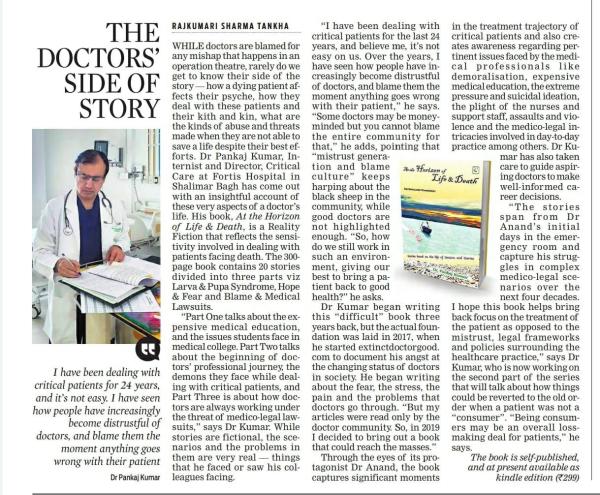
      While doctors are usually blamed for any mishap, be it natural poor prognosis or genuine complications, rarely people get to know their side of the story — how a dying patient affects their psyche, how they deal with these patients and their kith and kin, what are the kinds of abuse and threats made when they are not able to save a life despite their best efforts. Dr Pankaj Kumar, Director Critical Care at a Delhi Hospital, India has come out with an insightful account of these very aspects of a doctor’s life.

         His book ‘At the Horizon of Life & Death’ is a Reality Fiction that reflects the sensitivity involved in dealing with patients facing death.

     Through the eyes of its protagonist Dr Anand, the book captures significant moments in the treatment trajectory of critical patients. The book tries to create awareness regarding pertinent issues faced by the medical professionals like demoralisation, expensive medical education, the extreme pressure and suicidal ideation, the plight of the nurses and support staff, assaults and violence and the medico-legal intricacies involved in day-to-day practice among others. The author has also taken care to guide aspiring doctors to make well-informed career decisions.

     Part One (Larva & Pupa Syndrome)-  talks about the expensive medical education, and the issues students face in medical college.

    Part Two (Hope & Fears) talks about the beginning of doctors’ professional journey, the disease demons they face while dealing with critical patients, dilemmas of doctors and patients near death situations.

    Part Three (Medical Lawsuits) is about how doctors are always working under the threat of medico-legal lawsuits.

        While stories are fictional, the scenarios and the problems in them are very real — things that he faced or saw his colleagues facing.

     Medical profession has become victim of mistrust generation and blame culture. Everyone keeps harping about the few black sheep in the community, while larger good work of doctors is not highlighted enough.

    The stories span from Dr Anand’s initial days in the emergency room and capture his struggles in complex medico-legal scenarios over the next four decades. This book is an effort to bring back focus on the treatment of the patient as opposed to the mistrust, legal frameworks and policies surrounding the healthcare practice.

           The book is self-published, available worldwide on Kindle Amazon, Apple, Barnes & Noble, Tolino, Kobo, Scibd, BorrowBox, Baker & Taylor , Vivilo, Overdrive  etc.

Advantages-Disadvantage of being a doctor

     25 factors- why health care is expensive

     REEL Heroes Vs Real Heroes

     21 occupational risks to doctors and nurses

     Covid paradox: salary cut for doctors other paid at home

   Medical-Consumer protection Act- Pros and Cons

 Side Effects-Implementing Medical-Consumer-Protection-Act in Haste


        Medical consumer protection act was implemented in 1995. Patients defined as consumers and hence doctors converted to service providers in lieu of some money.  Consequently the changed definitions altered the doctor-patient relationship in an irreversible way. Instead of the earlier congenial relationship, now-a day’s doctors and patients are fighting in courts, whereas most of aspects of the law still remain grey after 26 years of implementation. Here in this case even courts differ in the interpretation (among themselves) of the law after more than two decades of its implementation.

        The doctors are supposed to treat, provide relief and save lives are the most affected, it is needless to say that the way of treating patients has been altered like never before. Medical lawsuits and complaints (right or wrong) are breaking medical professionals from within, not to mention the toll it takes on someone’s confidence and belief, which takes a lifetime to build.

   The reality is that neither doctors, nor patients were ready for such a legal relationship, and the system was not robust enough for such a change.  To work with weak infrastructure, non-uniform medical education along with legal threats pushed doctors into a shell and forced defensive practice.  It caused erosion of doctor-patient relationship and escalated cost of care.

   Medical business, insurance and legal industry made full use of the opportunity to have the benefits of changed doctor-patient relationship.  Doctors were used as scapegoats for poor infrastructure by administrators and further exploited by law industry.

   Justice eluded doctors at all stages.

      It is discouraging for medical professionals to note that courts are still clarifying the law even after 26 years of its implementation.  What is more disheartening that many more aspects about the medical-consumer protection act are either remain  unclear and create difficulty for doctors.  To differentiate medical mistakes, poor prognosis from negligence is a very fine line and difficult to judge. Therefore medical profession has  become  a subject to blackmail by patients, lawyers and sitting ducks for punishments. The consequent insecurity among doctors, practice of defensive medicine, enhanced costs, excessive documentation and the distraction from the primary point of intention (treatment)  are few of the  side effects, which will  definitely be passed on to the patients inadvertently.  After all doctors have to save themselves as well.

 Consequently being consumer may be overall a loss making deal for the patients.

     The point to ponder is that courts themselves differ on interpretation of law even after 26 years of its implementation.  

The Supreme Court has reiterated that service rendered by medical officers on behalf of a Hospital, free of cost, would not fall within the ambit of  medical consumer protection act.

https://www.livelaw.in/top-stories/consumer-case-not-maintainable-over-medical-services-given-free-of-charge-doctor-salary-hospital-supreme-court-187291

     Advantages-Disadvantage of being a doctor

     25 factors- why health care is expensive

     REEL Heroes Vs Real Heroes

     21 occupational risks to doctors and nurses

     Covid paradox: salary cut for doctors other paid at home

   Medical-Consumer protection Act- Pros and Cons

 Pendency at Hospitals Vs Courts: A Comparison- Imparting Justice Vs Health


Justice and Health- Both are crucial for happiness of the living beings as well as society as a whole.  Hospitals are full of patients and so are courts with litigants. None of the people go to hospital and courts happily and everyone invariably wants early relief.

   Once a patient visits hospital, he will ponder over about the benefit of the visit. So is the person visiting the courts. Did they were imparted justice?

      None of patient, who visits hospital, comes back without treatment. Doctor gets few minutes to decide. Most of the time, for the investigations and the treatment few visits are required. But there is no pendency. In Government hospitals, even appointments are not given. A doctor sitting in outdoor will see hundreds of patients. On emergencies night duties, doctor will not be able to count how many he/she has stabilized or numbers treated.

      Even in such chaotic systems, doctor can be punished, dragged to courts or assaulted for unintentional mistakes, that are  almost always secondary to load of patients or inept infrastructure.

      The work at hospital continues day and night, 24 hours and 365 days, despite almost always lesser number of doctors and required manpower. Systems in hospitals  are designed and maintained meticulously   to have no pendency what-so-ever situation is.   Larger number of patients go back home treated and very few unfortunate patients are unable to recover, but still whatever is required- is done invariably.

        Justice is needed for satisfaction of soul and peaceful mind, is of same importance what is to the health of body. Justice delayed gives a sense of hurt and pain to soul. Pendency in courts simply reflects the grave injustice people are living with.

44 million pending court cases: How did we get here?

       There are about 73,000 cases pending before the Supreme Court and about 44 million in all the courts of India, up 19% since last year.

According to a 2018 Niti Aayog strategy paper, at the then-prevailing rate of disposal of cases in our courts, it would take more than 324 years to clear the backlog. And the pendency at that time was 29 million cases. Cases that had been in the courts for more than 30 years numbered 65,695 in December 2018. By January this year, it had risen more than 60% to 1,05,560.

Grave injustice for medical professions:

  1.   A doctor making wrong diagnosis (gets few minutes to decide) can be prosecuted, but courts giving wrong verdicts (get years to decide) are immune?

   2. Compare the remuneration of lawyers to doctors. Doctors gets few hundreds to save a life (often with abuses) and lawyers can get paid in millions (happily).

   3. Doctors treat the body and larger is still not fully known about mechanisms. Still doctors can be blamed for unanticipated events. Whereas  law is a completely known and written subject.

   4. If health is citizen’s right so should be a timely justice.

         Despite doing so much for patients, still people’s behaviour to doctors and hospitals is not respectful. Doctors are punished for slight delays and people and courts intolerant to unintentional mistakes. But people can’t behave in the same manner to courts and legal system and tolerate the blatant injustice for years.    

     Advantages-Disadvantage of being a doctor

     25 factors- why health care is expensive

     REEL Heroes Vs Real Heroes

     21 occupational risks to doctors and nurses

     Covid paradox: salary cut for doctors other paid at home

   Medical-Consumer protection Act- Pros and Cons

Justice Delayed to Doctor- Vindication # Supreme-Court # Medical-Negligence?


It has taken 23 years to end harassment of a doctor to decide upon a problem, which should not have been there at all. Practically doctors can be dragged to courts, blackmailed, harassed and assaulted with impunity just because of any adverse outcome.  So the legal and illegal demonization of medical profession has become a routine, while law industry makes merry at the cost of doctors.  Natural complications, genuine poor prognosis, and death that occur after some treatment can be easily pinpointed to the doctors. Saviours are fighting the death as well as court cases to save themselves. In this case, Supreme Court was kind enough to give a favourable verdict, but not all doctors are lucky enough. Many suffer because of frivolous cases, poor medical governance and unwise decisions.

 Doctor can’t be held guilty of negligence just because a patient died: Supreme Court

    The bench said: ‘In spite of the treatment, if the patient had not survived, the doctors cannot be blamed as even the doctors with the best of their abilities cannot prevent the inevitable…’ A doctor can assure life to his patient but can only attempt to treat everyone to the best of his or her abilities, said the Supreme Court.

      No doctor can assure life to his patient but can only attempt to treat everyone to the best of his or her abilities, said the Supreme Court on Tuesday, as it underscored that a doctor cannot be held guilty of medical negligence just because a patient has not survived.

“There is a tendency to blame the doctor when a patient dies or suffers some mishap. This is an intolerant conduct of the family members to not accept the death in such cases. The increased cases of manhandling of medical professionals who worked day and night without their comfort has been very well seen in this pandemic,” lamented a bench of justices Hemant Gupta and V Ramasubramanian.

The bench added: “In spite of the treatment, if the patient had not survived, the doctors cannot be blamed as even the doctors with the best of their abilities cannot prevent the inevitable…The doctors are expected to take reasonable care but none of the professionals can assure that the patient would overcome the surgical procedures.”

  It underlined that there must be sufficient material or medical evidence should be available before the adjudicating authority to arrive at the conclusion that death is due to medical negligence. “Every death of a patient cannot on the face of it be considered to be medical negligence,” said the bench.

The court said this while allowing an appeal filed by Bombay Hospital and Medical Research Centre against the National Consumer Disputes Redressal Commission’s order to pay ₹14.18 lakh to the family of one Dinesh Jaiswal, who died in June 1998 following unsuccessful surgeries of his gangrene in his limbs.

The family attributed Jaiswal’s demise to negligence in conducting surgeries, absence of the treating senior doctor, lack of operation theatre, and a broken-down angiography machine. The hospital, however, refuted all allegations, stating the best possible treatment by present medical professionals and within the resources available was provided.

In its 2010 judgment, the national consumer commission invoked the principle of “res ipsa loquitur” (mere occurrence of certain event can lead to an inference of negligence of the other side) to hold the hospital guilty of medical negligence.

But the top court on Tuesday set aside this judgment, noting the order suffered from legal as well as factual infirmities.

“It is a case where the patient was in serious condition impending gangrene even before admission to the hospital but even after surgery and re-exploration, if the patient does not survive, the fault cannot be fastened on the doctors as a case of medical negligence. It is too much to expect from a doctor to remain on the bed side of the patient throughout his stay in the hospital which was being expected by the complainant here. A doctor is expected to provide reasonable care which is not proved to be lacking in any manner in the present case,” held the bench.

The court underlined that there was never a stage when the patient was left unattended and mere fact that the main treating doctor had gone abroad cannot lead to an inference of medical negligence because the patient was admitted in a hospital having 20 specialists in multi-faculties.

“The patient was in a critical condition and if he could not survive even after surgery, the blame cannot be passed on to the hospital and the doctor who provided all possible treatment within their means and capacity,” it said.

On the aspect of delay in re-exploration after the initial surgery threw up complications due to non-availability of an operation theatre, the bench noted that it was only a matter of chance that all the four operation theatres of the hospital were occupied when the patient was to undergo surgery.

“We do not find that the expectation of the patient to have an emergency operation theatre is reasonable as the hospital can provide only as many operation theatres as the patient load warrants. If the operation theatres were occupied at the time when the operation of the patient was contemplated, it cannot be said that there is negligence on the part of the hospital,” it said.

The court added that a team of specialist doctors was available and also attended to the patient but “unfortunately, nature had the last word” and the patient breathed his last. “The family may not have coped with the loss of their loved one, but the hospital and the doctor cannot be blamed as they provided the requisite care at all given times,” it maintained.

The deceased’s family was paid ₹5 lakh as interim compensation by the top court in March 2010 when it had agreed to examine the hospital’s appeal. The bench said that this amount shall be treated as ex gratia payment to Jaiswal’s family and will not be recovered by the hospital.

Advantages-Disadvantage of being a doctor

     25 factors- why health care is expensive

     REEL Heroes Vs Real Heroes

     21 occupational risks to doctors and nurses

     Covid paradox: salary cut for doctors other paid at home

   Medical-Consumer protection Act- Pros and Cons
Poverty of justice-Doctors and nurses scapegoats # arrested for hospital fire


     In present era,  Doctors and Nurses have become sitting ducks for assaults, punishments and harassment for every reason, inept medical system, whether right or wrong.  An unfortunate example of  not only  plight  of  health care workers but the strange kind of governance, is the  arrest of doctor and nurses  at  Ahmed Nagar -Pune blaming them for fire in the hospital.  Strangely, the administrators and staff responsible for the maintenance and infrastructure safety are not in the picture.

      Making health care workers scapegoats for such tragedies just reflects not only the inept governance and poverty of justice but also the callous attitude of authorities  towards real issues.

Ahmednagar hospital fire: Medical officer, 3 nurses arrested

A medical officer and three staff nurses were arrested Tuesday on charges of causing death by negligence and culpable homicide not amounting to murder after 11 people lost their lives last week in a fire incident at a hospital in Maharashtra’s Ahmednagar district. Medical officer Dr Vishakha Shinde, and staff nurses Sapna Pathare, Asma Shaikh and Channa Anant were arrested under sections 304 and 304A of the Indian Penal Code (IPC), said Manoj Patil, Superintendent of Police, Ahmednagar rural police.

Quoting Ahmednagar police, HT earlier reported that 70% of deaths were caused by smoke from the fire while the remaining died after directly getting caught in the blaze that broke out in the Intensive Care Unit (ICU) of the Civil Hospital. Most of them were senior citizens undergoing treatment for coronavirus disease (Covid-19). In connection with the incident, an FIR was registered against unidentified persons under Section 304(A) of the IPC.

The fire broke out last Saturday at 11am on the ground floor of the hospital, where 17 patients were admitted, of which 15 were on either ventilator or oxygen support. While 10 patients died in the blaze at the spot, one person later succumbed to injuries.

Alleging that the State Government was attempting to shift the blame on personnel on the ground after the tragedy, the protesting members of the medical fraternity blamed the Government for negligence in not conducting regular fire audits, while claiming that the District Civil Surgeon, who was recently suspended, had sought State funds to set up a fire safety system, none were forthcoming from the administration.

Dr. Anil Athare, president, IMA, Ahmednagar said it was shocking that clauses of Section 304 and 304A were applied against the medical officer and the three nurses, remarking that doctors and nurses were “always made scapegoats” in such cases.

“Instead of accusing the medical staff on ground, why is anyone not questioning the officials of the Public Works Department (PWD) and Electrical Department regarding wiring and maintenance works which caused the fire in the first place,” said Dr. Athare, demanding that the arrested medical personnel be released immediately.

Advantages-Disadvantage of being a doctor

     25 factors- why health care is expensive

     REEL Heroes Vs Real Heroes

     21 occupational risks to doctors and nurses

     Covid paradox: salary cut for doctors other paid at home

   Medical-Consumer protection Act- Pros and Cons

Medical Education- a business: Supreme Court


The medical profession and education have become a business and now the regulation of medical education has also gone that way which is the nation’s tragedy, an anguished Supreme Court said on Tuesday, giving one chance to the Centre to put its “house in order” and take a call on reversing the changes made to the NEET Super Speciality Examination 2021 syllabus.

The apex court was not satisfied with the justification given by the Centre, National Board of Examination (NBE) and National Medical Commission (NMC) on making the last minute changes after the notification for examination was issued in July.

“This is how botched up our education system has become,” it said.

A bench of Justices D Y Chandrachud, Vikram Nath and B V Nagarathna in an over two hour hearing gave time to the Centre, NBE and NMC to come up with a solution by Wednesday morning and said it will continue hearing the matter to avoid any prejudice to the young doctors.

“This matter is part heard and you can still put your house in order, we will give you time until tomorrow. We will not adjourn the part heard matter now as this will only cause prejudice to the students but we hope better sense prevails. If there is a sense of obduracy, then we are armed with law and they are long enough to reach out to the obduracy. We are giving you one opportunity to reform,” the bench said.

The top court was hearing a batch of pleas of 41 Post Graduate doctors and others who have challenged the last minute changes made to the syllabus after the notification for examination was issued on July 23 for the test to be held on November 13 and 14.

Additional Solicitor General (ASG) Aishwarya Bhati, appearing for the Centre, said the court should not get the impression that the last minute change in syllabus was done to fill vacant seats in private colleges and they will try to persuade the court to dispel this notion.

“We are getting a strong impression that the medical profession has become a business, medical education has become a business and the regulation of medical education has also become a business. That’s the tragedy of the nation,” the bench said.

The authorities should show some concern for the students, as these are the students who do not start preparation for these course two or three months in advance but right from the time they join a Postgraduate course, they aspire for a super speciality, which requires years of commitment, it said.

The government has to balance out the investment made by the private sector in these medical colleges but it should equally think in the interest of the medical profession and the interest of students, the top court said.

“The interest of students must weigh far higher because they are the people who are going to be a torch bearer of providing medical care and it seems perhaps we have forgotten them in the whole process,” it said.

The top court said that prior to 2018, 100 per cent questions came from the feeder courses; from 2018 to 2020 there was major modification under which 60 per cent marks were from super specialisation and 40 per cent from the feeder super specialisation courses.

“Now what is sought to be done is one hundred per cent questions will be from primary feeder speciality which is general medicines. It is completely overlooking the facts that you are fundamentally changing the examination pattern and you are doing it for an examination announced to be held in November, 2021,” it said.

The bench added that NBE and NMC are not doing any favour in asking the court to push back the examination by another two months.

It told Bhati, “It does not matter as these doctors will join the Super Speciality courses two months later, so long the seats are filled up it does not matter. This shows us the length to which your clients are willing to go to ensure that seats are filled up. Nothing should go vacant”.

Bhati said that seats going vacant is not the only consideration that has weighed on experts but it is the comparative opportunity and comparative ease which will be in larger public interest of the students that has weighed with the experts.

The bench said, “So what really happened is this for all specialisation of super speciality, starting from critical care medicines, cardiology, clinical haematology and other courses the specialisation is only going to be and the examination will be on general medicines.”

“The idea is that general medicine has the largest pool, the largest group in PG, so tap and fill up the vacant seats. That seems to be the logic behind this, nothing more and nothing less”.

The top court said, “You may have a rationale; we are not saying you may not have a rationale. The question is that all changes, which you have brought has caused serious prejudice to the students. Problem is that you didn’t plan for the future. You did not have a vision and all that you do is that just because you have a certain degree of authority you will exercise it in whatever time you want”.

Don’t treat young doctors as football in power game, says Supreme Court on changes in syllabus

The bench asked Bhati and senior advocate Maninder Singh, appearing for NBE, what was the great hurry to do it for this year as heavens would not have fallen except for the fact that some 500 seats would have remained vacant in some private medical colleges.

On September 27, the top court said, “Don’t treat young doctors as football in the game of power,” and warned the Centre that it may pass strictures if it is not satisfied with justification for last minute changes to the syllabus.

Advantages-Disadvantage of being a doctor

     25 factors- why health care is expensive

     REEL Heroes Vs Real Heroes

     21 occupational risks to doctors and nurses

     Covid paradox: salary cut for doctors other paid at home

Blog at WordPress.com.

Up ↑