This book comprises of stories that capture the pivotal moments in the treatment trajectory of the critical patients facing death. The times that force the doctor to confront the saddest moments, while battling a terrifying, unbeatable foe, the death monster alongside families’ fears, gloom, indecisiveness, dilemmas about future and saviour’s own predicaments intertwined with medico-legal intricacies and consequent complex emotional interactions.
The situations depict ‘the real issues’ through ‘fictional narratives’.
The stories reflect life of a doctor in the present era, amidst sick patients in an imposed legal milieu, a mystic journey, an arcane odyssey punctuated with pain and pleasure in the narrow and uncertain lanes at the horizon of life and death, carrying the burden of various vicissitudes like consumerism, legalities, unpredictable course of diseases, mistrust and blame for poor outcomes.
The narratives try to unmask the eternal latent vulnerability that is intrinsic in doctor’s work, which is exploited by media, law industry and even celebrities to sensationalize and sell their news and shows. The vulnerability turns more evil as the delineating cleft that separates doctors from the invisible overpowering medical industry is not shown, thus ensuring to sustain the prejudice with its dangerous bias towards health care workers.
One negative news story through a ‘portrayal effect’ generates unbridgeable gap in doctor -patient relationship, painful burden of mistrust loaded on doctors, that would heal only if millions of unfettered, unprejudiced, unbiased facts are clearly projected.
The book tries to highlight a seemingly illogical and contrary nature of the conflict; the doctors are finding themselves increasingly being engaged into. The dense mazes of consumerism, extensive communication, documentation, unrealistic expectations, negative media insinuations, legal complexities are demoralizing to doctors and certainly counterproductive for patients.
The futile discords emanate frequently, that are mundane in reality when compared to the actual disease and the real point of intention which is ‘The Treatment of the Patient’.
But is this what the patients actually need? Does the entanglement of doctors in such a maze help the patients in real sense?
The author felt morally compelled and attempted to find answers, embedded in a journey that was wondrous and inspirational, but with horrifying moments as well.
Has the decision to treat human fragility become a mistake in present era? No reward, if you win the match of life and death but sword hanging; if one were to lose?
Patient will need to decide someday, whether to be a consumer or just remain a patient.
Being a consumer may be an overall loss-making deal for the patient.
Disclaimer
The stories are fictional, but the depiction of the problems to the doctors, nurses and patients are real, based on day to day routine incidents. The episodes do not pertain to any single particular person, patient, doctor, nurse, hospital and organization. All the characters, names and dialogues in the book are figment of imagination of the author and similarity to any person, any situation or organization may be co-incidental.
The stories are not against any law, word of courts, profession, any government or any organizational set up or rules of any country. They depict the problems commonly faced by doctors in performing their duties hence are likely to affect the patient directly.
As in last few decades, patients are defined as consumers and Medical Consumer Protection Act takes roots, the whole system of medicine and healthcare has changed. All the new changes in regulation, insurance and legal system have resulted in facilitating and exercising an easy control of medical industry over health care, each revision has affected doctors adversely. They have been reduced to just only one small component of the industry, who deliver care and remain at receiving end for poor outcomes. Other important stake holders are patients. How this change has been beneficial for patients?
Suppressed professionals can be used to work more, get less paid and can be dragged to courts easily. It should be a win-win situation for all, except doctors. Therefore everyone makes merry, while doctors sulk, except those who can mingle with the present scenario, act smart and are able to entrench themselves in changed business and legal milieu.
Disadvantages of medical consumer Protection Act (Negatives, cons)
1 .Promotes Defensive medicine: Every patient with any illness has a potential for complications. Progression of any disease state can cause death. If doctors start looking at every patient as a potential litigant, especially while dealing with very sick ones, practice of defensive medicine is a natural consequence. This may manifest as excessive investigations, more use of drugs, antibiotics and even reluctance or refusal to treat very sick patients. Worst scenario of excessive fear will be refusal of very sick patients in emergency situations or non-availability of doctors.
2. Erosion of doctor-patient relationship: Stray and occasional Incidents about negligence, the cases in courts or their outcome attract wide publicity in media. People are unable to understand the correct application of such stray incidents to themselves. But they always try to imagine themselves being in the chaos or scenario projected. Because of prejudiced notions, a sense of mistrust gradually creeps in, which then extends into and involves their own imagination and circumstances. This sense of mistrust multiplies manifold whenever there is some adverse or even small unpleasant event. Ultimately doctor and patients move forward together with a strained relationship and the treatment goes on with a surmounting sense of mistrust.
3. Increased cost of care: With the increasing need for defensive medicine, there is a need to document everything and to offer everything possible in the world, leading to increased medical costs. Insurance companies, medical industry and lawyers have positioned themselves in between doctor and patients. They charge everyone on both sides, heavily for allaying the fears, both patients (medical insurance, lawyer fee) and doctors(indemnity insurance, lawyer’s fee) alike. The vicious cycle of rising costs, need for insurance, medicolegal suits, and high lawyer fee (for patients and doctors) goes on unabated. All these contribute significantly to overall increased cost of health care.
4. Enhanced insecurity in medical profession: Needless to say, consumer protection act has increased the anxiety and insecurity of the medical profession. One keeps wondering which patient will prove to be his bane and finish his total career, will result in professional hanging or a media trial. There is a real probability of being entangled in these problems in present era in day to day practice.
5. Unnecessary litigation: Legal cases can be put on doctors for various trivial reasons, for example the sense of revenge or to extract money or simply for avoiding to pay for services. In an era where family members, brothers and sisters fight for money, it will be naïve to think that idea of making money from doctor does not exist. These ideas are further stoked by the incidents of previous high compensations granted by courts .
6. Increased paper work: excessive documentation and time consumption: crucial and large chunk of time of doctors and nurses, goes in completing documentation. Needless to say, this time previously was dedicated solely to patient service. Management is now-a day more worried about completing paper work as well. Initially it was a symbolic documentation, but now there is requirement of mammoth paper work. It leads to consumption of time that was meant for real discussions for the benefit of patients.
7. Doctors used as scape-goats for revenge: Any unsatisfied patient can vent his anger by putting complaint or case against the doctor. This is done to some extent for revenge or just finding a human factor which can be punished. Not uncommonly doctors are used as scape- goats to have a concession on the patient treatment by administrators. Everything can be easily put on doctors as they are universal final link to a patient’s treatment and adverse effects.
8. Distraction of doctors from the primary point of intention: Nothing else ever has distracted doctors more than medico-legal cases and punishments. In certain circumstances, saving themselves becomes more important than saving a patient. Uncertainty of prognosis, grave emergencies, split second lifesaving and risky decisions that may later be proved wrong by retrospective analysis with wisdom of hindsight. Complex medico-legal situations are endless distractions that have creeped in and are enough to distract doctors from primary point of intentions ‘the treatment.
9. Early retirement or burn out: Becoming a doctor and practising has become a tough job. After people have reached a point of financial security or when near point of burn out, doctors tend to leave practice. No wise man will like to face medicolegal complexities in older age. Taken to court for a genuine decision is enough to spoil and tarnish health, wealth and fame that was earned by slogging the doctor’s whole life.
10. Reluctance to do emergency, risky work: If the decision to decide or act or help someone in an emergency situation, puts one’s own life and career to risk, why should anyone put himself in that difficult position? Therefore increasingly, financially secure doctors are staying away from the riskier jobs.
11 .Only Doctors are sufferers of the act: Patient can have poor outcome because of any reason. It can be severe disease, poor prognosis, rare or genuine complications or even unintentional mistake or human errors, system errors or deficiency. But retrospectively doctors can easily be blamed because of wisdom of hindsight. All patients, who are unsatisfied or with unrealistic or unexpected outcome can go to courts. Whatever court decides, harassment of doctors is full and permanent. There is no compensation possible for the sufferings and agony spanned over years, even if court decides in favour of doctor.
12. Spoils teamwork among doctors; Whenever there is adverse outcome in any patient, all the doctors involved may start looking for, whom to blame among themselves. All of them will try to pinpoint each other’s mistake. Such situation produces a bitter and worst kind of disagreements among various teams or specialties. Mutual understandings take a back seat and the teamwork is spoiled permanently. Administrators in a bid to be safe, encourage putting doctor’s concerns against each other, creating a strange sense of enmity. Ultimately a mutual understanding and team work takes a hit.
13. Doctors converted to cheap labour:
Hugely benefitted are medical industry, law industry and administrators; The ease with which doctors can be harassed has lead to rampant misuse of consumer protection ac and t has instilled a sense of deep fear in mind of medical professionals. The act has been used as a whip against the doctors by all these three stakeholders. Fear of medicolegal cases has reduced doctors to cheap labour. Industry has used the protective systems to gain the maximum out of doctors hard work. Benefits to law industry and lawyers are obvious and don’t need to be elaborated. Besides this, even insurance industry has collected money both from doctors and patients by creating the fear.
14. Confusion while treating; Right decisions ? A certain element of doubt always remains in minds of doctor whether he will get justice in the long run, or will end up being victim of sympathy towards patient or clever lawyering. What was medically right and judicious decision at that real time situation may be looked as wrong later, especially when retrospective analysis is done over years with fault finding approach. So taking medical decisions is becoming more difficult amid future uncertainty of disease.
15. Delayed treatment in emergency situations: Due to prejudiced minds, it is not uncommon for patient’s relatives to keep seeking second opinion, thereby delaying consent for procedures, surgeries and treatment. Though doctors know this problem, but they obviously cannot proceed without necessary documentation. With increasing mistrust, even emergency treatments are delayed. Delay in surgeries or therapies are a common outcome.
16. Instigation by law industry; Windfall profits for lawyers and law industry at the cost of doctors is a disadvantage for medical profession: One can see zero fee and fixed commission advertisements on television by lawyers in health systems even in developed countries. They lure and instigate patients to file law suits and promise them hefty reimbursements. There is no dearth of such relatives, lawyers who are ready to try their luck sometimes in vengeance and sometimes for lure of money received in compensations. This encouragement and instigations of lawsuit against doctors is a major setback for medical profession.
17. Hostile environment for young impressionable doctors: The young and bright doctors complete their long arduous training and then suddenly find themselves starting the work in a hostile environment. They find it strange to find themselves at the receiving end of public wrath, law and media for reasons, they can’t fathom. They work with continuous negative publicity, poor infrastructure and preoccupied negative beliefs of society.
18. Doctors have become ‘Sitting ducks’ for continuous blackmail: Even with routine complications amongst very sick patients, a threat looms over doctor’s head. People do not accept even the genuine complication, what to talk of unintentional mistakes. Mistakes are always easy to be pinpointed with retrospective analysis and with lawyers pondering over it for years. In such situations, doctors are sitting ducks for any kind of blackmail.
19. Demoralization of medical professionals – as selectively applied: strangely it applies only to doctors. All of other professions are out of it. Selective application is what demoralizes doctors. Considering the uncertainty and kind of work of medical profession, actually it should be other way around.
The consequences are like victimization.
Advantages of Medical Consumer Protection Act: (Positives, Pros)
1. Redressal of grievances: patient will get satisfaction, if there is a genuine negligence case
2. Better quality of care ; medical systems will improve as they will need to lessens the errors and court cases. Better systems from abroad are also copied to improve the efficiency.
3. Better introspection by medical profession: although doctors from the beginning are sensitive about their work and always look at how better results can be achieved. But act will make this process more formal and official.
4. Training of medical professionals: it will be difficult to put errors under carpet. Doctor will like to get trained better as no one want to be in soup.
5. Future learning from court cases: each and every court decisions is viewed carefully by medical fraternity. Improvement in protocol and policy making is a natural consequence.
6. Eye openers for medical profession: court cases and decisions have acted as eye opener for medical profession. It gives an idea, how law looks at medical treatment. It has made clear that medical science and medical law are a bit different. In real time, things are easier to be said than done.
7. Better documentation and communication: for doctors to save themselves, documentation is the key. Previously doctors were doing everything, but not documenting much. But now there is lot of stress on documentation.
Stress itself is not a bad thing. It can often help us perform at our best, expand beyond our limits and achieve better results. The real problem lies in the fact that in this age, anxiety prevailing more for care givers, a sense of injustice prevails . Stress generated can alter the ways, the patients get treated. If the core of the health care (medical hands) are harmed, no one can benefit in the long run.
Any substance is considered effective only after rigorous testing through randomised clinical trials with Covid-19 patients, and additional laboratory analyses. The substances that are merely propagated on social media or claims of company or advised by quacks will not help and merely remain as part of immunity business. They provide a false hope and thereby earn money because of fear in the minds of masses.
As there is no definite treatment or prevention against Covid-19, people need to depend upon their own body resistance and preventive strategies. There are advisory in respected papers about the same in The Hindustan times and The Wall Street Journal, that may be helpful.
Scientists bust myths about ‘immunity-boosting’ substances in fighting Covid-19
Indian scientists on Thursday released a statement against the promotion of “immunity-boosting substances” to protect oneself from being infected with the novel coronavirus. Citing lack of scientific evidence, scientists said consuming mustard oil or tea, homaeopathic solutions or ayurvedic preparations, or modern medicines like hydroxychloroquine that are claimed to provide either immunity or cure “do not provide any known and/or validated protection against Covid-19”.
Additionally, drinking cow urine, wearing talismans, exposure to ultraviolet light or injecting disinfectants are harmful to the human body, while excess consumption of supplements such as zinc or datura seeds can prove to be fatal.
Aniket Sule, astrophysicist at Homi Bhabha Centre for Science Education and one of the signatories, said, “Since the beginning of Covid-19 epidemic, several statements have propagated ‘immunity-boosting’ substances. Some assertions were also supported by a few government functionaries at the Centre and in various states; and we, therefore, wanted to place scientific facts in the public domain.”
The most severe cases of Covid-19 are made worse by an overreaction of the immune system. So trying to boost general immunity using untested methods may be risky.”
Facts (and Myths) About Boosting Your Immune System
It’s crucial to stay healthy as the threat of coronavirus spreads. Here are the best strategies.
As the new coronavirus continues to spread across the country, having an optimally functioning immune system is more important than ever.
Medical professionals say it is important not to rush to buy supplements and vitamins that promise to enhance your immune system; there isn’t much evidence that such products do any good. Instead, they say, stick with the more mundane, but proven, approaches:
Keep your stress levels down.It’s a bit of a vicious cycle, of course: The more you stress about the virus, the more likely you are to suffer from it. “Stress can certainly hurt your immune system,” says Morgan Katz, an assistant professor of infectious diseases at Johns Hopkins University. “Do not panic, try to minimize stress.”
Andrew Diamond, chief medical officer of One Medical, a nationwide network of primary-care providers, says the stress hormone cortisol turns off cells in your immune system. He recommends engaging in activities that people find relaxing, such as meditation.
Exercise.Low- and moderate-intensity exercise naturally lowers cortisol levels and helps with immune-system function, says Dr. Diamond. One Medical recommends 30 to 60 minutes of exercise a day. If you’re apprehensive about germs in the gym, walk or run outside.
But it is important not to go overboard. A recent study found high-performance athletes have an increased risk of infection, says Elizabeth Bradley, medical director of the Cleveland Clinic’s Center for Functional Medicine. “Exercise helps boost the immune system, but we have to be careful not to overexercise because it can weaken your immune system,” she says.
Get adequate sleep.For adults, that means getting seven to eight hours of sleep a night. Children should get more, depending on their age.
Make sure your vaccines are up-to-date, especially the flu vaccine.
Eat plenty of plain yogurt every day.“It’s really an easy way to boost your probiotics and help support your microbiome,” Dr. Katz says. “It helps to support the good bacteria that live in your body, which help to fight bad bacteria or viruses.”
Dr. Katz also suggests avoiding antibiotics unless you must take them because they deplete the good bacteria in the system, leaving you more vulnerable to other infections.
Other foods that can help support the microbiome include garlic, onion, ginger, sauerkraut and fermented foods, says Dr. Bradley.
Watch your diet. Stick to a healthful, balanced diet filled with lots of colorful fruits and vegetables to ensure you’re getting enough zinc and vitamin D and other important vitamins and minerals. Most experts say you should be able to get enough of these vitamins and minerals through your diet, and extra supplementation isn’t necessary. But because vitamin D deficiency is relatively common, experts do recommend supplementation if levels are low.
Dr. Bradley recommends eating lots of dark green, leafy vegetables and berries, as well as nuts and seeds, and to minimize foods with sugar and trans fats, which aren’t as nutrient-dense.
Your immune system needs fuel, so avoid ultralow-carbohydrate diets, experts say. In addition, drink lots of water and reduce alcohol consumption, which can disrupt your sleep.
Stop smoking or vaping.Smokers and those with respiratory disease have a higher rate of serious illness and complications from coronavirus. “Anything that is challenging to your lungs is going to work in the wrong direction,” says Dr. Diamond.
Anastasia Vasilieva, the head of the Alliance of Doctors, was stopped by the police on Thursday and held overnight while traveling from Moscow to an impoverished rural town to deliver masks, gloves and other supplies to a local hospital, a colleague who was traveling with her said.
Earlier a Chinese doctor Li Wenliang, one of the eight whistle-blowerswho warned other medics of the coronavirus outbreak but were reprimanded by the police, died of the epidemic on Thursday, official media reported. Li, a 34-year-old doctor who tried to warn other medics of the epidemic, died of coronavirus.
Administrators and regulators refrain to study data that would establish and quantify the occupational hazards of being a doctor and nurses. Some of these hazards may be known, but there is no comprehensive analysis of workplace risk for physicians and nurses, like those that have been done for other professions. Perhaps society prefers to remain blissfully ignorant of the sacrifice and risk their doctors and nurses take on. Perhaps we all despise to let reality and data shatter the illusion
The detention of Dr. Vasilieva, an eye specialist who has been highly critical of Russia’s response to the pandemic, added fuel to already widespread skepticism, particularly among Kremlin critics, about the accuracy of official figures showing relatively few cases of the virus in Russia. Her detention also increased skepticism about the readiness of Russia’s health care system to cope with the pandemic.
A group of doctors at a hospital in St. Petersburg, Russia’s second biggest city, released a video on Friday appealing to the public for help in obtaining the protective equipment they said they needed to treat coronavirus patients.
Maria Bakhldina, the head doctor at the hospital, speaking to Fontanka, a news site in the city, dismissed the doctors complaints as “untrue.”
Views on how far the virus has really spread in Russia and how prepared the country is have been largely determined by political leanings. The general public, which mostly supports President Vladimir V. Putin, has voiced little concern while many of the Kremlin’s opponents suspect a cover-up.
Aleksei A. Navalny, Russia’s most prominent opposition leader, recently accused the authorities of lying about the number of tests carried out and suggested that, as a result, the number of cases could be much higher than reported.
Russia has sharply stepped up testing and now says it has conducted more than 575,000 tests, but this includes cases of multiple tests on the same person, lowering the head count.
In an address to the nation on Thursday, President Putin, holed up for most of the past week in his country residence outside Moscow, praised health workers for “holding the line of defense against the advancing epidemic” but acknowledged the worst is yet to come.
Dr. Vasilieva, the detained physician, set up the Alliance of Doctors last year in part to counter the Kremlin’s claims of dramatic improvements in funding and other support for hospitals. She has treated Mr. Navalny as a patient and affiliated her group with his. The authorities arrested her last year for rallying opposition to the closure of a tuberculosis clinic in a poor region of southern Russia.
Mr. Putin’s approval rating, according to a recent survey by the Levada Center, a respected Russian polling organization, fell from 69 percent in February to 63 percent in March, near to what it was in 2014 before a surge in the president’s popularity after Russia’s seizure of Crimea from Ukraine.
In his last public outing early last week, Mr. Putin visited a new state-of-the-art infectious diseases center, Hospital No. 40 in Moscow, escorted by its head doctor, who this week tested positive for the virus. The Kremlin said that Mr. Putin has been tested regularly and that “everything is O.K.”
Russia on Friday reported 601 new infections, down from 771 new cases reported on Thursday, bringing the total number to 4,419. This is a fourfold increase over the past week but still far fewer than the more than 245,000 cases reported in the United States and nearly 118,000 in Spain and 115,000 in Italy.
Critics of the Kremlin, however, have questioned the official figures. Dr. Vasilieva, the detained doctors’ union head, said in a video late last month that authorities were lying about the true number of infections, accusing them of deliberately misclassifying people who had developed the disease as victims of ordinary pneumonia.
A few days later, she said she had been called in for questioning over her comments, declaring defiantly in another video that “You can send whomever you want to get me — the Federal Security Service, the fire service — but the truth will not change.” The real number of coronavirus cases, she said, “is much higher than the authorities say.” She provided no evidence of any cover-up.
Her medical workers’ union, warning that Russian hospitals were desperately short of masks and other protective equipment, recently started a fund-raising drive online to raise money from the public to buy supplies for hospitals and clinics.
The government, too, seems worried that it may need to do more to control the virus. On Friday, it suspended the last remaining flights into the country, halting even special flights bringing Russians home from abroad, the Interfax news agency reported. All land borders have already been closed.
Moscow, St. Petersburg and many Russian regions this week ordered residents not to leave their homes except to buy food and medicine or walk their dogs close to their residence.
Dr. Vasilieva was stopped by police officers on Thursday while attempting to deliver supplies by car to a hospital in Okulovka, northwest of Moscow, according to Natalia Kolosova, a colleague who was traveling with her. “They were clearly waiting for us,” Ms. Kolosova said, noting that police officers had set up a check point at the entry to Okulovka but stopped no other vehicles.
Dr. Vasilieva appeared in court on Friday charged with disobeying police orders and violating quarantine restrictions. She was released on Friday evening after being ordered to pay a small fine.
Natalia Zviagina, director for Amnesty International in Russia, condemned the detention, saying in a statement that: “It is staggering that the Russian authorities appear to fear criticism more than the deadly Covid-19 pandemic” caused by coronavirus. By detaining Dr. Vasilieva, she added, the authorities show “they are willing to punish health professionals who dare contradict the official Russian narrative and expose flaws in the public health system.”
Okulovka hospital’s head surgeon, Yuri I. Korvin, also a critic of the authorities, had been ordered to stay away from the hospital and self-isolate for two weeks because he had had contact with Dr. Vasilieva, Mr. Sokolov said. Police officers involved in her detention, however, were allowed to keep working, he added.
Mr. Sokolov said “nobody knows the real number of infections” and added that residents in Okulovka were alarmed by a recent flood of people arriving from Moscow and St. Petersburg. Fleeing quarantine restriction and high infection rates in their home cities, urban residents have been fleeing to rural towns like Okulovka to take shelter at country homes.
“None of us know where these people have been or whether they have been tested,” he said.
A chaotic and non-uniform system, after years of neglect cannot be corrected overnight or by change in piecemeal policies. It needs to be revamped from the roots. To do it from grass root level especially with financial constraints, it will need a sincere will to develop the system.
India’s top think tank said Thursday that the country’s healthcare system resembled a “sinking ship”and desperately needs more private participation in smaller towns to run the government’s ambitious Ayushman Bharat program efficiently.
“We would require all hands on deck, as they say,” Niti Aayog adviser Alok Kumar said at the Healthcare Federation of India’s Sixth Annual Summit, referring to the poor state of healthcare in India. The Ayushman Bharat’s insurance program, Pradhan Mantri Jan Arogya Yojana (PMJAY), has been facing constraints in smaller cities due to a dearth of hospitals.
“We can’t have all the patients being transported to tier-1 and tier-2 cities for treatment because that is not a model which is sustainable,” Kumar said.
The Lancet, the world’s oldest and most prestigious journal, had last year ranked India’s healthcare system at a dismal 145 out of 195 countries, worse than even North Korea and Syria. The ranking was worse than its smaller Asian peer Philippines and neighbour Sri Lanka, a fact also pointed by Kumar.
Kumar said that a number of hospitals in smaller cities, including those run by public sector enterprises, are under-utilized even though there is strong demand for their services in these regions, especially because of the insurance program.
“Singrauli, for instance, the power capital of India, has hospitals of NTPC, Coal India Ltd; all of them underutilized (like) shells standing. Railway hospitals (are like) shells standing but not being utilized efficiently enough,” Kumar said.
He urged large private hospital chains to manage the hospitals run by state enterprises better by widening the scope of their services to beyond their own employees.
The PMJAY was introduced last year, and aims to provide health insurance cover of ₹5 lakhs per family per year for secondary and tertiary care hospitalization to over 10 crore poor and vulnerable families, which would total around 50 crore beneficiaries.
Ayushman Bharat is the umbrella program, with PMJAY for secondary and tertiary hospitalization, and health and wellness centres for primary healthcare facilities. Under the Ayushman Bharat, the government aims to create around 1.5 lakh health and wellness centres.
While the Indian government aims to increase the share of public health spending to 2.5% of GDP by 2025 under the National Health Policy, currently it is still only around 1%.
Another major problem for the poor state of the sector is the lack of health insurance for patients, leading to an out of pocket expenditure making up for 61% of total health expenses for households, as of 2015-16, latest National Health Accounts data showed.
To reduce out of pocket expenses, the government introduced the Ayushman Bharat insurance scheme, but large private hospital chains have shown resistance to participating in it due to ‘low package rates’ for various treatment procedures. Kumar said that the government was willing to listen to hospitals and other private entities and make changes to policy if they were ready to invest in the sector.
Crosspathy is dangerous to human race and potential global catastrophe because of antibiotic resistance. All allopathic medicines are hazardous chemicals in inexperienced hands. Incorrect and massive use of antibiotics will cause antibiotic resistance, which has global ramifications. From this angle, it is a retrograde step. When all over the world, need is being felt that there has to be better control of antibiotic prescription. We are entering an era, where antibiotics are getting useless and more so because of rampant misuse of antibiotics. Rather than exercising a better control, it will be a catastrophic to human race world over by causing antibiotic resistance.
Will thousands or lac of alternate medicine graduate will dispense all antibiotics, anticancer , anti diabetic , cardiac medications? It is hard to think about hundreds of potentially dangerous medicines being given without structured training and proper exams in this system of crosspathy.
Although it appears to be an avoidable decision, but still if required can be done by creating “doctors for area of need.
Following steps should be taken before implementation:
Main Aim; to create doctors for area of need. (AON doctor)
To identify areas of need; most basic step is to identify the areas of need, where doctors are not available. Government should identify area of need and implement the scheme in selected areas, and with selected simple drugs. Such areas should be such that which do not have medical facilities or lack doctors. Areas which already have doctors will not accept the diluted or sub-optimal care, for example urban population.
Limited seats-To identify the number required; let us say start with pilot project of selecting 500 to1000 such doctors. All the lakhs of alternate doctors can not be allowed to prescribe allopathic medicines. It will put the community at risk.
Each and every seat of AON and its doctor needs to be identified , earmarked and trained for the particular seat.
To identify the skills required for the area; for example emergency, for paediatrics or obstretics and gynaecology, trauma.
Willingness to work in area of need- to identify the doctors: have a written competition from all candidates who apply for bridge course. To identify doctors who have given willingness to work in these areas of need. People who perform well should be taken for bridge course only on limited seats. Bridge course should not free for all.
To develop a structured bridge course, which should be around one year after comparing the course of MBBS and the course done by the candidate.
Admission and exit in the bridge course should be through exam and limited seats.
Bridge course and allopathic medicines should not be made free for all, that any body can dispense it. We can get benefit only if is specific to needs of people. If everyone is allowed to practice allopathy in all locality, it will be a global hazard besides our community .
These trained doctors will have an undertaking to serve in area of need only. For a period at least 10 to 20 years.
Number should be limited but training should be good.
A special course needs to be designed separately for one year, so that people in area of need do not get substandard care
Without proper planning and implementation and identification of area of need, this bridge course will not benefit anyone, rather it can be disastrous.
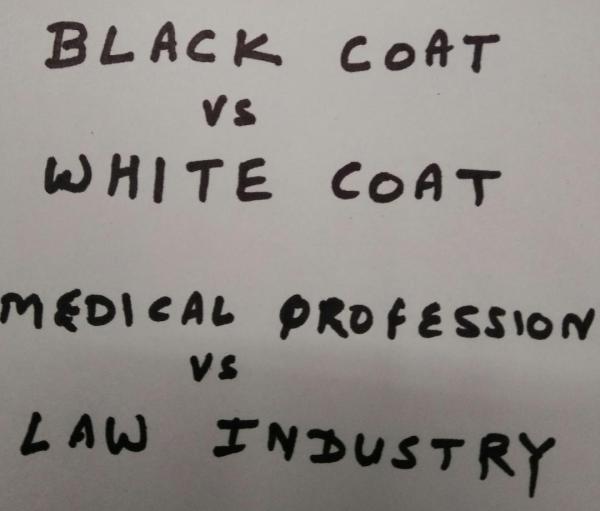
Every medical case that goes to court involves lawyers and their expensive fees. Most of the time even though the doctors may be right, he has to defend himself with the help of lawyers. Law industry has been benefited enormously because of consumer protection act at the cost of doctors. Increasing mistrust and unhappiness in patient’s mind definitely does not help patients and doctors, but ends up benefiting law industry.
Strangely doctor’s fee are quite low but lawyers charges them astronomical amounts, which are beyond any logic.
In a country where people fight with their parents, brothers and sisters for money and property, it will be naive to think that idea of making money from doctor does not exist. With court compensations going into crores, doctors can sense many times that some patient relatives try to use the opportunity. They have nothing at stake so they try to make some noise on social media and harass the doctor in court or on social platforms. Even for patients, who had poor prognosis at the very onset of treatment, relatives can create problems, many times due to financial reasons. Doctors have no protection from these nuisance. All these factors further enhance insecurity in doctor’s mind.
It is because of career building of few professions, that medico-legal cases are being fueled. Medical errors and complications are integral part of the treatment . Even simplest of diseases carry some amount of risk. These will still remain, even if doctors are hanged to death. Natural complications, poor prognosis can be attributed to errors by clever lawyering and because of benefit derived by other professions.
Many careers are shining in name of preventable deaths and medical errors at the cost of medical profession. The managers, right activists, media and lawyers have made their career and wealth out of it. Ask any doctor really, are these issues really preventable beyond a point. The line separating errors or natural complications is really blurred and arbitrary. People who work in life and death situation know it well that even natural poor prognosis can be labelled and proved as error by retrospective analysis and wisdom of hindsight and more certainly with luxury of time at disposal for lawyers and courts.
It becomes a unbalanced match specially when the amount of money which was paid to doctor to save a life was peanuts as compared to now being paid to punish him.
Zero fee advertisements and fixed commission ads on television by lawyers in health systems in certain developed countries is an example of instigation against medical profession. They lure patients to file law suits and promise them hefty reimbursements. There is no dearth of such relatives, lawyers who are ready to try their luck, sometimes in vengeance and sometimes for lure of money received in compensations. This encouragement and instigation of lawsuit against doctors has become a major disadvantage for medical profession.
Sense of impending injustice is fueling among doctors, giving a feeling of sitting ducks for harassment.
Every news item presented on TV about medical profession creates an anxiety in minds of doctors. As almost always, these are cooked for media business to create sensations. Medical profession can not fight with media power and remains at receiving end always. Painful burden of mistrust against them grows further.
News article or TV programs are created so convincing and so capable of sway public opinion against doctors. while the fears in the minds of patients is not without basis, but risk to life of patient does not really comes from doctors, but it is from mistrust generated from inexorable creep of media into our lives.
Even the most enlightened humans have biases. Media by negative publicity enhances and multiplies negative bias and propagates mistrust, beyond reasonable limits. These negative and uncertain prejudiced feeling in the mind of patients is difficult to identified , and more difficult to correct and treat .
While the news being aired, gave an impression like a judgment is passed, which is unable to take into account, the large good work being done by the medical community at large. As if the treatment done and life saved every minute is of no consequence. Such judgments are not based on any objective measurable data, and therefore they are highly susceptible to human biases. Unfortunately, a vicious cycle of mistrust and misfortune and more bias is created and there is no circuit breaker or any assessment of the mistrust thus promoted, whether it was good for society or patients. It can be at the best a late or remote afterthought by few wise ones.
Growing awareness about risk of medical interventions or its limitations, has not slowed the rapid ingestion of toxic negativity into the fabric of society. We are living in times, where media tends to influence what people see, hear, feel and buy. Spread of negative news rapidly spreading into nooks and crannies of minds of masses, but in the guise of magical optimization of medical profession and treatment. Masses rely on the one example presented before them, without knowing it was one of millions, a rarity rather than routine, without factoring in the biases and problems underlying that one patient. In majority of such cases, biases are hidden, hindsight analysis are baked, submerged and woven into an emotional fabric that is wrapped around business under the banner of better medical services optimization.
These sensational news, promoting mistrust against medical profession, if unchecked will put lives of patient more at risk than real benefit to society. People will suffer because of a relationship of mistrust with doctors, will refrain from seeking treatment. But still no one will know that it is “a curse generated by media”.
With the evolution of medical science and medical care intertwined with medical business, braided changes in medical regulation is not an far off expectation. But reticulation of evolution to modern medicine and health care has not happened in isolation. Simultaneously there has been progressively complex emerging trends in medical business and changing patterns of health investments along with an era of corporate investments in health care has also ushered. Every one now wishes to live longer and dreams of better quality of life with support of progressive medical care. Opportunities projected by advancements in health care, have shown that these dreams can be a real possibility, in many cases. That kind of perception has given patients a hope in lieu of some money. With rich people willing to spend more, the insurance sector and corporate invested money into health care, which was unthinkable few decades back in the past. This reticulation of business and health care really took away the profession from control of doctors. As it is no more simply treating a disease and involves many more issues. New model of business in health care is still not a mature process. It has emerged and progressed in just for few decades, as compared to medical treatments and systems that existed since ancient times. It is still in infancy and still has to go a long way to do real justice to every one. No one really knows how to regulate this difficult area, which encompasses life and death, deals with extremes of poverty and riches, mortality and morbidity, pain and relief , sadness and happiness, smiles and sorrows and uncountable emotions, intertwines with financial aspects. Most difficult part is amalgamation of intricacies of science with minds of patient and doctor’s skill in newly evolved milieu of financial complexities. Results are not encouraging for the profession.
An effort to govern or regulate the medical profession is not new. Hammurabi had initiated to write the rules of the game. This single professional species was managed with cruel regulation 5000 years ago, that initiated a change in the global perception and regulatory system in radical and unprecedented ways.
Hammurabi, 5000 years ago, was not even at the doorstep of medical science, but he promulgated some rules. It is difficult to say whether he was naïve or brilliant enough to make it more mathematical. He fixed heavy prize for saving lives and used to cut the hands of physicians for death or untoward incident. But he was still wise enough to pay heavily if life was saved. After thousands of years, with some scientific advancements, our regulation has remained more or less similar in basics. It is still based on principles of revenge and punishments. Now clearly knowing well the limitation of medical science and the uncertainties and complexities of human body in better way, it still remains somewhat unfair to doctors. In other words, it has not attained enough evolution and maturity.
Hammurabi at the start of civilization believed that doctors needed to be punished in case there was poor prognosis. He failed to understand the complexity of human body and the limitations of medical science, most of which was unknown at that time. By an application of average wisdom, doctor can be easily blamed for poor outcome, because he is always a common link between treatment and poor prognosis. Stricter punishments were imposed to regulate medical profession, even when the medical science was not even developed enough to deal with most of diseases. Children are always taught in school that medical profession is a noble one. But they are never told, about the cruelty this profession has faced since ancient times. Almost universally, the earlier work or contribution of a doctor to society is not taken into account. Even for complexities of medical science and uncertainties of the outcome, blame can conveniently be passed on doctors by application of average wisdom.
Hammurabi’s Codex specified the harshest form of deselection of health providers possible. If the physician erred through omission or commission, his fingers or hands were cut off, immediately stopping his practice. Therefore, a single mistake can undo all the good work of past or the future good work that could have been accomplished. Problem here is that who can differentiate with certainty the real cause of sufferings of patient, a poor prognosis or a mistake. Such regulatory systems will dissuade other good people joining the profession, again resulting in further inhibition and flourishing of profession for the good. Obviously, harsher penalties will discourage a physician surplus.
Today the global system of medical regulation, is becoming somewhat similar, to those ancient regulations in terms of punishment and revenge. Differential payment system for health care also resembles the Code of Hammurabi in some respects. And this is despite the fact that now we are very well conversant with the known uncertainty and complexity of the human body and despite cognizance of the poor prognosis in many disease states.
In an effort to institute a well controlled healthcare, our society is in a way re-entering the realm of an ancient medical regulatory system. Certain aggrieved health care consumers may welcome a move toward harsh penalties in the name of justice and simply for revenge but we need to keep in mind the poor outcomes in complex diseases, limitation of science and of course the idiosyncrasies of the human body. Evolution of medical legal system and medical regulation has to evolve and mature, to enjoy benefits of medical advancement to the fullest. Fear factors and Impact of present legal complexities, on doctors is already on a par with that of Hammurabi era.
In present scenario, when patient is no more “patient” and defined as consumer, doctors is not more than a service provider. With Medical Consumer Protection Act acquired roots, the whole system of medical delivery and healthcare has changed. Most striking is this entire fiasco is the “Us and Them” syndrome that seems to afflicted every one. Doctors are pitted against every one, for example, Doctors vs administrators, doctors vs patients, doctor vs managers. From regulation, insurance and legal system, every change has affected doctors adversely. They have been reduced to just only one component of the industry, who deliver care and remain at receiving end. Other important stake holder are patients. How this change has been beneficial for patients? Suppressed professionals can be used to work more, get less paid and can be dragged to court. So fear of all kinds will make them more careful. It should be a win-win situation for all, except doctors. Therefore everyone makes merry, while doctors sulk, except those who can mingle with the present scenario and act smart in changed business and legal milieu.
Negatives effect on medical profession: cons or disadvantages of medical consumer Protection Act
Promotes Defensive medicine: Every patient with any illness has potential to complications. Progression of any disease state can cause death. If doctors start looking at every patient as a potential litigant, especially those who are dealing with very sick ones, practice of defensive practice is a natural consequence. This may manifest as excessive investigations, more use of drugs and antibiotics and even sometimes even refusal to treat very sick patients. Worst scenario of excessive fear will be refusal of very sick patients in emergency situations or non availability of doctors.
Erosion of doctor-patient relationship: stray and occasional Incidents about negligence and the cases in courts or their outcome are given wide publicity in media. People are unable to understand the correct application of such stray incidents to themselves. But they always try to imagine themselves in the scenario applied. Because of prejudiced notions, a sense of mistrust gradually creeps in, which then extends to and involves their own treating doctor .This sense of mistrust multiplies manifold whenever there is some adverse or even small unpleasant Ultimately doctor and patients move forward together with a strained relationship and the treatment goes on with a surmounting sense of mistrust.
Increased cost of care: With the creeping in of practice of defensive medicine, there is a need to document everything and to offer everything possible in the world, leading to inflated medical costs. Insurance companies and lawyers have positioned themselves in between. They charge everyone heavily for allaying the fears , both patients(medical insurance, lawyer fee) and doctors(indemnity insurance, lawyer’s fee) alike. The vicious cycle of rising costs , need for insurance, medicolegal suits, high lawyer fee (for patients and doctors) goes on unabated. All these contribute significantly to overall increased cost of health care.
Enhanced insecurity in medical profession : Needless to say, consumer protection act has increased the anxiety and insecurity in the medical profession. One keeps wondering which patient will prove to be his bane and finish his total career or will result in professional hanging or a media trial, with these having real probability in today’s day to day practice.
Unnecessary litigation: Legal cases can be put on doctors for various trivial reasons e.g for sense of revenge or to extract money or simply for not having to pay for services. In an era where family members , brothers and sisters fight for money, it will be naïve to think that idea of making money from doctor does not exist. These are further stoked by the incidents of previous high compensations granted by courts .
Increased paper work: excessive documentation and time consumption: crucial and large chunk of time of doctors and nurses, goes in completing documentation. Needless to say, this time previously was dedicated solely to patient service. Management is now-a days more worried about completing paper work as well. Initially it was a symbolic documentation , but now there is requirement of mammoth paper work. It leads to consumption of time that was meant for real discussions for the benefit of patients.
Doctors used as scapegoats for revenge : Any unsatisfied patient can vent his anger by putting complaint or case against the doctor . This is done to some extent for revenge or trying to find some human factor which can be punished. Not uncommonly doctors are used as scapegoat to have a concession on the patient treatment by health organizations. Everything can be easily put on doctors as they are universal final link to a patient’s treatment and adverse effects.
Distraction of doctors from the primary point of intention: Nothing else ever has distracted doctors more than these medico-legal cases and punishments. In many cases, saving themselves becomes more important than saving a patient. Uncertainty of prognosis, grave emergencies and split second life saving and risky decisions which may later be proved wrong by retrospective analysis, complex medico-legal situations are endless distractions that have creep in and are enough to distract doctors from primary point of intention.
Early retirement or burn out: Becoming a doctor and practicing has become a tough job. After people have reached a point of financial security or when near point of burn out, doctors tend to leave practice. No wise man will like to face medico-legal complexities in older age. Taken to court for a genuine decision by self is enough to spoil and tarnish health, wealth and fame earned by grilling the whole life.
Reluctance to do emergency, risky work: If the decision to decide or act or help someone in an emergency situation, puts ones own life and career to risk, why should one put oneself in that deciding position? Therefore increasingly, financially secure doctors are staying away from the riskier jobs.
Only Doctors are sufferers of the act: Patient can have poor outcome because of any reason. It can be severe disease, poor prognosis, rare or genuine complications or even unintentional mistake or human errors, system errors or deficiency. But retrospectively doctors can easily be blamed because of wisdom of hindsight. All patients with unrealistic or unexpected outcome can go to courts. Whatever court decides, harassment of doctors is full and permanent. There is no compensation possible for the sufferings and agony spanned over years, even if court decides in favour of doctor.
Spoils teamwork among doctors; Whenever there is adverse outcome in any patient, all the doctors involved may start looking for whom to blame among themselves. All of them will try to pinpoint other’s mistake. Such situation produces a bitter and worst kind of disagreements among various teams or specialties. Mutual understandings take a back seat and the teamwork is spoiled permanently. Administrators in a bid to be safe, encourage putting doctor’s concerns against each other, creating a strange sense of enmity. Ultimately a mutual understanding and team work takes a hit.
Hugely benefited are medical industry, law industry and administrators; Rampant misuse of consumer protection act has instilled a sense of deep fear in mind of medical professionals. The act has been used as a whip for doctors by all these three stakeholders. Fear of medico-legal cases has reduced doctors to cheap labour. Industry has used the protective systems to gain out of doctors hard work. Benefits to law industry are obvious and don’t need to be elaborated. Besides this, even insurance industry has collected money both from doctors and patients by creating the fear.
Right decisions or wisdom of hindsight?; A certain element of doubt always remains in minds of doctor whether he will get justice in the long run, or will end up being victim of sympathy towards patient or clever lawyering. What was medically right and judicious decision at that real time situation may look wrong later retrospectively, especially when retrospective analysis is done over years with fault finding approach.
Delayed treatment in emergency situations: Due to prejudiced minds, it is not uncommon for patient’s relatives to keep seeking second opinion, thereby delaying consent for procedures, surgeries and treatment. Though doctors know this problem but they obviously cannot proceed without necessary documentation. With increasing mistrust, even emergency treatments are delayed only to repent later.
Instigation by law industry;Windfall profits for lawyers and law industry at the cost of doctors is a disadvantage for medical profession: One can see zero fee and fixed commission advertisements on television by lawyers in health systems even in developed countries. They lure and instigate patients to file law suits and promise them hefty reimbursements. There is no dearth of such relatives, lawyers who are ready to try their luck sometimes in vengeance and sometimes for lure of money received in compensations. This encouragement and instigation of lawsuit against doctors is a major disadvantage for medical profession.
Hostile environment for young impressionable doctors: The young and bright doctors complete their long arduous training and then suddenly find themselves working in a hostile environment, at the receiving end of public wrath, law and media for reasons they can’t fathom. They face continuous negative publicity, poor infrastructure and preoccupied negative beliefs of society.
Subject of continuous blackmail: Even with routine complications amongst very sick patients, a threat looms over doctor’s head. People do not accept even the genuine complication, what to talk of unintentional mistakes. Mistakes are always easy to pinpoint with retrospective analysis and with lawyers pondering over it for years. In such situations , doctors are sitting ducks for any kind of
Positives, Pros or advantages of medical consumer protection act:
Although there are doubts, whether it will have any positive effect in long term, except monitory benefit to patient’s relatives and lawyers.
Quick redressal of grievances: patient will get satisfaction, if there is a genuine negligence case
Better quality of care will increase; medical systems will improve as they will need to lessens the errors and court cases. Better systems from abroad are also copied to improve the efficiency.
Better introspection by medical profession: although doctors from the beginning are sensitive about their work and always look at how better results can be achieved. But act will make this process more formal and official.
Training of medical professionals: it will be difficult to put errors under carpet. Doctor will like to get trained better as no one want to be in soup.
Future learning from court cases: each and every court decisions is viewed carefully by medical fraternity. Improvement in protocol and policy making is a natural consequence.
6. Eye openers for medical profession: court cases and decisions have acted as eye opener for medical profession. It gives an idea, how law looks at medical treatment. It has made clear that medical science and medical law are a bit different. In real time, things are easier to be said than done.
7. Better documentation and communication: Doctors to save themselves, documentation is the key. Previously doctors were doing everything, but not documenting. But now there is lot of stress on documentation.
Stress itself is not a bad thing. It can often help us perform at our best, expand beyond our limits and achieve better results. The real problem lies in the fact that In this age of anxiety prevailing more for care givers, do not get enough relieffrom stress.
But sad thing about this kind of learning is that it is at the cost of few, unfortunate doctors, who were in difficult situation, actually suffered, did not know the legal implications of their acts or situation. Most of the time, it is a system failure, but blame can be pinpointed to doctor.
May be The Act has good intention, but its practical application in its present form may cause more harm than good. If the core of the health care (medical hands) are harmed, no one can benefit in the long run.











 Evolution of Medical profession-Extinction of good doctors