Medical Consumer Protection Act: A Loss making deal for patients too?


ย ย ย ย  ย ย With the evolving medical science and health care getting intertwined withย business, braided changes inย medicalย regulation and law are not an unexpected development. New models of medical regulation, business and law inย health care have emerged and progressed in last few decades. ย Despite a wish to govern and regulate medical profession strictly, the laws and regulations still have to go aย long way to provide real justice to everyone.ย ย ย No one really knows how to regulate this difficult area,ย  which encompasses life and death, deals with extremes of poverty and riches, mortality and morbidity, pain andย  relief , sadness and happiness, smiles and sorrow and other uncountable emotions, all intertwined with financial aspects.But the wish of administrators to govern medical profession strictly with punishments is not new. ย Hammurabi (5000 years back) at the start of civilization believed that doctors needed to be punished in case there was a poor outcome. Strangely it was at a time, when no one understood the complexity of human body and the limitations of medicalย science; even basic anatomy and physiology of body was not discovered. ย 

      Considering the limitations of medical science along with uncertainties and complexities of human body, regulation of medical profession and system of punishments still remains somewhat unfair to doctors, even after 5000 years.  It is still based on principles of revenge and retributions rather than developing a robust system by learning from mistakes. By application of an average wisdom, doctors can be easily blamed for poor outcomes, as they are always and universal a common visible link between treatment and poor outcome. 

           One of the examples of easy punishments for doctors is Medical consumer protection act that was implemented in 1995 for medical services. Patients were defined as consumers and hence doctors were converted to service providers in lieu of some money.  Consequently the changed definitions altered the doctor-patient relationship in an irreversible way.   

    The reality is that neither doctors, nor patients are ready for such a legal relationship. More-over   the system is not robust enough for such a change.   To work with weak infrastructure, non-uniform medical education, poor numbers of support staff, inept health system along with legal complexities has pushed doctors into a shell and predisposed them to harassment. 

          Rather than   developing a system to promote   good doctor-patient relationship, Medical Consumer Protection Act has created a situation of โ€˜us versus them syndromeโ€™. It caused erosion of doctor-patient relationship and escalated cost of care.   Propagation of stray and occasional incidents about negligence case in court or their outcomes are given disproportionate wide publicity in media. The patients are unable to understand the correct application of such stray incidents to themselves. Such cases may be frivolous,  just one in million or a rarity, but people always try to imagine themselves being in the hospital chaos due to the   scenario projected.  It gives a negative projection about medical services and enhances patientsโ€™ fear to seek treatment at right time.

    There is a growing mutual mistrust; doctors too have started looking at every patient as a potential litigant. Especially while dealing with very sick ones, practice of defensive medicine is a natural consequence. This may manifest as excessive investigations, more use of drugs, antibiotics and even reluctance or refusal to treat very sick patients. 

    With the mandate to practise evidence based medicine, doctors need to document everything and to offer everything possible, leading to skyrocketing medical costs.  To save themselves, doctors have to do mammoth paper work, leading to consumption of time that was meant for real deliberations for the benefit of patients.

           Consequently insurance companies, medical industry and lawyers have become indispensable and have positioned themselves in between doctor and patients. Besides creating a rift between doctor and patient, they charge heavily from both sides; from patients (medical insurance, lawyer fee) and doctors (indemnity insurance, lawyerโ€™s fee) alike. The vicious cycle of rising costs, need for insurance, medicolegal suits, and high lawyer fee (for patients and doctors) goes on unabated. All these contribute significantly to overall inflated cost of health care.

       Not uncommonly doctors are used as scape goats to have a concession on the patientโ€™s treatment from administrators.  

       Medical consumer protection act has increased the anxiety and insecurity among   medical professionals.   Doctors can be dragged to courts for trivial reasons, for example the sense of revenge, simply for non-satisfaction, to extract money or simply for avoiding paying for services.  In an era where family members, brothers and sisters fight for money, it will be naรฏve to think that idea of making money from doctors does not exist. These money-making ideas are further stoked by the much publicized incidents of high compensations granted by courts.

     Medical lawsuits and complaints (right or wrong) are breaking medical professionals from within, not to mention the toll it takes on their confidence and belief, which takes a lifetime to build.

     Whenever there is adverse outcome in any patient, all the doctors involved start looking for whom to blame among themselves. Due to legal pressure they try to pinpoint each otherโ€™s mistakes.  Mutual understanding takes a back seat and the teamwork is spoiled permanently. Administrators in a bid to be safe, encourage putting doctorโ€™s concerns against each other,  creating a strange sense of enmity among medical professionals.

    The ease with which doctors can be harassed has led to rampant misuse of medical consumer protection act and it has instilled a sense of deep fear and insecurity in the mind of medical professionals. The act has been used as a whip against the  doctors by all, including  medical industry, law industry and administrators.  Only doctors are visible as those who deliver care, so they remain at receiving end for poor outcomes and all these industries remain invisible.    The industry has used the protective systems against medicolegal cases to gain  maximum benefits  out of doctorsโ€™ hard work.   

      In court cases, a certain element of doubt always remains in mind of a doctor whether he will get justice in the long run, or will end up being  a victim of sympathy towards patient or clever lawyering.  So taking medical decisions in critical situations is becoming more difficult  in view of the future uncertainty of disease.

             Windfall profits for lawyers is a strong  incentive   for  law industry to promote   instigation  of patients by against doctors .  One can see zero fee and fixed commission advertisements on television by lawyers in health systems even in developed countries. They lure and instigate patients to file law suits and promise them hefty reimbursements on โ€˜sharing and commission basisโ€™. There is no dearth of such relatives and lawyers who are ready to try their luck sometimes in vengeance and sometimes for the lure of money received in compensations. 

       Consequently doctors are now an easily punishable human link for poor outcomes.  Medical professionals work with continuous negative publicity, poor infrastructure, and preoccupied negative beliefs of society and burden of mistrust.

  Strangely  Medical Consumer Protection Act applies  only to doctors, that too selectively. All  other professions and services  are   out of it, not even other constituents of health services. Selective application is what is  demoralizing the doctors.  Considering the uncertainty and kind of work done by  medical professionals, actually it should be other way around.Mistakes are always easy to be picked with retrospective analysis and with lawyers pondering over it for years. In such situations, doctors are sitting ducks for any kind of blackmail.

            Nothing else has ever distracted doctors more than medico-legal cases and punishments. In certain circumstances, saving themselves becomes more important than saving a patient. Decision making also becomes difficult  by uncertainty of prognosis,  grave emergencies, split second lifesaving and risky decisions that may later be proved wrong by retrospective analysis with wisdom of hindsight with luxury of time and fault-finding approach.  The possibility of complex medico-legal situations in doctorโ€™s  mind are enough to distract doctors from their primary point of intentions โ€˜the treatmentโ€™.

          Therefore increasingly, financially secure doctors are staying away from the riskier jobs. No wise person will like to face medicolegal complexities in older age. Taken to court for a genuine decision is enough to spoil and tarnish health, wealth and fame that was earned by  slogging  the  entire  life.     

     Patients can have poor outcomes for many reasons. It can be severe disease, poor prognosis, rare or genuine complications or even unintentional mistake or human errors, system errors or deficiency. Whatever court decides,  while consuming years, the harassment of doctor is full and permanent. Even if court decides in favour of the doctor, there is no compensation possible for the sufferings and agony spanning over years.  Therefore, a single mistake can undo all the good work of past, and the illustrious future work that could have been accomplished.

        If the decision to decide or act or help someone in an emergency situation, puts oneโ€™s own life and career at risk, why would anyone put himself in that difficult  position?  

         Medical Consumer Protection Act  has become a tool to harass doctors and money making tool for lawyers, medical industry or administrators. But  it would be naรฏve to assume that by whipping doctors and regulating them in such a harsh manner will be helpful to patients in long run.  The consequent insecurity among doctors, practise of defensive medicine, enhanced costs, excessive documentation and the distraction from the primary point of intention (treatment)  are few of the  side effects, which will  definitely be passed on to the patients inadvertently.  After all doctors have to save themselves as well. As a result,  now the battle of life and death will be fought with less zeal, with subdued and demoralized soldiers.

ย ย ย ย ย ย ย  ย ย Patients are unable to realize their loss for punishing their saviours. For doctors, no rewards if you win, but sword hanging if one loses. ย Fear factors on doctors and impact of present legal complexities is already at par with that of Hammurabiโ€™s era. Consequently being consumer may be overall a loss making deal for the patients.

     Advantages-Disadvantage of being a doctor

     25 factors- why health care is expensive

     REEL Heroes Vs Real Heroes

     21 occupational risks to doctors and nurses

     Covid paradox: salary cut for doctors other paid at home

   Medical-Consumer protection Act- Pros and Cons

Quack Menace: Infant loses glans in botched circumcision


Infant loses glans in botched circumcision done by quack

        In an era, when even licensed and qualified doctors are finding it difficult to practice medicine, it is strange that unqualified and unlicensed are having a field day. Why strict regulations do not apply to them, is beyond any reasoning and logic. If a medical facility or clinic is functional, it is difficult for the patient, especially in emergency, to check or even doubt its credentials. How such facilities are open, functional and thriving. Sadly our regulation is trying to regulate, who are already regulated. It is trying to punish those who are qualified and licensed, but turns a blind eye towards unlicensed and unqualified doctors.

     Such fake doctors own medical set ups, may conduct surgeries, sometimes run hospitals with little help from qualified doctors  and do procedures. Another problem is that they   promote fake rumours about genuinely qualified doctors and create a mist of mistrust to propagate their fake medical business.

A toddler has died Australia after circumcision

Quack Menace: Infant loses glans in botched circumcision

ย The glans of an infantโ€™s penis shrivelled and fell off after a quack tied a horseโ€™s hair around it โ€˜to prevent bleedingโ€™ after a ritual of circumcision. The child was rushed to hospital, where a surgery was performed to ensure that the baby will be able to urinate normally, but the boy has lost his glans.. A quack had conducted the religious ritual of circumcision on November 22, 2021, and tied a horse hair to the childโ€™s penis. He then bandaged it and told the family to go home.

The child was born in October 2021. Ten days later, the family members noticed that the glans had come off along with the dressing. Families choose to get their male infants circumcised by neighbourhood quacks. This is not just unhygienic, but can lead to major complications as well. Other unhealthy practices like sprinkling ash on the wound after circumcision are also prevalent.

A toddler has died in Australia after circumcision

A toddler has died and his baby brother has required life-saving surgery in hospital after a medical procedure, understood to have been a circumcision, went horribly wrong in Perthโ€™s south-east. The brothers were rushed to hospital in Armadale by family Tuesday evening following the surgeries. The West Australian reports a two-year-old boy was pronounced dead at the hospitalโ€™s emergency department. His infant brother – aged between seven and eight months – was rushed to Perth Childrenโ€™s Hospital for emergency surgery.7NEWS reports he has since been discharged from hospital. WA Police have confirmed the toddlerโ€™s death is not being treated as suspicious. โ€œIt can be confirmed the boy underwent a medical procedure at a registered medical centre prior to his death,โ€ a police spokeswoman said.

Circumcision is one of the oldest surgical procedures and one of the most commonly performed surgical procedures in practice today. Descriptions of ritual circumcision span across cultures, and have been described in ancient Egyptian texts as well as the Old Testament.ย In the United States, circumcision is a commonly performed procedure. It is a relatively safe procedure with a low overall complication rate. Most complications are minor and can be managed easily. Though uncommon, complications of circumcision do represent a significant percentage of cases seen by paediatric urologists. Often they require surgical correction that results in a significant cost to the health care system. Severe complications are quite rare, but death has been reported as a result in some cases. A thorough and complete preoperative evaluation, focusing on bleeding history and birth history, is imperative. Proper selection of patients based on age and anatomic considerations as well as proper sterile surgical technique are critical to prevent future circumcision-related adverse events.

Complications of circumcision

Bleeding- Bleeding is the most commonly encountered complication of circumcision.

Infection, Insufficient Foreskin Removed, Excessive foreskin removed, Adhesions / Skin , Bridges, Inclusion Cysts, abnormal Healing

Meatitis, Meatal Stenosis, Urinary Retention, Phimosis, Chordee, Hypospadias, Epispadias

Urethrocutaneous Fistula, Necrosis of the Penis, Amputation of the Glans

Deathโ€”ย ย  ย death is an extremely unlikely complication of neonatal circumcision, but it has been reported.

     Advantages-Disadvantage of being a doctor

     25 factors- why health care is expensive

     REEL Heroes Vs Real Heroes

     21 occupational risks to doctors and nurses

     Covid paradox: salary cut for doctors other paid at home

   Medical-Consumer protection Act- Pros and Cons


US Doctor hailed-Indian Doctor Jailed for Same Surgery & gap of 25 years


ย ย ย  ย ย 

In a medical first, doctors transplanted a pig heart into a patient in a last-ditch effort to save his life and a Maryland hospital said Monday that he’s doing well three days after the highly experimental surgery. While it’s too soon to know if the operation really will work, it marks a step in the decades-long quest to one day use animal organs for life-saving transplants.

ย ย  In 1997, Dr Dhani Ram Baruah, along with Hong Kong surgeon Dr Jonathan Ho Kei-Shing, carried out a pig-to-human heart and lung transplant in Guwahati (India). The transplant stirred controversy all over and both the doctors were arrested within a fortnight for culpable homicide and under the Transplantation of Human Organs Act, 1994, and imprisoned for 40 days.

ย ย ย ย ย ย  The fault of Dr Baruah was that he was on the wrong side of the laws prevailing at that time. But now after 25 years USA has provided evidence that he was scientifically ahead of his times; hence punished and sent to jail for the same reason.ย  Instead of updating the laws, accepting and promoting the scientific advancement and encouraging the brilliance of the doctor, he was put in jail. The result is that now everyone is hailing the feat of doctors in USA for the same surgery that Dr Baruah dared to perform 25 years ago.

ย ย  ย ย ย ย ย In a patient with terminal ย heart ย failure, life isย  only possible if heart transplant is done. Human heart is difficult to be procured.

     The point to ponder is that whether Laws should be made or may be updated to promote or help scientific brilliance or it is wise to follow them blindly without application to  future wisdom. Instead of punishing and sending Dr Baruah to jail, Laws could have been modified or updated to help the path breaking advancement, which could have helped patients and saved lives.

       Such high handedness of authorities just point to an ecosystem, where scientific advancements and individual brilliance  are not respected.

       As doctors in the United States hail the path-breaking surgery in which a patient is recovering after receiving a heart from a genetically modified pig in Maryland, it evokes memories of an Indian doctor who had attempted the same over 20 years ago in Assam.

For those who havenโ€™t read, US doctors transplanted a pig heart into David Bennett, a 57-year-old Maryland handyman, in a last-ditch effort to save his life and a Maryland hospital said that he’s doing well three days after the highly experimental surgery.

We go back in time to take a look at the case in which Dr Dhani Ram Baruah, a transplant surgeon from Assam conducted a pig-to-human heart and lung transplant in Guwahati and why that incident got shrouded in controversy and led to him being imprisoned for 40 days.

The incident                                                   

In 1997, Dr Dhani Ram Baruah, along with Hong Kong surgeon Dr Jonathan Ho Kei-Shing, carried out a pig-to-human heart and lung transplant in Guwahati.

Times of India report says that Dr Baruah transplanted a pig’s heart into a 32-year-old man, who had a ventricular septal defect, or hole in the heart.

According to Dr Baruah, the surgery โ€” conducted at his very own facility, the Dhani Ram Baruah Heart Institute, and Institute of Applied Human Genetic Engineering at Sonapur outside Guwahati โ€” was completed in 15 hours.

However, the 32-year-old man โ€œdeveloped new anti-hyperacute rejection biochemical solution to treat donorโ€™s heart and lung and blind its immune system to avoid rejectionโ€, reported the Indian Express, and he died a week later.

The transplant stirred controversy all over and both the doctors were arrested within a fortnight for culpable homicide and under the Transplantation of Human Organs Act, 1994, and imprisoned for 40 days.

The Assam government formed an inquiry into the case and found that the procedure was unethical.

The inquiry also found that the Dr Dhaniram Heart Institute and Research Centre had โ€œneither applied for nor obtained registrationโ€ as required under the transplant laws.

What happened next?

After being in jail for 40 days, the doctor returned to his clinic but found it to be destroyed. A Times of India report added that he spent the next 18 months under virtual house arrest.

But, the doctor, who faced taunts, continued his research.

Controversyโ€™s child?

Dr Baruah hit the headlines again in 2008 when he claimed that he had developed a ‘genetically engineered’ vaccine that would correct congenital heart defects.

In 2015, he once again became popular after claiming to have discovered the ‘cure’ for HIV/AIDS and that he had ‘cured’ 86 people in the past seven-eight years.

He also wrote to the UNAIDS, WHO and the National Institute of Health of USA to tell them of his ‘successes’ and was open to scrutiny.

     Advantages-Disadvantage of being a doctor

     25 factors- why health care is expensive

     REEL Heroes Vs Real Heroes

     21 occupational risks to doctors and nurses

     Covid paradox: salary cut for doctors other paid at home

   Medical-Consumer protection Act- Pros and Cons

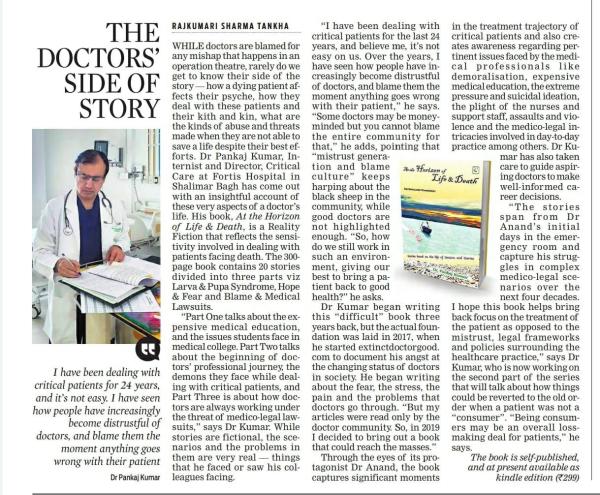
The Book-โ€˜At the Horizon of Life & Deathโ€™: Doctorsโ€™ struggle with death


The 300-page book contains 20 stories divided into three parts viz โ€“ Larva & Pupa Syndrome, Hope & Fear & Medical Lawsuits. The book is available worldwide on Kindle Amazon, Apple, Barnes & Noble, Tolino, Kobo, Scibd, BorrowBox, Baker & Taylor , Vivilo, Overdrive  etc.

      While doctors are usually blamed for any mishap, be it natural poor prognosis or genuine complications, rarely people get to know their side of the story โ€” how a dying patient affects their psyche, how they deal with these patients and their kith and kin, what are the kinds of abuse and threats made when they are not able to save a life despite their best efforts. Dr Pankaj Kumar, Director Critical Care at a Delhi Hospital, India has come out with an insightful account of these very aspects of a doctorโ€™s life.

         His book โ€˜At the Horizon of Life & Deathโ€™ is a Reality Fiction that reflects the sensitivity involved in dealing with patients facing death.

     Through the eyes of its protagonist Dr Anand, the book captures significant moments in the treatment trajectory of critical patients. The book tries to create awareness regarding pertinent issues faced by the medical professionals like demoralisation, expensive medical education, the extreme pressure and suicidal ideation, the plight of the nurses and support staff, assaults and violence and the medico-legal intricacies involved in day-to-day practice among others. The author has also taken care to guide aspiring doctors to make well-informed career decisions.

     Part One (Larva & Pupa Syndrome)-  talks about the expensive medical education, and the issues students face in medical college.

    Part Two (Hope & Fears) talks about the beginning of doctorsโ€™ professional journey, the disease demons they face while dealing with critical patients, dilemmas of doctors and patients near death situations.

    Part Three (Medical Lawsuits) is about how doctors are always working under the threat of medico-legal lawsuits.

        While stories are fictional, the scenarios and the problems in them are very real โ€” things that he faced or saw his colleagues facing.

     Medical profession has become victim of mistrust generation and blame culture. Everyone keeps harping about the few black sheep in the community, while larger good work of doctors is not highlighted enough.

    The stories span from Dr Anandโ€™s initial days in the emergency room and capture his struggles in complex medico-legal scenarios over the next four decades. This book is an effort to bring back focus on the treatment of the patient as opposed to the mistrust, legal frameworks and policies surrounding the healthcare practice.

           The book is self-published, available worldwide on Kindle Amazon, Apple, Barnes & Noble, Tolino, Kobo, Scibd, BorrowBox, Baker & Taylor , Vivilo, Overdrive  etc.

Advantages-Disadvantage of being a doctor

     25 factors- why health care is expensive

     REEL Heroes Vs Real Heroes

     21 occupational risks to doctors and nurses

     Covid paradox: salary cut for doctors other paid at home

   Medical-Consumer protection Act- Pros and Cons

ย Side Effects-Implementing Medical-Consumer-Protection-Act in Haste


        Medical consumer protection act was implemented in 1995. Patients defined as consumers and hence doctors converted to service providers in lieu of some money.  Consequently the changed definitions altered the doctor-patient relationship in an irreversible way. Instead of the earlier congenial relationship, now-a dayโ€™s doctors and patients are fighting in courts, whereas most of aspects of the law still remain grey after 26 years of implementation. Here in this case even courts differ in the interpretation (among themselves) of the law after more than two decades of its implementation.

        The doctors are supposed to treat, provide relief and save lives are the most affected, it is needless to say that the way of treating patients has been altered like never before. Medical lawsuits and complaints (right or wrong) are breaking medical professionals from within, not to mention the toll it takes on someoneโ€™s confidence and belief, which takes a lifetime to build.

   The reality is that neither doctors, nor patients were ready for such a legal relationship, and the system was not robust enough for such a change.  To work with weak infrastructure, non-uniform medical education along with legal threats pushed doctors into a shell and forced defensive practice.  It caused erosion of doctor-patient relationship and escalated cost of care.

   Medical business, insurance and legal industry made full use of the opportunity to have the benefits of changed doctor-patient relationship.  Doctors were used as scapegoats for poor infrastructure by administrators and further exploited by law industry.

   Justice eluded doctors at all stages.

      It is discouraging for medical professionals to note that courts are still clarifying the law even after 26 years of its implementation.  What is more disheartening that many more aspects about the medical-consumer protection act are either remain  unclear and create difficulty for doctors.  To differentiate medical mistakes, poor prognosis from negligence is a very fine line and difficult to judge. Therefore medical profession has  become  a subject to blackmail by patients, lawyers and sitting ducks for punishments. The consequent insecurity among doctors, practice of defensive medicine, enhanced costs, excessive documentation and the distraction from the primary point of intention (treatment)  are few of the  side effects, which will  definitely be passed on to the patients inadvertently.  After all doctors have to save themselves as well.

 Consequently being consumer may be overall a loss making deal for the patients.

     The point to ponder is that courts themselves differ on interpretation of law even after 26 years of its implementation.  

The Supreme Court has reiterated that service rendered by medical officers on behalf of a Hospital, free of cost, would not fall within the ambit of  medical consumer protection act.

https://www.livelaw.in/top-stories/consumer-case-not-maintainable-over-medical-services-given-free-of-charge-doctor-salary-hospital-supreme-court-187291

     Advantages-Disadvantage of being a doctor

     25 factors- why health care is expensive

     REEL Heroes Vs Real Heroes

     21 occupational risks to doctors and nurses

     Covid paradox: salary cut for doctors other paid at home

   Medical-Consumer protection Act- Pros and Cons

ย Pendency at Hospitals Vs Courts: A Comparison- Imparting Justice Vs Health


Justice and Health- Both are crucial for happiness of the living beings as well as society as a whole.  Hospitals are full of patients and so are courts with litigants. None of the people go to hospital and courts happily and everyone invariably wants early relief.

   Once a patient visits hospital, he will ponder over about the benefit of the visit. So is the person visiting the courts. Did they were imparted justice?

      None of patient, who visits hospital, comes back without treatment. Doctor gets few minutes to decide. Most of the time, for the investigations and the treatment few visits are required. But there is no pendency. In Government hospitals, even appointments are not given. A doctor sitting in outdoor will see hundreds of patients. On emergencies night duties, doctor will not be able to count how many he/she has stabilized or numbers treated.

ย ย ย ย ย  Even in such chaotic systems, doctor can be punished, dragged to courts or assaulted for unintentional mistakes, that are ย almost always secondary to load of patients or inept infrastructure.

      The work at hospital continues day and night, 24 hours and 365 days, despite almost always lesser number of doctors and required manpower. Systems in hospitals  are designed and maintained meticulously   to have no pendency what-so-ever situation is.   Larger number of patients go back home treated and very few unfortunate patients are unable to recover, but still whatever is required- is done invariably.

ย ย ย ย ย ย ย  Justice is needed for satisfaction of soul and peaceful mind, is of same importance what is to the health of body. Justice delayed gives a sense of hurt and pain to soul. Pendency in courts simply reflects the grave injustice people are living with.

44 million pending court cases: How did we get here?

       There are about 73,000 cases pending before the Supreme Court and about 44 million in all the courts of India, up 19% since last year.

According to a 2018 Niti Aayog strategy paper, at the then-prevailing rate of disposal of cases in our courts, it would take more than 324 years to clear the backlog. And the pendency at that time was 29 million cases. Cases that had been in the courts for more than 30 years numbered 65,695 in December 2018. By January this year, it had risen more than 60% to 1,05,560.

Grave injustice for medical professions:

  1.   A doctor making wrong diagnosis (gets few minutes to decide) can be prosecuted, but courts giving wrong verdicts (get years to decide) are immune?

   2. Compare the remuneration of lawyers to doctors. Doctors gets few hundreds to save a life (often with abuses) and lawyers can get paid in millions (happily).

   3. Doctors treat the body and larger is still not fully known about mechanisms. Still doctors can be blamed for unanticipated events. Whereas  law is a completely known and written subject.

   4. If health is citizenโ€™s right so should be a timely justice.

ย ย ย ย ย ย ย ย  Despite doing so much for patients, still peopleโ€™s behaviour to doctors and hospitals is not respectful. Doctors are punished for slight delays and people and courts intolerant to unintentional mistakes. But people canโ€™t behave in the same manner to courts and legal system and tolerate the blatant injustice for years.ย ย ย ย 

     Advantages-Disadvantage of being a doctor

     25 factors- why health care is expensive

     REEL Heroes Vs Real Heroes

     21 occupational risks to doctors and nurses

     Covid paradox: salary cut for doctors other paid at home

   Medical-Consumer protection Act- Pros and Cons
Justice Delayed to Doctor- Vindication # Supreme-Court # Medical-Negligence?


It has taken 23 years to end harassment of a doctor to decide upon a problem, which should not have been there at all. Practically doctors can be dragged to courts, blackmailed, harassed and assaulted with impunity just because of any adverse outcome.ย  So the legal and illegal demonization of medical profession has become a routine, while law industry makes merry at the cost of doctors.ย  Natural complications, genuine poor prognosis, and death that occur after some treatment can be easily pinpointed to the doctors. Saviours are fighting the death as well as court cases to save themselves. In this case, Supreme Court was kind enough to give a favourable verdict, but not all doctors are lucky enough. Many suffer because of frivolous cases, poor medical governance and unwise decisions.

ย Doctor canโ€™t be held guilty of negligence just because a patient died: Supreme Court

    The bench said: โ€˜In spite of the treatment, if the patient had not survived, the doctors cannot be blamed as even the doctors with the best of their abilities cannot prevent the inevitable…โ€™ A doctor can assure life to his patient but can only attempt to treat everyone to the best of his or her abilities, said the Supreme Court.

      No doctor can assure life to his patient but can only attempt to treat everyone to the best of his or her abilities, said the Supreme Court on Tuesday, as it underscored that a doctor cannot be held guilty of medical negligence just because a patient has not survived.

โ€œThere is a tendency to blame the doctor when a patient dies or suffers some mishap. This is an intolerant conduct of the family members to not accept the death in such cases. The increased cases of manhandling of medical professionals who worked day and night without their comfort has been very well seen in this pandemic,โ€ lamented a bench of justices Hemant Gupta and V Ramasubramanian.

The bench added: โ€œIn spite of the treatment, if the patient had not survived, the doctors cannot be blamed as even the doctors with the best of their abilities cannot prevent the inevitable…The doctors are expected to take reasonable care but none of the professionals can assure that the patient would overcome the surgical procedures.โ€

  It underlined that there must be sufficient material or medical evidence should be available before the adjudicating authority to arrive at the conclusion that death is due to medical negligence. โ€œEvery death of a patient cannot on the face of it be considered to be medical negligence,โ€ said the bench.

The court said this while allowing an appeal filed by Bombay Hospital and Medical Research Centre against the National Consumer Disputes Redressal Commissionโ€™s order to pay โ‚น14.18 lakh to the family of one Dinesh Jaiswal, who died in June 1998 following unsuccessful surgeries of his gangrene in his limbs.

The family attributed Jaiswalโ€™s demise to negligence in conducting surgeries, absence of the treating senior doctor, lack of operation theatre, and a broken-down angiography machine. The hospital, however, refuted all allegations, stating the best possible treatment by present medical professionals and within the resources available was provided.

In its 2010 judgment, the national consumer commission invoked the principle of โ€œres ipsa loquiturโ€ (mere occurrence of certain event can lead to an inference of negligence of the other side) to hold the hospital guilty of medical negligence.

But the top court on Tuesday set aside this judgment, noting the order suffered from legal as well as factual infirmities.

โ€œIt is a case where the patient was in serious condition impending gangrene even before admission to the hospital but even after surgery and re-exploration, if the patient does not survive, the fault cannot be fastened on the doctors as a case of medical negligence. It is too much to expect from a doctor to remain on the bed side of the patient throughout his stay in the hospital which was being expected by the complainant here. A doctor is expected to provide reasonable care which is not proved to be lacking in any manner in the present case,โ€ held the bench.

The court underlined that there was never a stage when the patient was left unattended and mere fact that the main treating doctor had gone abroad cannot lead to an inference of medical negligence because the patient was admitted in a hospital having 20 specialists in multi-faculties.

โ€œThe patient was in a critical condition and if he could not survive even after surgery, the blame cannot be passed on to the hospital and the doctor who provided all possible treatment within their means and capacity,โ€ it said.

On the aspect of delay in re-exploration after the initial surgery threw up complications due to non-availability of an operation theatre, the bench noted that it was only a matter of chance that all the four operation theatres of the hospital were occupied when the patient was to undergo surgery.

โ€œWe do not find that the expectation of the patient to have an emergency operation theatre is reasonable as the hospital can provide only as many operation theatres as the patient load warrants. If the operation theatres were occupied at the time when the operation of the patient was contemplated, it cannot be said that there is negligence on the part of the hospital,โ€ it said.

The court added that a team of specialist doctors was available and also attended to the patient but โ€œunfortunately, nature had the last wordโ€ and the patient breathed his last. โ€œThe family may not have coped with the loss of their loved one, but the hospital and the doctor cannot be blamed as they provided the requisite care at all given times,โ€ it maintained.

The deceasedโ€™s family was paidย โ‚น5 lakh as interim compensation by the top court in March 2010 when it had agreed to examine the hospitalโ€™s appeal. The bench said that this amount shall be treated as ex gratia payment to Jaiswalโ€™s family and will not be recovered by the hospital.

Advantages-Disadvantage of being a doctor

     25 factors- why health care is expensive

     REEL Heroes Vs Real Heroes

     21 occupational risks to doctors and nurses

     Covid paradox: salary cut for doctors other paid at home

   Medical-Consumer protection Act- Pros and Cons

Poverty of justice-Doctors and nurses scapegoats # arrested for hospital fire


ย ย ย  ย In present era, ย Doctors and Nurses have become sitting ducks for assaults, punishments and harassment for every reason, inept medical system, whether right or wrong.ย  An unfortunate example ofย  not onlyย  plightย  ofย  health care workers but the strange kind of governance, is theย  arrest of doctor and nursesย  atย  Ahmed Nagar -Pune blaming them for fire in the hospital.ย  Strangely, the administrators and staff responsible for the maintenance and infrastructure safety are not in the picture.

ย ย ย ย ย  Making health care workers scapegoats for such tragedies just reflects not only the inept governance and poverty of justice but also the callous attitude of authoritiesย  towards real issues.

Ahmednagar hospital fire: Medical officer, 3 nurses arrested

A medical officer and three staff nurses were arrested Tuesday on charges of causing death by negligence and culpable homicide not amounting to murder after 11 people lost their lives last week in a fire incident at a hospital in Maharashtraโ€™s Ahmednagar district. Medical officer Dr Vishakha Shinde, and staff nurses Sapna Pathare, Asma Shaikh and Channa Anant were arrested under sections 304 and 304A of the Indian Penal Code (IPC), said Manoj Patil, Superintendent of Police, Ahmednagar rural police.

Quoting Ahmednagar police, HT earlier reported that 70% of deaths were caused by smoke from the fire while the remaining died after directly getting caught in the blaze that broke out in the Intensive Care Unit (ICU) of the Civil Hospital. Most of them were senior citizens undergoing treatment for coronavirus disease (Covid-19). In connection with the incident, an FIR was registered against unidentified persons under Section 304(A) of the IPC.

The fire broke out last Saturday at 11am on the ground floor of the hospital, where 17 patients were admitted, of which 15 were on either ventilator or oxygen support. While 10 patients died in the blaze at the spot, one person later succumbed to injuries.

Alleging that the State Government was attempting to shift the blame on personnel on the ground after the tragedy, the protesting members of the medical fraternity blamed the Government for negligence in not conducting regular fire audits, while claiming that the District Civil Surgeon, who was recently suspended, had sought State funds to set up a fire safety system, none were forthcoming from the administration.

Dr. Anil Athare, president, IMA, Ahmednagar said it was shocking that clauses of Section 304 and 304A were applied against the medical officer and the three nurses, remarking that doctors and nurses were โ€œalways made scapegoatsโ€ in such cases.

โ€œInstead of accusing the medical staff on ground, why is anyone not questioning the officials of the Public Works Department (PWD) and Electrical Department regarding wiring and maintenance works which caused the fire in the first place,โ€ said Dr. Athare, demanding that the arrested medical personnel be released immediately.

Advantages-Disadvantage of being a doctor

     25 factors- why health care is expensive

     REEL Heroes Vs Real Heroes

     21 occupational risks to doctors and nurses

     Covid paradox: salary cut for doctors other paid at home

   Medical-Consumer protection Act- Pros and Cons

Doctor ย treating celebrity (Puneeth Rajkumar): Faces new kind of problem


Previously the death of any patient was thought to be because of natural causes or Godโ€™s wish. But in present era of consumerism, first possibility is to blame the doctor and not the disease or natural causes. The doctors treating celebrities are likely to face the ire of fans as they can be easily blamed for the death. Doctors need to be more careful especially about documentation while treating the celebrities. Not only doctors will be at risk of physical assaults or loss of reputation but they should be ready with legal scrutiny as well.       

Bengaluru: Late actor Puneeth Rajkumarโ€™s doctor gets police protection

This comes after the Private Hospitals and Nursing Homes Association sought protection for Dr Ramana Rao and other medical professionals who were involved in the treatment of the late actor as there were allegations of “medical negligence” doing the rounds on social media.

A week after Kannada superstar  Puneeth Rajkumar owing to a cardiac arrest in Bengaluru, his family doctor has been provided police protection in the wake of several fans alleging โ€œmedical negligenceโ€.According to Bengaluru City Police, a KSRP platoon has been deployed outside the residence and clinic of Dr Ramana Rao at Sadashivanagar. โ€œWe are closely monitoring the situation near these areas with intensified patrolling to avoid any untoward incident,โ€ a senior officer confirmed.This comes after the Private Hospitals and Nursing Homes Association (PHANA) sought protection for Dr Ramana Rao and other medical professionals who were involved in the treatment of the late actor. In a letter addressed to Chief Minister Basavaraj Bommai, PHANA president Dr Prasanna H M had expressed concerns about โ€œattempts by fans and well-wishersโ€ to discuss the medical condition of the deceased, which he felt was โ€œa gross violation of the healthcare privacy of an individual or a familyโ€. โ€œWe strongly oppose attempts by the public to point fingers at the treating physicians, especially Dr Ramana Rao, who did his best,โ€ Dr Prasanna wrote. The Association has also pointed out that certain TV and social media platforms were running narratives โ€œblaming lack of care by the medical professionalsโ€ who offered services to the late actor. โ€œThis kind of judgemental and hypercritical media frenzy is creating distrust in society as well as risk to the lives of the medical professionals who served the deceased,โ€ the letter stated.Further, PHANA also requested Bommai to give a public statement in an attempt to boost the morale of the medical fraternity. โ€œAfter all, we know that the medical profession has limitations, and saving lives is not always possible,โ€ the letter added.

Advantages-Disadvantage of being a doctor

     25 factors- why health care is expensive

     REEL Heroes Vs Real Heroes

     21 occupational risks to doctors and nurses

     Covid paradox: salary cut for doctors other paid at home

   Medical-Consumer protection Act- Pros and Cons

Medical Negligence? Doctor removes kidney instead of stone


Doctor- save the Patient but save yourself also

KMG General Hospital in Balasinor, Gujarat has to pay Rs 11.23L compensation to patientโ€™s relative after the doctor removed his left kidney after the patient was admitted for removal of kidney stones.

Nephrectomy due to stone disease may be a challenging procedure owing to the presence of significant inflammation and infection, and can have high complication rate. Merely because a Kidney has been removed for stones canโ€™t be negligence on part of surgeon.  Doctors need to save themselves while taking decisions in good faith. Natural complications can be easily labelled as medical negligence because of faulty definitions of consumerism applied to complex medical scenarios.

Doctors need to be careful on following points as any adverse event can lead to professional hanging.

Communication- Possibly appears to be the main mistake. Doctor could have communicated the need for kidney removal, instead of doing it in good faith. One should remember the strings of consumerism applied to medical science and not the good intentions.

Informed Consent: Many times, surgical plans change during surgery. Therefore consent has assumed an important role in present era. There was no consent for Nephrectomy, but done in good faith. In absence of consent, Whole blame and responsibility is shifted to  the Surgeon. An informed consent will avert untoward aggression apart from legal entanglements.

Performing in suboptimal facility– as newspapers says, Raval was advised to go to a better facility, but he chose to undergo surgery in the same hospital.  Doctors should now be careful to operate, if facilities are not available. They should refrain from taking blame for suboptimal infrastructure.  

Wrong Projection of the problem by media; As the paper says- โ€œThe surgery was just for removal of stone from the kidney and the consent was taken for removal of stone only, but the kidney was removed insteadโ€.

  Merely because a  Kidney removed for stones canโ€™t be a negligence on part of the surgeon. It is a procedure which is not uncommon.

Medical Opinion of  experts: The news report doesnโ€™t tell about the expert medical opinion. How in the given circumstances, negligence is proved?  Has any competent surgeon given a report of negligence or it is merely because the patient has died.

KMG General Hospital in Balasinor has to pay Rs 11.23 lakh compensation to a patientโ€™s relative after the doctor removed his left kidney after the patient was admitted for removal of kidney stones, ordered the Gujarat State Consumer Dispute Redressal Commission. The patient passed away four months after the vital organ was taken out.According to the report, Devendrabhai Raval from Vanghroli village of Kheda district consulted Dr Shivubhai Patel of KMG General Hospital in Balasinor town for severe back pain and difficulty during passing urine. In May 2011, Raval was diagnosed with a 14 mm stone in his left kidney.

However, Raval was advised to go to a better facility, but he chose to undergo surgery in the same hospital.

He was operated upon on September 3, 2011. The family was surprised when the doctor after the surgery said that instead of the stone, the kidney had to be removed. The doctor cited it was done in the best interest of the patient.Later on, when the patient began having greater problems in passing urine, he was advised to shift to a kidney hospital in Nadiad. Later when his condition deteriorated further, he was taken to IKDRC in Ahmedabad. He succumbed to renal complications on January 8, 2012. Minaben, Ravalโ€™s widow, approached the Consumer Dispute Redressal Commission at Nadiad, which in 2012 ordered the doctor, the hospital and the United India Insurance Co Ltd to pay compensation of Rs 11.23 lakh to the widow for the medical negligence.

The district commissionโ€™s order brought the hospital and the insurance company to the state commission over the dispute as to who should be held liable to pay compensation. After hearing the dispute, the state commission observed that the hospital had the insurance policy for indoor and outdoor patients, but the insurer was not liable for medical negligence by the treating doctor. The surgery was just for removal of stone from the kidney and the consent was taken for removal of stone only, but the kidney was removed instead. Thus, it is a clear case of negligence on part of the doctor and hospital, reported Times of India.

Doctor- save the Patient but save yourself also

     Advantages-Disadvantage of being a doctor

     25 factors- why health care is expensive

     REEL Heroes Vs Real Heroes

     21 occupational risks to doctors and nurses

     Covid paradox: salary cut for doctors other paid at home

   Medical-Consumer protection Act- Pros and Cons

Blog at WordPress.com.

Up ↑