The ongoing Russia- Ukraine conflict has generated a discussion about a sub-plot, which links to India’s medical education. There have been reports that there are 18000 Indian medical students in Ukraine. People are wondering why Medical Students from India need to go to Ukraine for studying medicine. Answer is quite simple and does not need an Einstein Brain. It is the steep fee that private medical colleges charge from students which is unjustified and beyond any logic. It just needs a sincere ‘Government Will’ to implement the justified fee for MBBS seats in private medical colleges in India. Medical colleges in Ukraine, Georgia, Kyrgyzstan, Bangladesh, Philippines and China have been benefitted because of the severe exploitation of medical students in India.
It needs a sincere and honest assessment of the fee and expenditure of medical college and education rather than a permission for heavy profiteering. If honest calculations are carried out, the fee should not be more than one fifth of present rates, taking into account the hospital services expenditure.
Why do Indian students go to Ukraine to pursue courses, especially MBBS? Because of affordability, says Manjula Naidu, proprietor of a firm that helps send students to Ukraine’s Bukovinian State Medical University. Usha Rani, an Anekal resident whose son is in first-year MBBS at Zaporizhzhia State Medical University, said she wouldn’t have sent him to Ukraine had she been able to pay nearly Rs 80 lakh for an MBBS course in Karnataka. Though Karnataka has more than 9,000 MBBS seats, government quota seats account for not even 40%, forcing many aspirants to opt for countries like Ukraine, Georgia and Kyrgyzstan. What students and their parents find attractive is the Rs 25-30 lakh package for the entire course. Besides there are consulting agencies to help them with loans and the medium of instruction is English. On the other hand, the first fee slab for an MBBS seat in a government college is Rs 59,000 per year, followed by the second slab of government quota seats in private colleges (Rs 1.4 lakh per annum). The next fee slab is of private seats (management quota) in private colleges that varies from Rs 10 lakh to Rs 25 lakh a year. Even more expensive are the NRI quota seats and those in deemed universities.
In an era when doctors are being punished for small mistakes or merely perceived negligence, the blunders committed by administrators are not even noticed. Doctors are not paid for four months and for protesting the same, they were given termination letters. It seems that doctors need to live with blatant injustice all their lives.
Any punishment for the administrators for mismanagement? Looks impossible but punishment to the sufferers is on the cards.
Medical students or aspiring doctors should be carefully watching the behaviour and cruelty by which doctors are governed, regulated and treated by administrators. Mere few words of respect and false lip service during Covid-pandemic should not mask the real face of administrators, indifference of courts and harshness of Government towards medical profession. Choosing medical careers can land anyone into the situations, which are unimaginable in a civilized world.
Doctors pleadings even for their rightful issues and routine problems are paid deaf and indifferent ears. It is disheartening to see that they receive apathetic attitude and dealt with stick or false assurances even for the issues which should have been solved automatically in routine even by average application of governance.
It is discouraging for the whole medical fraternity to see that even the rightful is not being given what to expect the gratitude and respect.
The indifferent behaviour has also unveiled the approach of tokenism such as ‘mere lip service’ showing respect to corona warriors.
The strong political and legal will is absent to solve Doctors’ problems.
New Delhi: Doctors, nurses and paramedical staff of East Delhi Municipal Corporation-run hospitals continued their protest on Thursday as well over non-payment of salaries for four months. Meanwhile, an order issued by the medical superintendent of Swami Dayanand Hospital, Dr Rajni Khedwal, stated that services of all senior and junior resident doctors would be considered terminated from February 4 and fresh interviews would be conducted accordingly. The order also stated that all Diplomate of National Board (DNB) residents and contractual doctors would be marked absent.
“We all were there in the protest, none of us went for our duties. We have also asked the administration to speak on our behalf because they are too part of the hospital. Maybe the matter will be resolved tomorrow. Unless we get a concrete statement regarding salary, we will continue the protest,” said Dr Atul Jain, president of the hospital’s resident doctors’ association.
Meanwhile, EDMC commissioner Vikas Anand said that no order had been issued regarding the termination/suspension of the striking doctors’ services so far. The termination order is only for the DNB workers and for the rest of the medical staff, it is based on ‘no work no pay’ as per the SC rule, he clarified.
“The salaries will be provided at the earliest. We have a very good team of doctors at Swami Dayanand Hospital. The only request is that they should join back and resume services,” said the commissioner.
Anand also said that the salaries for the months of February and March would be paid on time. “EDMC is going through a financial crisis and even in such difficult times, the corporation is sensitive towards the interests of its employees. Their due arrears will be paid in the month of May as per the availability of the funds,” he added.
In an era, when even licensed and qualified doctors are finding it difficult to practice medicine, it is strange that unqualified and unlicensed are having a field day. Why strict regulations do not apply to them, is beyond any reasoning and logic. If a medical facility or clinic is functional, it is difficult for the patient, especially in emergency, to check or even doubt its credentials. How such facilities are open, functional and thriving. Sadly our regulation is trying to regulate, who are already regulated. It is trying to punish those who are qualified and licensed, but turns a blind eye towards unlicensed and unqualified doctors.
Such fake doctors own medical set ups, may conduct surgeries, sometimes run hospitals with little help from qualified doctors and do procedures. Another problem is that they promote fake rumours about genuinely qualified doctors and create a mist of mistrust to propagate their fake medical business.
The glans of an infant’s penis shrivelled and fell off after a quack tied a horse’s hair around it ‘to prevent bleeding’ after a ritual of circumcision. The child was rushed to hospital, where a surgery was performed to ensure that the baby will be able to urinate normally, but the boy has lost his glans.. A quack had conducted the religious ritual of circumcision on November 22, 2021, and tied a horse hair to the child’s penis. He then bandaged it and told the family to go home.
The child was born in October 2021. Ten days later, the family members noticed that the glans had come off along with the dressing. Families choose to get their male infants circumcised by neighbourhood quacks. This is not just unhygienic, but can lead to major complications as well. Other unhealthy practices like sprinkling ash on the wound after circumcision are also prevalent.
A toddler has died and his baby brother has required life-saving surgery in hospital after a medical procedure, understood to have been a circumcision, went horribly wrong in Perth’s south-east. The brothers were rushed to hospital in Armadale by family Tuesday evening following the surgeries. The West Australian reports a two-year-old boy was pronounced dead at the hospital’s emergency department. His infant brother – aged between seven and eight months – was rushed to Perth Children’s Hospital for emergency surgery.7NEWS reports he has since been discharged from hospital. WA Police have confirmed the toddler’s death is not being treated as suspicious. “It can be confirmed the boy underwent a medical procedure at a registered medical centre prior to his death,” a police spokeswoman said.
Circumcisionis one of the oldest surgical procedures and one of the most commonly performed surgical procedures in practice today. Descriptions of ritual circumcision span across cultures, and have been described in ancient Egyptian texts as well as the Old Testament. In the United States, circumcision is a commonly performed procedure. It is a relatively safe procedure with a low overall complication rate. Most complications are minor and can be managed easily. Though uncommon, complications of circumcision do represent a significant percentage of cases seen by paediatric urologists. Often they require surgical correction that results in a significant cost to the health care system. Severe complications are quite rare, but death has been reported as a result in some cases. A thorough and complete preoperative evaluation, focusing on bleeding history and birth history, is imperative. Proper selection of patients based on age and anatomic considerations as well as proper sterile surgical technique are critical to prevent future circumcision-related adverse events.
In an act of revenge that took over two years, a doctor with a government hospital in Yavatmal – 650 km from Mumbai – was shot dead, allegedly by a family member of his patient who had died under the doctor’s supervision two years ago.
Attacks and assaults on doctors is an indicator of a lawless, uncivilized society, poor governance and broken health system. Unwillingness or failure of government to prevent such attacks on doctors will have deep ramifications on future of medical profession. The impunity with which criminals can dare to take law into their hands and punish doctors instantly at will is a blatant disrespect to courts and judicial system. In absence of strict laws for protection of doctors, health care workers have become vulnerable to assaults and revenge.
Doctors have become punching bags for all the malaise prevalent in the system. A failing system which is unable to provide health to the people and security to doctors. The rickety system hides behind their hard working doctors and presents them as punching bags. The impunity with which attendant easily and brutally assault doctors is really appalling, should be shameful to law enforcing agencies.
Role of media, celebrities, film stars and prominent personalities in spreading the hatred against the medical profession and creating an environment of mistrust is unpardonable. They project single stray incident as an example and portray poor image of medical profession as generalization just to earn money and fame for themselves.
Hence by selective projection the blame for deficiencies of inept system, powerful industry, inadequate infrastructure and poor outcomes of serious diseases is shifted conveniently to doctors, who are unable to retaliate to the powerful media machinery. Role of doctor associations, parent institutes have been spineless and not encouraging.
The demonstration of the cleft that separates doctors from the actual overpowering controlling medical industry and administrators is not given, in order to maintain the prejudice with its dangerous bias towards doctors, who are in forefront and are visible to public.
Family members of the patient had alleged that it was due to the negligence of Dr Hanumant Dharmakare, medical officer at the R P Uttarwar Kutir Hospital, that their son Arbaz (20), who had met with a bike accident, died in May 2019.
The police are on the lookout for the main suspect, Aifaz Shaikh, the elder brother of Arbaz, who is believed to have shot the doctor.On January 11, Dharmakare was shot dead in broad daylight by an unidentified person on the Umarkhed – Pusad Road in Yavatmal. The police team found that the application concerned the death of his nephew Arbaz.When the police questioned Tousif further, they found that his nephew Arbaz had met with an accident on May 4, 2019. Arbaz had been riding a bike with his brother Aifaz (then 22) and a relative Moshin, when the accident took place.The family had rushed the trio to the local hospital, where Dharmakare was the on-duty doctor. The family alleged that due to negligence on the part of the doctor, Arbaaz lost his life. The family even had a fight with Dharmakare and they allegedly threatened that he would have to pay for his actions. Bhujbal said that during the police investigation, they found that for the past two years, the family had been looking for an opportunity to get back at Dharmakare. They had kept an eye on his movements even earlier this year, following which they decided to allegedly kill him last Tuesday. It was Arbaz’s elder brother Aifaz who allegedly fired at the doctor and fled from the spot on the bike.
Are we a lawless society? More problematic is the government apathy and silence of human right commission. Here comes the point that what is the role of our doctor’s organizations, human right organizations, parent hospitals and institutes.
Good Governance lies in prevention of such incidents. Knee-jerk policing activities after every incident are of limited benefit. Moreover the impunity with which people dare to take law into their hands and tend to punish doctors instantly for perceived negligence, is a blatant disrespect to courts and judicial system.
In a medical first, doctors transplanted a pig heart into a patient in a last-ditch effort to save his life and a Maryland hospital said Monday that he’s doing well three days after the highly experimental surgery. While it’s too soon to know if the operation really will work, it marks a step in the decades-long quest to one day use animal organs for life-saving transplants.
In 1997, Dr Dhani Ram Baruah, along with Hong Kong surgeon Dr Jonathan Ho Kei-Shing, carried out a pig-to-human heart and lung transplant in Guwahati (India). The transplant stirred controversy all over and both the doctors were arrested within a fortnight for culpable homicide and under the Transplantation of Human Organs Act, 1994, and imprisoned for 40 days.
The fault of Dr Baruah was that he was on the wrong side of the laws prevailing at that time. But now after 25 years USA has provided evidence that he was scientifically ahead of his times; hence punished and sent to jail for the same reason. Instead of updating the laws, accepting and promoting the scientific advancement and encouraging the brilliance of the doctor, he was put in jail. The result is that now everyone is hailing the feat of doctors in USA for the same surgery that Dr Baruah dared to perform 25 years ago.
In a patient with terminal heart failure, life is only possible if heart transplant is done. Human heart is difficult to be procured.
The point to ponder is that whether Laws should be made or may be updated to promote or help scientific brilliance or it is wise to follow them blindly without application to future wisdom. Instead of punishing and sending Dr Baruah to jail, Laws could have been modified or updated to help the path breaking advancement, which could have helped patients and saved lives.
Such high handedness of authorities just point to an ecosystem, where scientific advancements and individual brilliance are not respected.
As doctors in the United States hail the path-breaking surgery in which a patient is recovering after receiving a heart from a genetically modified pig in Maryland, it evokes memories of an Indian doctor who had attempted the same over 20 years ago in Assam.
For those who haven’t read, US doctors transplanted a pig heart into David Bennett, a 57-year-old Maryland handyman, in a last-ditch effort to save his life and a Maryland hospital said that he’s doing well three days after the highly experimental surgery.
We go back in time to take a look at the case in which Dr Dhani Ram Baruah, a transplant surgeon from Assam conducted a pig-to-human heart and lung transplant in Guwahati and why that incident got shrouded in controversy and led to him being imprisoned for 40 days.
The incident
In 1997, Dr Dhani Ram Baruah, along with Hong Kong surgeon Dr Jonathan Ho Kei-Shing, carried out a pig-to-human heart and lung transplant in Guwahati.
A Times of India report says that Dr Baruah transplanted a pig’s heart into a 32-year-old man, who had a ventricular septal defect, or hole in the heart.
According to Dr Baruah, the surgery — conducted at his very own facility, the Dhani Ram Baruah Heart Institute, and Institute of Applied Human Genetic Engineering at Sonapur outside Guwahati — was completed in 15 hours.
However, the 32-year-old man “developed new anti-hyperacute rejection biochemical solution to treat donor’s heart and lung and blind its immune system to avoid rejection”, reported the Indian Express, and he died a week later.
The transplant stirred controversy all over and both the doctors were arrested within a fortnight for culpable homicide and under the Transplantation of Human Organs Act, 1994, and imprisoned for 40 days.
The Assam government formed an inquiry into the case and found that the procedure was unethical.
The inquiry also found that the Dr Dhaniram Heart Institute and Research Centre had “neither applied for nor obtained registration” as required under the transplant laws.
What happened next?
After being in jail for 40 days, the doctor returned to his clinic but found it to be destroyed. A Times of India report added that he spent the next 18 months under virtual house arrest.
But, the doctor, who faced taunts, continued his research.
Controversy’s child?
Dr Baruah hit the headlines again in 2008 when he claimed that he had developed a ‘genetically engineered’ vaccine that would correct congenital heart defects.
In 2015, he once again became popular after claiming to have discovered the ‘cure’ for HIV/AIDS and that he had ‘cured’ 86 people in the past seven-eight years.
He also wrote to the UNAIDS, WHO and the National Institute of Health of USA to tell them of his ‘successes’ and was open to scrutiny.
NEET PG Post-Graduation after MBBS is an entrance qualification exam, one of toughest and important exam not only for medical students but for medical colleges and hospitals. As this exam will decide and form the back bone of the health care system in the whole country. Ultimately this exam will be the check gate to supply specialist doctors to medical colleges, hospitals and private health institutions in all the states. Post graduate trainees form the bulk load of doctors performing the duties. Needless to say these doctors form the back bone of the total health system across the country. For last two years, these junior doctors were at the forefront of the fighting the pandemic.
Since NEET PG was to be conducted in Jan 2021, but due to pandemic got postponed to Sept 2021 and result were declared few months back.
NEET PG counselling is not only issue for doctors but an actually a larger public health issue and kind of emergency due to pandemic, which will decide the availability of doctors to public.
Actually it is in patient’s interest to have early counselling.
It is a sad situation, when the world is preparing to tackle the wave of pandemic due to Omicron Variant, other countries are ramping up their health care infrastructure and manpower, and Indian doctors are being dragged on roads by police instead of employing them in hospitals.
Its importance assumes an emergency situation in face of looming pandemic. If the administrators had perceived it as merely a trivial doctors’ issue and remained complacent, it had been a grave mistake.
What was the emergency to change and frame new rules when a pandemic of such a large proportion was going on?
A delay in academic counselling means a wasted year for the NEET PG aspirants. It also means that 50000 doctors are missing from the medical system and the health care force because of bureaucratic delays, at a time when health care staff is overworked and in desperate need of more hands.
Point to ponder here is that is it the doctors who desperately need help? More precisely and in reality it is the patients and public who need doctors desperately. An early counselling is in public interest actually, the point administrators have failed to understand.
But sadly, it is up to the wisdom of administrators that decides “what is emergency and what is not” rather than medical wisdom, a case of misplaced priorities.
Medical students or aspiring doctors should be carefully watching the behaviour and cruelty by which doctors are governed, regulated and treated by administrators. Mere few words of respect and false lip service during Covid-pandemic should not mask the real face of administrators, indifference of courts and harshness of Government towards medical profession. Choosing medical careers can land anyone into the situations, which are unimaginable in a civilized world.
At a time when Political groups, terrorists, drug addicts, celebrities commit crimes and get a priority hearing by courts and speedy relief (whether deserve or not worthy), doctors pleadings even for their rightful issues and routine problems are paid deaf and indifferent ears. It is disheartening to see that they receive apathetic attitude and dealt with stick or false assurances even for the issues which should have been solved automatically in routine even by average application of governance.
It is discouraging for the whole medical fraternity to see that even the rightful is not being given what to expect the gratitude and respect.
The barbaric response of Police towards peacefully demanding doctors has unmasked the real indifferent attitude of Government and administrators as well as apathy of courts towards medical profession. The cruel behaviour has also unveiled the approach of tokenism such as ‘mere lip service’ showing respect to corona warriors.
The strong political and legal will is absent to solve Doctors’ problems.
It also shows the scant concern of the Government to provide a real good health care system despite showing a verbal concern for medical services. It also explains why successive Governments irrespective of political moorings have terribly failed to provide healthcare to its people. Why patients fail to get a bed, oxygen, doctors or nurse is consequence to the misplaced priorities of administrators.
Who would be the worst sufferer of the apathetic attitude of the Government? Doctors will suffer initially till they continue to choose medical profession. Once they also become apathetic like administrators, it would be the patients.
A day after resident doctors protesting delays in NEET-PG counselling alleged that they were assaulted by the police, doctors from the All India Institute of Medical Sciences (AIIMS) as well as those associated with the Federation of All India Medical Association (FAIMA) have decided to join the stir.
Doctors from AIIMS, one of the only big tertiary-care government medical college hospitals that had stayed away from the protest, in a letter to the Union health minister, said that they would withdraw from all non-emergency work on Tuesday if no concrete steps are taken.
“It’s high time for the government to release a report of what has been done till date, and what are the government’s plans moving forward for expediting NEET-PG counselling. If no adequate response from the government is received within 24 hours, AIIMS RDA shall proceed with a token strike on 29/12/21 including shutdown of all non-emergency services,” the letter read.
This would hamper patient care in the city further. With emergency departments of big hospitals like Safdarjung and Lok Nayak affected by the strike, patients were being referred to the AIIMS for treatment.
.
In addition, FAIMA called for its resident doctors’ association to withdraw from all work, including emergency services, after Monday’s incident. The protest began with withdrawal from outpatient department (OPD) services in November end by two national organisations – the Federation of Resident Doctors’ Association (FORDA) and FAIMA.
The protest slowly intensified with doctors boycotting even emergency work, following which on the insistence of the government the strike was paused for one week.
The strike resumed on December 17 as FORDA members withdrew from all services.
Non-uniformity of medical education is treating medical students as slaves and killing enthusiasm of young doctors.
Medical profession is an extremely strenuous and highly specialised field that requires individuals to dedicate their lives in the service of others. As part of medical professionals’ education and training, they are necessitated to undertake training across various settings. In this context, a stipend is paid as a matter of right and not charity. It is therefore essential that parity and equity be maintained across all medical institutions, whether run by private bodies or by the government. In absence of proper Governance and rules, the young doctors are thrown at the mercy of cruel businessman for proper pay and working conditions.
Great disparity in stipend at Govt. Private Colleges
Medical education is one field where one can notice the extreme variations of the unimaginable magnitude that are beyond comfort.
Falling standards of medical education is the most important side effect which should be an important issue, but sadly it is the last priority on the list of administrators. Each and every medical college can be different and student passing out of many colleges receive below average medical education.
Another important variation is in the stipend and remuneration of young trainee doctors receive. It varies from college to college, city to city, state to state as well as North to South and East to West. Besides being a cause for heartburn. it is a cause for extreme dissatisfaction among medical students.
Needless to say the arbitrariness exercised by various authorities to pay them at their will is a reflection of grave injustice imposed by administrators.
Another arbitrariness reflecting injustice is variation in fee of medical colleges. The steep fee charged by private medical colleges and restrictive bonds of Government medical colleges in name of expensive medical seats need a sincere and honest introspection by authorities. The basis for calculations of the cost of medical education should be transparent and shown in public domain.
Needless to say that medical students have been sufferers of poor and arbitrariness of inept administrative policies. Just because they decided to be doctors, they have to endure poor, unjust and arbitrary policies.
Ironically as a child decides to be a doctor, he is exploited in name of such policies of unreasonable high fee, poor education and low pay. That too while working in extremely inhuman conditions, long and hard working hours. Strangely these medical students suffer grave injustice inflicted by the society since start of their medical education, but when they become doctors, everyone expects sympathy, empathy and honesty.
In absence of proper Governance and rules, the young doctors are thrown at the mercy of cruel businessman.
Still the sufferers of grave injustice themselves are expected to impart justice to everyone along with burden of mistrust.
Ensure uniform stipend to Interns: Great disparity in stipend at Govt. Private Colleges
Binoy Viswam, Rajya Sabha MP, has urged Union Health Minister Mansukh Mandaviya to ensure equity in payment of internship to medical students in private and government medical colleges across the country.In a letter to the Minister, Mr. Viswam said that the National Medical Commission’s Draft Regulations on Compulsory Rotating Internship, 2021, issued on April 21 and gazetted on November 18, had said that all interns shall be paid stipend “as fixed by the appropriate fee fixation authority as applicable to the institution/university/State.”
Ambiguity
“The phrasing of this provision allowed for great ambiguity and arbitrariness. It may also result in management of private colleges denying stipend to the interns as they have complete discretion without any safeguarding mechanism. The ramifications of the same are already being seen in colleges across the country as great variance exists in stipend amounts being paid in government colleges as opposed to private colleges,” he pointed out.
A right, not charity
Mr. Viswam said that medical profession was an extremely strenuous and highly specialised field that required individuals to dedicate their lives in the service of others. “As part of medical professionals’ education and training, they are necessitated to undertake internships across various settings. In this context, a stipend is paid as a matter of right and not charity. It is therefore essential that parity and equity be maintained across all medical institutions, whether run by private bodies or by the government,” he said.
The MP requested the Minister to consult with all stakeholders, including State governments, medical college managements, medical professionals, and students to formulate a policy that ensures equity among medical students. A uniform stipend to all interns would ensure that, he added.
The erstwhile Medical Council of India had come up with a public notice on January 25, 2019, on Graduate Medical Education Regulations, 1997. The Board of Governors that superseded the MCI was considering a provision that said “All the candidates pursuing compulsory rotating internship at the institution from which MBBS course was completed, shall be paid stipend on par with the stipend being paid to the interns of the State government medical institution/Central government medical institution in the State/Union Territory where the institution is located.” However, it was not gazetted until the Board was dissolved.
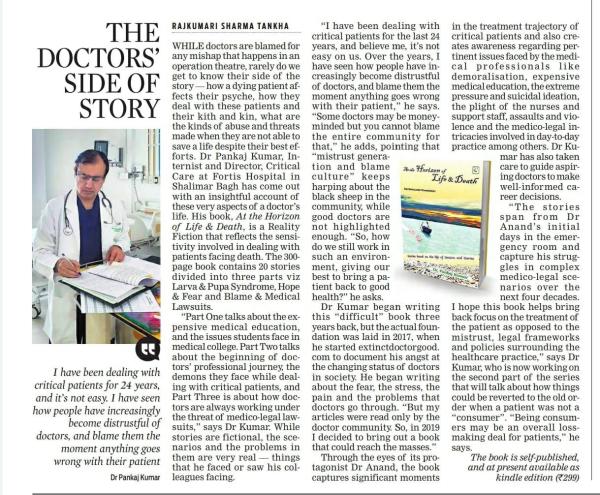
The 300-page book contains 20 stories divided into three parts viz – Larva & Pupa Syndrome, Hope & Fear & Medical Lawsuits. The book is available worldwide on Kindle Amazon, Apple, Barnes & Noble, Tolino, Kobo, Scibd, BorrowBox, Baker & Taylor , Vivilo, Overdrive etc.
While doctors are usually blamed for any mishap, be it natural poor prognosis or genuine complications, rarely people get to know their side of the story — how a dying patient affects their psyche, how they deal with these patients and their kith and kin, what are the kinds of abuse and threats made when they are not able to save a life despite their best efforts. Dr Pankaj Kumar, Director Critical Care at a Delhi Hospital, India has come out with an insightful account of these very aspects of a doctor’s life.
His book ‘At the Horizon of Life & Death’ is a Reality Fiction that reflects the sensitivity involved in dealing with patients facing death.
Through the eyes of its protagonist Dr Anand, the book captures significant moments in the treatment trajectory of critical patients. The book tries to create awareness regarding pertinent issues faced by the medical professionals like demoralisation, expensive medical education, the extreme pressure and suicidal ideation, the plight of the nurses and support staff, assaults and violence and the medico-legal intricacies involved in day-to-day practice among others. The author has also taken care to guide aspiring doctors to make well-informed career decisions.
Part One (Larva & Pupa Syndrome)- talks about the expensive medical education, and the issues students face in medical college.
Part Two (Hope & Fears) talks about the beginning of doctors’ professional journey, the disease demons they face while dealing with critical patients, dilemmas of doctors and patients near death situations.
Part Three (Medical Lawsuits) is about how doctors are always working under the threat of medico-legal lawsuits.
While stories are fictional, the scenarios and the problems in them are very real — things that he faced or saw his colleagues facing.
Medical profession has become victim of mistrust generation and blame culture. Everyone keeps harping about the few black sheep in the community, while larger good work of doctors is not highlighted enough.
The stories span from Dr Anand’s initial days in the emergency room and capture his struggles in complex medico-legal scenarios over the next four decades. This book is an effort to bring back focus on the treatment of the patient as opposed to the mistrust, legal frameworks and policies surrounding the healthcare practice.
The book is self-published, available worldwide on Kindle Amazon, Apple, Barnes & Noble, Tolino, Kobo, Scibd, BorrowBox, Baker & Taylor , Vivilo, Overdrive etc.
Medical consumer protection act was implemented in 1995. Patients defined as consumers and hence doctors converted to service providers in lieu of some money. Consequently the changed definitions altered the doctor-patient relationship in an irreversible way. Instead of the earlier congenial relationship, now-a day’s doctors and patients are fighting in courts, whereas most of aspects of the law still remain grey after 26 years of implementation. Here in this case even courts differ in the interpretation (among themselves) of the law after more than two decades of its implementation.
The doctors are supposed to treat, provide relief and save lives are the most affected, it is needless to say that the way of treating patients has been altered like never before. Medical lawsuits and complaints (right or wrong) are breaking medical professionals from within, not to mention the toll it takes on someone’s confidence and belief, which takes a lifetime to build.
The reality is that neither doctors, nor patients were ready for such a legal relationship, and the system was not robust enough for such a change. To work with weak infrastructure, non-uniform medical education along with legal threats pushed doctors into a shell and forced defensive practice. It caused erosion of doctor-patient relationship and escalated cost of care.
Medical business, insurance and legal industry made full use of the opportunity to have the benefits of changed doctor-patient relationship. Doctors were used as scapegoats for poor infrastructure by administrators and further exploited by law industry.
Justice eluded doctors at all stages.
It is discouraging for medical professionals to note that courts are still clarifying the law even after 26 years of its implementation. What is more disheartening that many more aspects about the medical-consumer protection act are either remain unclear and create difficulty for doctors. To differentiate medical mistakes, poor prognosis from negligence is a very fine line and difficult to judge. Therefore medical profession has become a subject to blackmail by patients, lawyers and sitting ducks for punishments. The consequent insecurity among doctors, practice of defensive medicine, enhanced costs, excessive documentation and the distraction from the primary point of intention (treatment) are few of the side effects, which will definitely be passed on to the patients inadvertently. After all doctors have to save themselves as well.
Consequently being consumer may be overall a loss making deal for the patients.
The point to ponder is that courts themselves differ on interpretation of law even after 26 years of its implementation.
The Supreme Court has reiterated that service rendered by medical officers on behalf of a Hospital, free of cost, would not fall within the ambit of medical consumer protection act.









 Evolution of Medical profession-Extinction of good doctors