Cough syrup tragedy. Responsible:  doctor-pharma-drug regulator?


A doctor has been arrested in Madhya Pradesh’s Chhindwara after a toxic batch of Coldrif cough syrup allegedly caused the deaths of 18 children across two states, exposing alarming lapses in drug quality control. Of the total deaths, 14 were reported from Chhindwara alone,    A special team from Kotwali police arrested Dr Soni from Rajpal Chowk in Chhindwara late Saturday night after the FIR was registered against him, the SP said.

      The doctor has been booked for negligence and prescribing the medicine even after its adverse effects on children for nearly a month. The manufacturer had been charged as it was supplying contaminated syrup, as per the test report, Pandey told PTI.

        Here doctor who prescribed was arrested, whereas who manufactured the cough syrup is primarily responsible.

 What is the role of ‘Drug regulator’ and ‘drug quality regulator’ in such cases?

Do they carry any accountability or responsibility?  

Strangely doctors are invariably the easy scape-goats.  It is time to treat pharmaceutical malaise. The rise in “falsified and substandard medicines” has become a “public health emergency.” A surge in counterfeit and poor-quality medicines means that thousands of patients a year are thought to die after receiving shoddy or outright fake drugs intended to treat ailments. Most of the deaths are in countries where a high demand for drugs combines with poor surveillance, quality control, and regulations to make it easy for criminal gangs and cartels to infiltrate the market.

   If deep investigations are not done in such cases, poor quality medicines will continue to be marketed and doctors would be held responsible for the adverse reactions and deaths. Strict regulations for quality of pharmaceutical agents are need of the hour.

    Usually, every problem related to health is called medical malaise, but that is a misnomer.  In fact, health care comprises tens of different industries.  Complex interplay of various industries like pharmaceutical, consumable industry and other businesses associated with health care remain invisible to patients. Various important components for example pharma industry, suppliers, biomedical, equipment, consumables remain largely unregulated. Collective malaise of all these is conveniently projected as medical problems as blame is conveniently passed on to doctors, as they are only visible component of mammoth health business.  Rest all remain invisible, earn money and doctors are blamed for the poor outcome of the patient, as doctor is the only universal link that is visible with patient. By an average application of wisdom, it is easier to blame doctors for everything that goes wrong with patient.

     In routine, if patient gets fake or low-quality medicines and does not get well, gets side effects, doctor will face harassment. Whereas people involved and industry will be sitting pretty and make money.

The government on Sunday also suspended Dr Soni from service. He has been attached to the health department regional officer in Jabalpur, as per an order.

MP Chief Minister Mohan Yadav on Saturday said strict action will be taken against those responsible.

The Tamil Nadu drug control authorities, in their report dated October 2, declared the Coldrif syrup sample (Batch No SR-13; Mfg: May 2025; Exp: April 2027) manufactured by Sresan Pharmaceuticals, Kancheepuram, as adulterated because it contained diethylene glycol (48.6% w/v), a poisonous substance “which may render the contents injurious to health”.

Following the report, the Madhya Pradesh Food and Drug Administration issued instructions to stop further sale and distribution of Coldrif statewide and immediately seize any available stock for investigation under the Drugs and Cosmetics Act, 1940. It also ordered that other products manufactured by Sresan Pharmaceuticals be removed from sale pending testing.

The Tamil Nadu government on Friday banned Coldrif following reports of deaths in Madhya Pradesh and at least three similar fatalities in Rajasthan due to suspected kidney infections.

  Advantages-Disadvantage of being a doctor

     25 factors- why health care is expensive

REEL Heroes Vs Real Heroes

 21 occupational risks to doctors and nurses

Covid paradox: salary cut for doctors other paid at home

   Medical-Consumer protection Act- Pros and Cons

Expensive Medical College  seat- Is it worth it?

NEET- Not so Neat- percentile system

The  Myth  of  cost of  spending  on  medical  education needs to be made  transparent.

Racial discrimination of animals: Dog vs monkeys. Finances?


          The paradox – ‘if they have such exuding love for stray dogs- why such love and compassion cannot be extended to other animals?’

                A very strange paradox exists, when the situation boils down to animal love. Very recently Supreme court passed a very desirable verdict about rehabilitation of street dogs.  Such an order is of great necessity to common man, when  children playing in streets are being mauled, attacked and bitten every day. Hundreds dying because of rabies and dog bites. The silent killer still remains the infective nature of dog faeces, which pollutes underground water, environment and air with pathogenic bacteria.

 Till now Courts have also upheld animal rights but failed to formulate and implement policies to ensure safety of humans from these violent strays. Government has not made out any policy to safeguard public from such attacknor have courts come up with any solid guidelines, which can save public, children, women and older people from such bites.

        After the court verdict, a hue and cry are raised by a breed of ‘Dog Lovers’. This section has not taken any responsibility for the inconvenience to public and death of children due to dog bites, but they have forced the court to review decision.  These are people who in reality are unaffected by stray animals because they are celebrities and often self-congratulate themselves for projecting themselves as animal lovers.

           Now the question about the paradox starts- ‘if they have such exuding love for stray dogs, why such love and compassion cannot be extended to other animals?’

     Billions of chicken are slaughtered every second.

     Billions of goats, cattle and lambs are killed mercilessly every minute.

     Everyday millions of pigs are killed, and various dish are prepared.

      Fish (not countable) are caught and usually gasps – very cruel for a while before being killed.

   Leather is collected from animal skin—very cruel

    Even monkeys are caught and relocated- no court has stopped it.

  It is difficult to understand this kind of differential love for stray dogs. If relocation of stray dogs is cruelty, then killing all other animals is bigger one because none of animals are actually doing any harm. They all are being held for financial reasons. 

  So clearly, we need to look at the financial implication and output of all these animals.

  Chicken  are killed and they make a big business.

 Goats, lamb, pigs and cattle again give good money when they are raised and killed for meat.

Stray dogs produce financial   output only when they bite.  Anti rabies serum is used and is expensive. It will be good to compare data of use of Anti Rabies Serum in India and other countries.  It can contribute to pharma-industry in some manner.

      Court can also have data on this issue, if they take the financial factor into consideration.

Basic question still remains the same-

  1. If it is animal love- why only stray dogs?  Why others are being slaughtered? Why this kind of racial discrimination is being done. Surely it is not animal love.
  2. What are financial benefits of having huge population of stary dogs in the community? The dogs which are mauling children, biting common people and hunt in packs in residential areas.

Hope court take a decision and keep other animals in mind while deciding on love for stray dogs.

SUGGESTION: the Government, NGOs and people who claim to be “animal lovers” should create shelters to save strays “as well as people”. It should be mandatory that all the dog and animal (stray or pet) droppings are properly collected and disposed of. This single step can do wonders as it will reduce infections, people’s suffering, save lives and eventually reduce use of antibiotics. A rationale mind will appreciate the danger due to strays and can initiate proper steps rather criticizing above said facts in the name of animal rights. An animal has no sense of responsibility, so rights should be limited accordingly.

Two siblings mauled by  stray dogs in Delhi; An urban jungle-where animals hunt humans – Evolution of Medical profession-Extinction of good doctors

4-year-old mauled to death by stray dogs in Amberpet

An urban jungle-where animals hunt humans

Dog Lover but not for human child

Differential justice- Evaluation & compensation of ‘hundreds of healthy deaths’ vs one hospital death #Odisha-train-accident 


Death is the inevitable conclusion of life, a universal destiny that all living creatures share.   Death can occur through conflict, accident, natural disaster, pandemic, violence, suicide, neglect, or disease.  But the evaluation and compensation of  ‘Death’ in this  new era  of consumerism has become a story of paradox. Compare the situation  when  someone is admitted in hospital for a serious ailment  to a healthy person who is travelling happily in train. It doesn’t require an Einstein’s brain to compare, who is more at risk for death.  Although death in both situation is sad but the differential  compensation formulas applied by courts and justice systems require a re-look in both the situations.    

     Accidents can happen  everywhere. It can be on roads, trains or in the air and more possible in the hospital, when doctors are trying to save a  critically sick patients. Chances are more in hospital as situation is akin to as doctors are trying to fly a defective aeroplane.

Medical accidents are usually interpreted as medical negligence. Ironically, for genuine mistakes or even a natural  poor outcome, an impression is created as if the doctors have killed a healthy person and is  assumed as a doctor’s fault. Not uncommonly  doctors become  punching bags  as a revenge in case of a hospitalized death. The death is more perceived as failure of medical treatment rather than an invincible power or a certain final event. But all these issues are variable and depend upon understanding level and wisdom of people. What is surprising is the non-uniformity of courts and justice systems in evaluating and compensation of death. For  hospital death alleged due to medical negligence – compensation formula is applied that is not used for other hundreds of healthy deaths.

Coromandel –Odisha- train accident

 An unfortunate incident   of train accident causing hundreds of untimely deaths happened yesterday.  In fact the burden of   negligence here (like a train accident- hundreds of deaths) in healthy deaths is massive and these deaths are unpardonable.

          It will be interesting to see how courts apply the formula for compensation in hundreds of healthy deaths due to negligence as is applied in cases of medical negligence when someone has poor outcome.

    That brings forth a fundamental question. Why compensation to death is not uniform? Why medical profession is  handed over a harsher punishment and pays a higher compensation (while trying to treat) for a death which is more natural and consequence to some  disease? Why for compensation in hundreds of healthy deaths that was completely unnatural – same formula is not applied?

        Such differential evaluation and compensation of death is not only illogical and unreasonable but a grave injustice to medical profession. Point to ponder- if trying to save someone’s life raises a risk of heavy compensations, why should doctors do it?

     Advantages-Disadvantage of being a doctor

     25 factors- why health care is expensive

REEL Heroes Vs Real Heroes

 21 occupational risks to doctors and nurses

Covid paradox: salary cut for doctors other paid at home

   Medical-Consumer protection Act- Pros and Cons

Expensive Medical College  seat- Is it worth it?

NEET- Not so Neat- percentile system

The  Myth  of  cost of  spending  on  medical  education needs to be made  transparent.

Exorbitantly expensive medical education and lowered merit

  Pearl harbour Anaesthesia Tragedy- Historical Significance


    Up to the end of World War II, less than 10% of the general anaesthetics administered were with intravenous barbiturates. The remaining 90% of anaesthetics given in the USA were with diethyl ether. In the United Kingdom and elsewhere, chloroform was also popular. Diethyl ether administration was a relatively safe and simple procedure, often delegated to nurses or junior doctors with little or no specific training in anaesthesia. During the Japanese attack on the US bases at Pearl Harbor, with reduced stocks of diethyl ether available, intravenous Sodium Pentothal(®), a most ‘sophisticated and complex’ drug, was used with devastating effects in many of those hypovolaemic, anaemic and septic patients. The hazards of spinal anaesthesia too were realised very quickly. These effects were compounded by the dearth of trained anaesthetists.  The anaesthesia tragedies at Pearl Harbor, and the discovery in the next few years of many other superior drugs that caused medical and other health professionals to realise that anaesthesia needed to be a specialist medical discipline in its own right. Specialist recognition, aided by the foundation of the National Health Service in the UK, the establishment of Faculties of Anaesthesia and appropriate training in pharmacology, physiology and other sciences soon followed. Modern anaesthesiology, as we understand it today, was born and a century or more of ether anaesthesia finally ceased.

It was estimated that the use of sodium thiopentone (Pentothal®) anaesthesia caused 1178 perioperative deaths in the hundreds of casualties who required emergency surgery in the 24 hours following the attack.

The  World War II  medical tragedies, especially those at Pearl Harbor, were a wake-up call for surgeons and the medical profession generally throughout the world. There was a realisation that it was no longer appropriate for any junior doctors or nurses to administer ‘sophisticated’ anaesthetic drugs for many types of surgeries and to critically ill patients. This had been known for many years in thoracic surgery and neurosurgery, but in the years after the war it was clear that appropriately trained anaesthetists were required, who had the knowledge and skills to use advanced drugs such as thiopentone and the new techniques and equipment which had rapidly developed in the 1940s.

The significance of the results of attempts of nurse and doctor anaesthetists to use thiopentone anaesthesia in military casualties who were hypovolaemic was very clear. Cardiovascular collapse and respiratory arrest with a lack of oxygen supplies, resuscitative skills and knowledge of thiopentone’s pharmacology and dosage, along with the insufficient numbers of skilled anaesthetists, clearly resulted in many tragedies. Some spinal anaesthetics also contributed to the perioperative mortality. So it was not too long during that fateful day in 1941 before surgeons and others reverted to using ‘drip ether’ as the principal anaesthetic technique and restricted the use of the available local anaesthetics, procaine and tetracaine, to infiltration only—mainly in burns patients. Exactly how many anaesthetic deaths resulted from intravenous thiopentone and hexobarbital will probably never be known as there were no defined classifications of such deaths as we have today.

In summary, the greatest significance of the anaesthetic events at Pearl Harbor, and more broadly throughout World War II, was that the surgeons, the medical profession generally  and health authorities recognised the need for appropriately trained and skilled specialist practitioners of anaesthesia. Modern anaesthesia, or anaesthesiology as I believe we should refer to it, was born soon after Pearl Harbor and World War II, and the ‘ether century’ began to expire, although ether continued to be used into the 1970s for many simpler surgeries in less developed centres.

     Advantages-Disadvantage of being a doctor

     25 factors- why health care is expensive

REEL Heroes Vs Real Heroes

 21 occupational risks to doctors and nurses

Covid paradox: salary cut for doctors other paid at home

   Medical-Consumer protection Act- Pros and Cons

Expensive Medical College  seat- Is it worth it?

NEET- Not so Neat- percentile system

The  Myth  of  cost of  spending  on  medical  education needs to be made  transparent.

Exorbitantly expensive medical education and lowered merit

Two siblings mauled by  stray dogs in Delhi; An urban jungle-where animals hunt humans


In an  horrifying and frightening  incident,  mauled and   hunted  two siblings, aged 7 & 5, killed in stray dog attack in Delhi’s Vasant Kunj

NEW DELHI: Two siblings, aged seven and five, were killed allegedly in stray dog attack in two separate incidents in the Vasant Kunj area of Delhi. The police said that the 7-year-old boy went missing on March 10 and his body was recovered later with animal bite like injuries.

They  needed some shield to protect himself which society, government, courts and so called “dog-lovers” failed to provide. 

4-year-old mauled to death by stray dogs in Amberpet

An urban jungle-where animals hunt humans

Dog Lover but not for human child

        Courts have also upheld animal rights but failed to formulate and implement policies to ensure safety of humans from these violent strays. Government has not made out any policy to safeguard public from such attacknor have courts come up with any solid guidelines, which can save public, children, women and older people from such bites.

 Danger of stray dogs is increasing every day around us. As the strays population in increasing, now they are grouped and see vulnerable humans as easy prey. Packs of dogs have become dangerous and difficult to control. Protected by Dog lovers and animal right laws, the danger to normal people of being hunted even around their homes is real. Human right of being in a safe environment is being ignored. Is it not hypocritical that you care for a violent stray that is a threat to the society? Problem is not about loving and feeding dogs, but simultaneous apathy towards safety of humans. Such dog lovers most of the time, totally ignore the fact that these dogs are a threat to children and older people. An immediate sense of hatred towards such dog lovers is a consequence and a natural thought.

Animal lovers while pretending of “dog love” have formed NGOs and have donations and accumulate money. But have failed to create shelters for stray dogs. Neither have any steps been taken to save people from dog bites. So consequently, people especially vulnerable are children and older people who are mauled and eaten alive by stray dogs. What responsibility and accountability these animal lovers and NGO bear towards such incidents? Why people who collect money in name of animals do not take care and form shelters for these strays? every single death from such preventable cause raise a question on this issue.

Apathy of these so called dog lovers towards humans is appalling.

SUGGESTION: the Government, NGOs and people who claim to be “animal lovers” should create shelters to save strays “as well as people”. It should be mandatory that all the dog and animal (stray or pet) droppings are properly collected and disposed off. This single step can do wonders as it will reduce infections, people’s suffering, save lives and eventually reduce use of antibiotics. A rationale mind will definitely appreciate the danger due to strays, and can initiate proper steps rather criticizing above said facts in the name of animal rights. An animal has no sense of responsibility, so rights should be limited accordingly.

     Advantages-Disadvantage of being a doctor

     25 factors- why health care is expensive

REEL Heroes Vs Real Heroes

 21 occupational risks to doctors and nurses

Covid paradox: salary cut for doctors other paid at home

   Medical-Consumer protection Act- Pros and Cons

Expensive Medical College  seat- Is it worth it?

NEET- Not so Neat- percentile system

The  Myth  of  cost of  spending  on  medical  education needs to be made  transparent.

Exorbitantly expensive medical education and lowered merit

End of Life issues-  ‘Hold on’ or ‘Let go’ #Tom-Sizemore


A difficult decision near death- try to ‘hold on’ or ‘let go’

The eternal human wish is to fight hard against age, illness, and death and holding on to life, to our loved ones, is indeed a basic human instinct. However, as an illness advances, “raging against the dying of the light” often begins to cause undue suffering, and “letting go” may instead feel like the next stage.

Tom Sizemore has no hope of recovery after he suffered a brain aneurysm, his family has said, confirming they are making an end-of-life decision for the Saving Private Ryan actor. The 61-year-old has been in a coma in the intensive care unit of Providence Saint Joseph Medical Center in Los Angeles since he was hospitalised on 18 February. On Monday night, Sizemore’s representative, Charles Lago, issued a statement revealing that there was no chance for his recovery. “Today doctors informed his family that there is no further hope and have recommended end of life decision. The family is now deciding end of life matters and a further statement will be issued on Wednesday,” Lago said.

      Humans have an instinctive desire to go on living. We experience this as desires for food, activity, learning, etc. We feel attachments to loved ones, such as family members and friends, and even to pets, and we do not want to leave them.

     When we realize that the end of life may be approaching, other thoughts and feelings arise. Fears arise, and may be so strong that they are hard to think about or even admit to: fear of change, of the dying process, of what happens after death, of losing control, of dependency and more. Both the person who is ill and the caregiver might also experience resentment, guilt, sadness, and anger at having to do what neither wants to do, namely face death and dying.

As death nears, many people feel a lessening of their desire to live longer. This is different from depression or thoughts of suicide. Instead, they sense it is time to let go.  They may reach a point where they feel they have struggled as much as they have been called upon to do and will struggle no more. Refusing to let go can prolong dying, but it cannot prevent it. Dying, thus prolonged, can become more a time of suffering than of living.

Family members and friends who love the dying person may learn to accept a life limiting illness, and then accept the possibility of a loved one dying. They may see that dying is the better of two choices and  accept the inevitability of death.

The dying may be cause distress and  grief for those who love them. If a stage  has reached when treatments are no longer working as well as before, and everyday life maintaining activities are becoming more and more burdensome. In a sense, life is disappearing. One has to look beyond the fears and wishes.  What is really best for the one who is dying, and for the others around? Given that death is unavoidable, what is the kindest thing to do? It might be holding on or it might be letting go.

Advantages-Disadvantage of being a doctor

     25 factors- why health care is expensive

REEL Heroes Vs Real Heroes

 21 occupational risks to doctors and nurses

Covid paradox: salary cut for doctors other paid at home

   Medical-Consumer protection Act- Pros and Cons

Expensive Medical College  seat- Is it worth it?

NEET- Not so Neat- percentile system

The  Myth  of  cost of  spending  on  medical  education needs to be made  transparent.

Protection to Dogs but not to Human Child- Shameful Scenario


A horrifying and frightening video was recorded in Hyderabad, where a four year child was seen running and screaming for his life. 4-5 stray dogs were near him, mauled and   hunted him as a prey. He needed some shield to protect himself which society, government, courts and so called “dog-lovers” failed to provide. 

4-year-old mauled to death by stray dogs in Amberpet

HYDERABAD: In yet another gruesome incident of its kind in Hyderabad, a four-year-old boy was mauled and killed by stray dogs in Amberpet area. Although the attack happened on Sunday, it came to light on Tuesday after CCTV footage of the dogs surrounding the boy and not letting him escape went viral. In the past year alone, the government-run fever hospital in the city has seen at least four cases of people dying after contracting rabies from dog bites. Toddlers have been killed by strays in various parts of the state. According to data submitted in Parliament, Telangana reported about 80,000 cases of dog bite last year. Greater Hyderabad Municipal Corporation (GHMC) officials said the victim, Pradeep, accompanied his father K Gangadhar, a security guard at a car service centre, to his workplace on Sunday. The dogs attacked the boy while he was playing by himself. The 1:07-minute CCTV footage shows the child walking alone in the parking area of the service centre and three dogs rushing towards him. The boy, surrounded by the aggressive canines, looked scared and tried to run away. Soon, a dog pounced on him from the rear, resulting in him falling to the ground. The child gathered himself, got up on his feet and tried to escape, but the dogs attacked him again. Within seconds, all three canines began mauling him. The dogs tried to pull him away in different directions even as three other sub-adult dogs tried to join them. CCTV footage shows that the boy tried to fend off the attack, but gave up after being surrounded by the strays. A few seconds later, as the boy lay limp, the dogs tried dragging him away. Gangadhar, along with other staff members, rushed in and chased away the dogs. They rushed the boy to a hospital, but he succumbed to his injuries on the way and doctors pronounced him dead on arrival. Officials said the boy was carrying food in one hand, which might have attracted the dogs.

An urban jungle-where animals hunt humans

Dog Lover but not for human child

        Courts have also upheld animal rights but failed to formulate and implement policies to ensure safety of humans from these violent strays. Government has not made out any policy to safeguard public from such attacknor have courts come up with any solid guidelines, which can save public, children, women and older people from such bites.

     Danger of stray dogs is increasing every day around us. As the strays population in increasing, now they are grouped and see vulnerable humans as easy prey. Packs of dogs have become dangerous and difficult to control. Protected by Dog lovers and animal right laws, the danger to normal people of being hunted even around their homes is real. Human right of being in a safe environment is being ignored. Is it not hypocritical that you care for a violent stray that is a threat to the society? Problem is not about loving and feeding dogs, but simultaneous apathy towards safety of humans. Such dog lovers most of the time, totally ignore the fact that these dogs are a threat to children and older people. An immediate sense of hatred towards such dog lovers is a consequence and a natural thought.

Animal lovers while pretending of “dog love” have formed NGOs and have donations and accumulate money. But have failed to create shelters for stray dogs. Neither have any steps been taken to save people from dog bites. So consequently, people especially vulnerable are children and older people who are mauled and eaten alive by stray dogs. What responsibility and accountability these animal lovers and NGO bear towards such incidents? Why people who collect money in name of animals do not take care and form shelters for these strays? every single death from such preventable cause raise a question on this issue.

Apathy of these so called dog lovers towards humans is appalling.

SUGGESTION: the Government, NGOs and people who claim to be “animal lovers” should create shelters to save strays “as well as people”. It should be mandatory that all the dog and animal (stray or pet) droppings are properly collected and disposed off. This single step can do wonders as it will reduce infections, people’s suffering, save lives and eventually reduce use of antibiotics. A rationale mind will definitely appreciate the danger due to strays, and can initiate proper steps rather criticizing above said facts in the name of animal rights. An animal has no sense of responsibility, so rights should be limited accordingly.

     Advantages-Disadvantage of being a doctor

     25 factors- why health care is expensive

REEL Heroes Vs Real Heroes

 21 occupational risks to doctors and nurses

Covid paradox: salary cut for doctors other paid at home

   Medical-Consumer protection Act- Pros and Cons

Expensive Medical College  seat- Is it worth it?

NEET- Not so Neat- percentile system

The  Myth  of  cost of  spending  on  medical  education needs to be made  transparent.

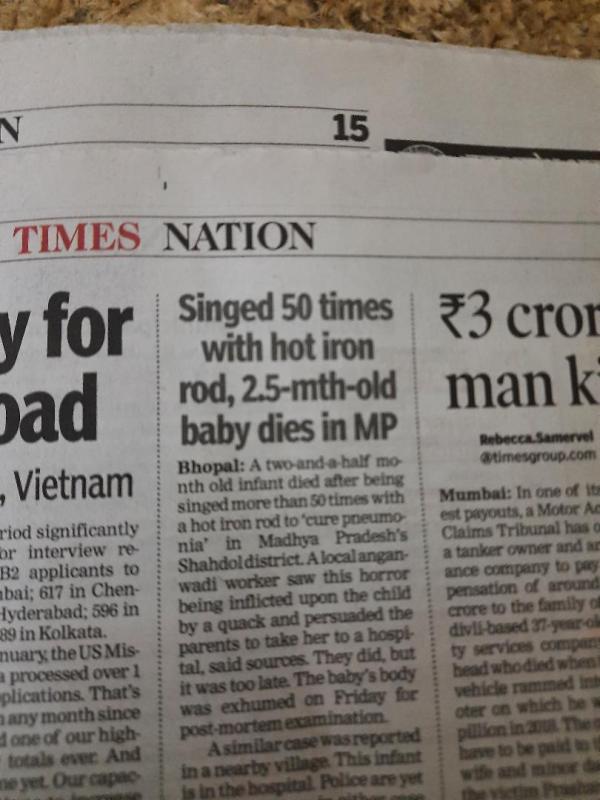
Singed with hot rod to ‘cure pneumonia’- the child dies: Illogical distribution of health care


         In a heart wrenching and unfortunate incident from Bhopal (Madhya Pradesh), a 2.5 month child was singed with hot iron 50 times by a quack for treatment of pneumonia.  He died and   the incident appeared in newspapers, but similar kind of  treatments must be going on at many places and  gullible patients keep on suffering .The suffering is of two types; one, that they are deprived of correct treatment and other is the tremendous suffering because of such nature of cruel practices in the garb of  treatment.    

         That brings to the fore the basic question; why such type of treatments are being practiced and allowed to be conducted in 21th century. Why people allow  and consent for such treatments by quacks?

     These incidents simply reflect that the health system has not been able to travel  the last mile and  has failed to  touch the last man.

         Most important reason for such disparity is illogical distribution of health care.  Corporatization of health care has projected medicine as a purchasable commodity and consequently resulted in an Illogical distribution of health care

 People, who can afford, spend millions in the last few days of their life, just to have only a few more days to live. Resources spent in such a futile quest are equivalent to  thousands of times the money for food and medicines for the poor who lose lives for fraction of that expense.

It seems humanity has legalized the hoarding of medical care; give it to the rich, bundled with consumerism though not necessarily the needy. It is the same as hoarding of the food that is sold to rich, letting the poor die somewhere in the world without food, which remains invisible to all.

          Another worrisome aspect of the incident is  that  avoidance of people to  seek treatment from appropriate  clinics and hospitals. Anganwadi worker was there in the village, so it was possible  to seek help from the health system. Is the mistrust and malice  generated  by media towards  doctors and  medical professionals is the reason to  avoid seeking help from them?

BHOPAL: A newborn has died after being singed more than 50 times with a red hot iron rod in a bizarre ritual to ‘cure pneumonia’ in MP’s Shahdol district. A local anganwadi worker saw this horror being inflicted upon the child by a quack and persuaded the parents to take her to a hospital, say sources. They did, but it was too late. The baby’s body was exhumed on Friday evening for post-mortem examination. Even as police were grappling with this horror, a similar case was reported in a nearby village. This infant is in hospital. Police are yet to arrest anyone in either case and it’s not yet known if the same quack, a woman, was behind singeing both babies. The Child Welfare Committee has written to police to take action under section 75 of Juvenile Justice Act, but nothing has been done. When TOI spoke with Singhpur police, they said they were taking legal opinion on how to proceed with the case. An officer said they are waiting for the autopsy report to see what charges can be pressed. The baby who died was two and a half months old and suffering from pneumonia. Her parents live in Kathotiya village, around 520km from Bhopal and close to Chhattisgarh. “The infant was ‘torched’ as a method of ‘treatment’ on January 10.” Singhpur police station in charge, MP Ahirwar told TOI. The second incident happened in Samtapur villagee. The baby’s parents deny they put the girl through the burning ritual.

     Advantages-Disadvantage of being a doctor

     25 factors- why health care is expensive

REEL Heroes Vs Real Heroes

 21 occupational risks to doctors and nurses

Covid paradox: salary cut for doctors other paid at home

   Medical-Consumer protection Act- Pros and Cons

Expensive Medical College  seat- Is it worth it?

NEET- Not so Neat- percentile system

The  Myth  of  cost of  spending  on  medical  education needs to be made  transparent.

Supreme Court simplifies  rules on passive euthanasia& Living Will


NEW DELHI: The Supreme Court on Tuesday modified its 2018 order on passive euthanasia to make the procedure of removal of (or withholding) life support from terminally ill patients less cumbersome for the patients, their families and the doctors by limiting the role played by government officials. While the requirement of setting up two medical boards — one primary and other review — to examine the medical condition of the patient has been retained, the SC has done away with the rule mandating that the district collector set up the review board. The court said both boards will be constituted by the hospital and there would be one nominee doctor of the district medical officer in the review board. The medical boards must take a decision on such cases preferably within 48 hours, it added.

While the current rules state that the consent of the judicial magistrate is required for conducting passive euthanasia, the new order by a five-judge bench of justices K M Joseph, Ajay Rastogi, Aniruddha Bose, Hrishikesh Roy and C T Ravikumar says the magistrate just needs to be informed. While making the procedure for passive euthanasia less cumbersome, the Supreme Court on Tuesday also simplified the process of making a “living will”, an advance directive by a person wishing not to be put on artificial life support. While the earlier rule stipulated that a living will had to be made in the presence of two attesting witnesses and countersigned by the jurisdictional JMFC, the new order says such a will can be attested by notary or a gazetted rank officer. The process prescribed in2018 was onerous as it not only involved family members and doctors but also a judicial magistrate and collector as well as setting up of two medical boards before removal of life support systems and there was no prescribed time period for medical boards to give their opinion. As per 2018 guidelines, in the event a person became terminally ill with no hope of recovery, the treating physician had to ascertain the authenticity of the case from the JMFC. If the physician was satisfied, the hospital then constituted a medical board consisting of the head of the treating department and at least three expert doctors with 20 years of experience.

If the medical board certified that life support system could be removed, the hospital had to inform the collector who then had to constitute another medical board comprising the chief district medical officer and three expert doctors. If the review board allowed withdrawal of treatment, it had to convey the decision to the JMFC. The JMFC then had to visit the patient and, after examining all aspects, decide on whether the euthanasia directive could be implemented. Modifying the order, the bench said that medical practitioners with five year of experience can be part of the medical board. The court also agreed with the petition that there was no need to involve JMFC in the process of preparation of the living will. Times View: The new guidelines have been issued because the earlier guidelines were proving to be unworkable. It is good that the apex court has taken a relook on the subject. It is entirely possible that even these new guidelines may need to be revised in future. But the principle must be about making things easier for consent-givers without increasing the risk of misuse.

     Advantages-Disadvantage of being a doctor

     25 factors- why health care is expensive

REEL Heroes Vs Real Heroes

 21 occupational risks to doctors and nurses

Covid paradox: salary cut for doctors other paid at home

   Medical-Consumer protection Act- Pros and Cons

Expensive Medical College  seat- Is it worth it?

NEET- Not so Neat- percentile system

The  Myth  of  cost of  spending  on  medical  education needs to be made  transparent.

 Supreme Court agrees to make Passive Euthanasia & Living Will rules workable


SC to tweak 2018 verdict to make passive euthanasia rules workable

NEW DELHI: The Supreme Court on Tuesday decided to “tweak” its 2018 verdict on passive euthanasia to make the procedure and guidelines fixed by it workable, and said that it may fix a time frame within which medical boards would have to submit reports to remove life-support systems from a terminally ill patient. Admitting that the procedure prescribed by the apex court in 2018 was very onerous and time consuming, a five-judge constitution bench of Justices K M Joseph, Ajay Rastogi, Aniruddha Bose, Hrishikesh Roy and C T Ravikumar sought suggestions from the Centre and senior advocates Arvind Datar and Prashant Bhushan to make it workable without compromising with the safeguards put in place by the court four years ago while legalising passive euthanasia. The process prescribed in 2018 not only involves family members and doctors but also judicial magistrates and collectors. Besides, two medical boards need to be constituted before life-support system can be withdrawn. The verdict said the living will, or advance directive for not putting a person on artificial life-support system, has to be made in the presence of two attesting witnesses and countersigned by the jurisdictional judicial magistrate of first class (JMFC). In the event of a person becoming terminally ill, the treating physician shall ascertain the living will’s authenticity from the JMFC. If the physician is satisfied, the hospital shall then set up a medical board consisting of the head of the treating department and at least three expert doctors. If the medical board recommends removal of life support, the hospital shall inform the collector, who shall then constitute another medical board comprising the chief district medical officer and three expert doctors. If the board allows withdrawing treatment, it shall convey the decision to the JMFC before allowing life support to be withdrawn. JMFC shall visit the patient and, after examining all aspects, may permit implementation of the directive.

      Seeking modification in the procedure, lawyers contended that time was crucial for terminally ill patients and the whole purpose of passive euthanisa was defeated due to the time taken by the process. That was the reason why there has not been a single case of passive euthanasia in the last four years despite it being legalised, they added.

Agreeing with their contention, the bench observed that dying in peace was dying with dignity, and suffering of a patient should not be prolonged due to the lengthy process. It said that the court could set a time limit for completion of the two-tier procedure without delay and also consider that a living be prepared like normal will without the mandatory presence of a judicial officer. The bench sought response from the Centre on whether it intended to frame a law for its regulation as the court had said in 2018. Paving the way for passive euthanasia, the apex court had in 2018 said, “It has to be stated without any trace of doubt that the right to live with dignity also includes the smoothening of the process of dying in case of a terminally ill patient or a person in PVS (persistent vegetative state) with no hope of recovery. A failure to legally recognise advance medical directives may amount to non-facilitation of the right to smoothen the dying process and the right to live with dignity.”

Supreme Court agrees to not involve judicial officers, collectors in ‘living will’ process

NEW DELHI: Amidst divergent opinions evading consensus on various points to make 2018 verdict on passive euthanisa workable on ground, the Supreme Court on Wednesday agreed in principle to keep judicial officer and district collector out of the process for making living will and setting up of medical board for removing life support system for terminally ill patients. Facing the onerous task to tweak 2018 verdict without modifying it and to continue with the safeguard put in place four years back, Justices KM Joseph, Ajay Rastogi Aniruddha Bose, Hrishikesh Roy and Justice CT Ravikumar are exploring ways to build consensus among parties, including the Centre, to make the process of making and executing living will or advance directive practical and less cumbersome for the patient. As the petitioner, represented by advocate Arvind Datar and additional solicitor general KM Nataraj, agreed that there was no need to involve judicial magistrate of first class (JMFC) in the process of preparation of will, the bench agreed that the living will can be attested by notary or a gazetted rank officer. As per 2018 verdict, the living will or advance directive, for not putting on artificial life support system, has to be made in the presence of  two attesting witnesses and countersigned by the jurisdictional JMFC. The court also in principle agreed that collectors be kept out of the process and will take a call on who should be entrusted with the task to constitute secondary medical board.

Advantages-Disadvantage of being a doctor

     25 factors- why health care is expensive

REEL Heroes Vs Real Heroes

 21 occupational risks to doctors and nurses

Covid paradox: salary cut for doctors other paid at home

   Medical-Consumer protection Act- Pros and Cons

Expensive Medical College  seat- Is it worth it?

NEET- Not so Neat- percentile system

The  Myth  of  cost of  spending  on  medical  education needs to be made  transparent.
Blog at WordPress.com.

Up ↑