Story of Unlabeled drugs and Fraud In name of Ayurvedic treatment


         A myth, that any plant extracted drug is useful, free of side effects, is a belief ingrained deep in the minds of people. Such unscrupulous advice is followed blindly without even verifying the authenticity of the source. A hope of miracle is flashed to patients who have been given a “no hope” by scientific medicine, are an easy prey for such fraudsters.

   Another major problem is that medicines and syrups distributed in such manner are without name of drug, contents and doses. It is not uncommon to get lethal substances like steroids, hormones and heavy metals in dangerous doses.  

     Ayurvedic medicines and practitioners  belong to a  stream, also based on a  science. The medicines and treatment has to be  controlled and regulated in the same way, as for allopathic  stream.  So that criminals, who are not trained in ayurvedic stream can not play with lives of gullible people, giving them false hope.  Such acts  are  real crime to society, done with an intention to cheat rather than treating them.

   Any one distributing medicines or medical advice of any kind, has to be registered with a council, for those particular medicines. advertisement of such drugs or products should be on some scientific basis.

Regulating Ayurvedic medicines and practice will help  not only the genuine  Ayurvedic  doctors but also go a long way  in benefiting the ancient system of medicine and promote research.  

  Following may be just one of the cases, millions may remain unnoticed.

False ayurveda hopes to the hopeless

Tarun Mandal has spent almost all of his savings trying to get his son, suffering from acute jaundice since his birth, treated for the past one and a half years. A desperate Mandal recently paid a youth Rs 65,000 for an ayurvedic cure. However, his wife’s suspicion about the ‘gold ash’ tasting like churan led cops to an inter-state racket cheating terminally ill patients with a promise of cure. Mandal, who sells food items on a cart at the Sarojini Nagar market, was not the only one to fall in the trap. Cops have found at least 40 people who had been duped by the gang. Most of the victims are family members of children from different states getting treated in the capital’s top government hospitals.
“I gave away all my savings to them. They even guaranteed that all my money would be returned if the medicines failed. But when I went back to the same shop, they refused to recognise me,” said Mandal, who has already spent Rs 2 lakh and needs more money for a surgery.
The gang has also duped the grandfather of a seven-year-old thalessemia patient from Uttarakhand.

other incident dangerous chemicals in alternate medicines

The Story of Faulty Johnson & Johnson (J&J) Hip Implant


Govt to track patients with faulty J&J hip implant to ensure compensation

Close to 4,700 people with damaged hip joints in India received the implant before 2010, when it was recalled, of which only 1,080 were tracked and compensated.

   The Union health ministry will establish committees at the Central and state levels to track and compensate patients who received a faulty artificial hip implant that was recalled worldwide by the manufacturer Johnson & Johnson (J&J), in 2010.

Close to 4,700 people with damaged hip joints in India received the implant before 2010, when it was recalled, of which only 1,080 were tracked and compensated. Of them, 275 underwent revision surgeries.

Following complaints from patients, the health ministry set up an 11-member committee on February 7, 2017, to investigate patient complaints of adverse events against J&J’s metal-on-metal Articular Surface Replacement (ASR) hip implant devices — XL Acetabular Hip System and Hip Resurfacing System.

The committee  submitted its report on February 19, 2018. It said specialists must assess cases individually for treatment and compensation of at least Rs 20 lakh.

In November last year, the federal jury in Dallas had ordered J&J and its DePuy Orthopaedics unit to pay $247 million to six patients for not warning patients about the potential risks of the defective design of the metal-on-metal hip implants .

The committee at the state level will be tracking the affected patients. These cases are old and hospitals don’t have data available on them; close to 100 hospitals were approached but there was no data. State governments will be widely advertising the move to see that affected people approach them,” said a senior official, requesting anonymity.

Each case will be physically and clinically assessed by the state government committee to determine the degree of disability and refer to the central government committee to decide on the compensation amount.

In it response J&J said: “DePuy has fully cooperated with the expert committee in their investigation of the ASR matter. However, the Expert Committee Report has not been provided to the company for review to date, so it would be inappropriate for us to comment on it. We would like to reiterate that we have furnished full facts and data available with us to the expert committee.”

Metal on metal implants are rarely used now, say orthopaedic surgeons. “Metal-on-metal hip implants have been largely discontinued because of the associated complications. With other implants, the revision surgery rate would be around 3-5%, but with this particular brand, it was a higher 10-12 percent.

People complain of pain, which is largely due to loosening of the implant and wear and tear of the metal that would cause collection of metal in the body that it would react to. Another  available implant is ceramic cross-linked with plastic polyethylene socket, where head ball is of ceramic and socket of polyethylene.

After years of testing, ASR was imported and marketed in India and in various countries around the world, with all regulatory approval and permissions as were then applicable. After it was on the market, DePuy continued studying and closely watching how the device was performing and in August 2010.  DePuy issued a voluntary recall of the ASR Hip System after receiving new information from the UK National Joint Registry.

It immediately informed the Drugs Controller General of India (DCGI) about the voluntary recall. Since then, we have kept the DCGI informed of all key actions and worked to provide Indian patients and surgeons with the information and support they need, in line with government requirements.”

Expensive medical education ? Future may be “free medical education”: NYU offers free education for all its medical students


     At a time when students, parents and even doctors are uncertain whether opting for medical college along with the vulnerability and risk associated with   becoming a doctor is worth it or not, some are naive enough to pay millions as fee for medical education and for securing a seat of MBBS.

Truth  cannot remain hidden for long.  It has  to be realized that getting into medical college is a minuscule component of the process of becoming a good doctor.  Once they opt for this profession, the real tough and prolonged battle begins. Quite a few successful candidates may eventually feel that the money spent and the hard work may not be worth it, especially those who may have invested in heavy fees and in debt.

Although the whole effort and huge expenditure to become doctors in this way may be really worthless in today’s scenario, considering the difficult times and vulnerability of medical profession

Paying the irrational fee of medical colleges may be an unwise idea for the candidates, who are not from strong financial backgrounds. But at the same time unfortunately, it may be a compulsion and entrapment for students, who have entered the profession and there is no way forward or fail to get residency.

The New York University School of Medicine will provide free tuition for all present and future students, the university announced.

Citing the risk of “overwhelming” debt, it says every student will qualify regardless of merit or financial need.  NYU said financial worries were driving graduates to more lucrative specialities, pushing doctors away from more general positions. The scholarship covers annual tuition costs of up to $55,000 (£43,000). A study produced by the Association of American Medical Colleges estimated that in 2017 75% of medical students graduated in debt. The university has reportedly been working for more than a decade to accrue the necessary funds to pay for tuition, and hopes to raise a total of $600 million (£472m) to make the scholarships available permanently. NYU School of Medicine made the surprise announcement at its annual White Coat Ceremony on Thursday – when new students receive a white lab coat as they begin their studies. In their statement, the university said debt is “fundamentally reshaping the medical profession in ways that are adversely affecting healthcare”.Graduates move towards higher-paying areas of medicine over paediatrics, primary care or gynaecology due to their “staggering student loans”. Aspiring physicians and surgeons should not be prevented from pursuing a career in medicine because of the prospect of overwhelming financial debt”. Robert Grossman, dean of the medical school and chief executive officer of NYU Langone Health, said: “This decision recognises a moral imperative that must be addressed, as institutions place an increasing debt burden on young people who aspire to become physicians.”To date, only a handful of institutions have tried to make medical education tuition-free, according to Julie Fresne, senior director of student financial services of the Association of American Medical Colleges, a nonprofit organisation that represents medical schools. At UCLA’s David Geffen School of Medicine, a $100m (£79m) fund announced several years ago pays for the entire cost of medical school for all four years, including tuition, fees, books and living expenses for about 20 per cent of its students. But that program is based on merit, not need.

Meanwhile, a small medical school affiliated with Case Western Reserve University at the Cleveland Clinic covers the tuition and fees for its five-year programme focusing on research. Most of the roughly 20,000 students per year enrolled in US medical schools take out sizeable federal loans to support their studies. According to the Association of American Medical Colleges, in 2017, the median debt for graduating medical students was $192,000 (£151,000).The median cost of medical school attendance, including living expenses, was $60,945 (£47,906) a year for public medical school and $82,278 (£64,675) for private medical school.

This may be a indicator of the future days to come, the need for medical education   to be cheap or made free,  to encourage young generation to become doctors. Society has the choice to encourage and nurture good doctor for itself or discourage them by financial exploitation and subjecting them to debt trap. NYU has wisely decided on its choice.


Medical lawsuits, revenge & punishments to doctors : reminiscent of realms of ancient Hammurabi medical regulation


With the evolution of medical science and medical care intertwined with  medical business, braided changes in  medical  regulation is not an far off expectation. But reticulation of evolution to modern medicine  and health care has not happened  in  isolation. Simultaneously there has been  progressively complex emerging trends in medical business and changing patterns of health investments along with an era of corporate investments in health care  has also ushered.  Every one now wishes  to live longer  and  dreams of better quality of life with support of progressive medical care.  Opportunities projected by advancements in health care, have shown that these dreams can be a real possibility, in many cases. That kind of perception has given patients a hope in lieu of some money. With rich people willing to spend more, the insurance sector and investors putting money into health care, which was unthinkable few decades back in the  past.  This reticulation of business and  health care allowed health care to be controlled  in some way by administrators and investors. Away from the health providers, who actually treated the patients.

As it is no more simply treating a disease and involves many more issues.  New model of  medical regulation and business in  health care is  still  not a mature process. It has emerged and progressed in  just  for few decades, as compared to  medical treatments and systems that existed since ancient times. It is still in infancy and still has to go a  long way to do real justice to every one.   No one really knows how to regulate this difficult area,  which encompasses life and death, deals with extremes of poverty and riches, mortality and morbidity, pain and  relief , sadness and happiness, smiles and sorrows and uncountable emotions, intertwines with financial aspects. Most difficult part is  amalgamation of  intricacies of science with minds of  patient and doctor’s skill in  newly evolved milieu of financial complexities.  Results are not encouraging for the medical profession.

 An effort to govern or  regulate the medical profession  is not new. Hammurabi  had initiated to  write the rules of the game. This single professional species was managed with cruel regulation around 5000 years ago, that initiated a change in the global perception and regulatory system in radical and unprecedented ways.

Hammurabi  5000 years ago,  was  not even at the   doorstep of medical science, but he  promulgated some rules. It is difficult to say whether he was naive or  brilliant  enough to make it more mathematical. He fixed  heavy prize for saving lives and used to  cut the hands of physicians for death or untoward incident. But he was still wise enough to pay heavily if life was saved.   After thousands of years, with some scientific advancements, our regulation has remained more or less similar in basics. It is still based on principles of revenge and punishments. Now clearly  knowing well the limitation of medical science and the uncertainties and complexities of human body in better way, it still  remains  somewhat  unfair to doctors.  In other words, it has not attained enough  evolution and maturity.

  Hammurabi at the start of civilization believed that doctors needed to be punished in case there was poor prognosis. He failed to understand the complexity of human body and the limitations of medical  science, most of which was unknown at that time. By an application of average wisdom, doctor can be easily blamed for poor outcome, because he is always a common link between treatment and poor prognosis. Stricter punishments were imposed to  regulate medical profession, even  when the medical science was not even developed enough to deal with most of diseases.  Children are always taught in school that medical profession is a noble one. But they are never told, about the cruelty this profession has faced since ancient times.  Almost universally, the earlier work or contribution of  a doctor  to society is  not taken into account.  Even for complexities of medical science and uncertainties of the outcome, blame can  conveniently be  passed on doctors due to application of average wisdom.

    Hammurabi’s Codex specified the harshest form of deselection of health providers possible. If the physician erred through omission or commission, his fingers or hands were cut off, immediately stopping his practice. Therefore, a single mistake can undo all the good work of past or the future good work that could have been accomplished.

Problem here is that who can differentiate with certainty the real cause of sufferings of patient, a poor prognosis or a mistake.  Such harsh  regulatory systems will dissuade  other good people joining the profession, again  resulting in  further inhibition and flourishing of profession for the good.  Obviously,  harsher  penalties will discourage a physician surplus.

Today the global  system of medical regulation, is becoming somewhat  similar, to those ancient regulations in  terms of punishment and revenge. Differential payment system for health care also resembles the Code of Hammurabi in some respects. And this is despite the fact that now we are very well conversant with the known uncertainty and complexity of the human body and despite cognizance of the poor prognosis in many disease states.

Fear factors on doctors and impact of present legal complexities is already at par with that of Hammurabi’s era

“Doctor, why to risk yourself for petty gains?” Telephonic treatment is negligence: Bombay High Court


“Doctor, save the patient, but save yourself also”.

In medicine, any small or big disease or  procedure can have complications.  Frequently, dangerous complications have a subtle and insidious onset with very little symptoms. DVT and pulmonary thrombo- embolism is a known and life threatening complication associated with pregnancy.  This complication and the unfortunate  scenario that  happened  is not unknown and has a potential to recur. So doctors need to learn from such incidences to save themselves.

Since the overall scenario of medical complication and consumerism have undergone a sea change, doctors need to  be careful and change their approach to save from legal issues arising from these. They have to make sure that each small problem  has to be seen carefully in person, as it may harbour a serious threat.

Observing that prescribing medicines to patients without diagnosis amounted to culpable negligence, the Bombay High Court has turned down the anticipatory bail pleas of a doctor couple booked for the death of a woman patient. The doctors have been booked by the Ratnagiri Police under section 304 of Indian Penal Code (culpable homicide not amounting to murder) after the patient died earlier this year. According to the police, the woman was admitted to the accused couple’s hospital in Ratnagiri in February this year where she underwent caesarean operation and gave birth to a baby. The court order said the woman and the child were normal and were discharged two days later. The doctor spoke with the chemist who then gave some medicines to the relatives of the woman. However, even after taking the medicines, the woman did not feel better and was taken to the same hospital, it said. When the woman’s condition deteriorated the next day, the doctors at the hospital shifted her to another hospital, where she died, it said.

   Question arises, why  doctors commonly   need to prescribe by telephonic advice,  specially as in this case, if the doctor themselves were not available.  what made them  to enter into such a dangerous situation? Do  really there are substantial gains to risk so much and everything in life? The reasons:

  1. Most of the time, to retain the patient. As they already treated the patient, It is a natural tendency to  continue the treatment. Factors here are loyalty issues and loosing patient to other physicians.
  2. Sometimes patient request, to avoid coming to hospital or to avoid visiting unknown hospital or other doctors. It is not uncommon that patients request some advice on phone.
  3. Symptoms do not look dangerous or alarming. Patient interpretation is not appropriate. Even myocardial infarction ( heart attack) is taken  as due to “wind problem.”  Main problem here is that doctor is relying on patient’s interpretation, which is likely to be incorrect.
  4. Most dangerous is a friendly advice or relatives. Where it is mistake of both doctor and patient.
  5. Patient is far off and for convenience


So  “Gains” in such situations are nil or petty.

Rarely it is done for earning money. It is just done for the sake of convenience. But doctors should  wake up in  the era of consumerism, where no one is going to pardon them for  mistakes.  Retrospective analysis gained with wisdom of hindsight makes them repent many times more than petty gains.

Doctor need to forgo petty gains in order to save themselves. Do not take chances. No one will realize later, what were the causes and intentions behind the mistake.

“Doctor, save the patient, but save yourself also”.


Viagra & anaesthetic drug sold as herbal alternative medicines


This news in Times of India  is just an tip of the iceberg, the reality  of alternative medicine  industry. Toxic substances being sold at exorbitant prices  labelled as herbal substances can be unmasked only if checked  and controlled strictly.  Gullible masses consume these substances without knowing the right dose or right drugs thinking them as herbal products . Assumptions that they are free from side effects is another myth, that goes unsaid.

MUMBAI: The Aurangabad division of FDA has found sildenafil citrate, commonly known as Viagra, and a short-acting anaesthetic drug in two alternative  medicines meant to increase sexual desire and potency that were randomly tested for quality recently. The worrying finding has prompted the drug regulatory body to issue a statewide circular asking its officials to seize any available stock of these drugs- Power up capsules and Tiger king cream. The containers of both the alternative medicines didn’t mention the allopathic components sildenafil and anaesthetic drug (lignocaine hydrochloride), giving rise to fear of serious health consequences in people who might consume them unknowingly. Viagra, in particular, which is given for erectile dysfunction, is supposed to be taken only when prescribed by a specialist as it can react with other ongoing medications and give rise to life-threatening complications. In July, FDA officials raided the office of Srishti Unani Medicine Agency in Aurangabad and found stocks worth Rs 16,000 that had arrived from Saharanpur district of Uttar Pradesh. Tests revealed each Power up capsule contained 49.45mg of Viagra, while Tiger king cream had a significant amount of lignocaine hydrochloride, though only the herbal components were mentioned in the packing material.

The spurious drugs were manufactured in violation of the Drugs and Cosmetics Act. “We will lodge an FIR against Naman India, the UP-based manufacturer, that has been selling these drugs in the name of herbal medicine to gullible consumers,”, joint commissioner, FDA, Aurangabad. He said the department is yet to establish where these drugs were supposed to be distributed, but there is demand from across the state. It was during a raid in the city sometime in 2015 when the department woke up to rampant adulteration of so-called alternative  medicines with allopathic drugs. An official said it was an “industry worth millions” that clandestinely ran out of Tier-2 and 3 cities or slums in metros. “Under the Act, manufacturing of alternative  drugs needs a licence, but there are no legal provisions for distribution and supply. So monitoring becomes a challenge,” said an FDA official. Medically, doctors say, such rackets are not just about making spurious drugs and making a quick buck but messing with people’s lives. “It’s a menace that has existed for years unchecked. Alternative  practitioners charge exorbitant sums for these  medicines that illegally contain sildenafil, which otherwise costs just Rs 30-40 when sold as an allopathy drug.

Private Medical College Seat (MBBS)(#Medical #NEET): System of Entrapment or (?)Debt Trap For Many.


MBBS debt trap for many Private Medical College Seat (MBBS)-Debt Trap For Many.

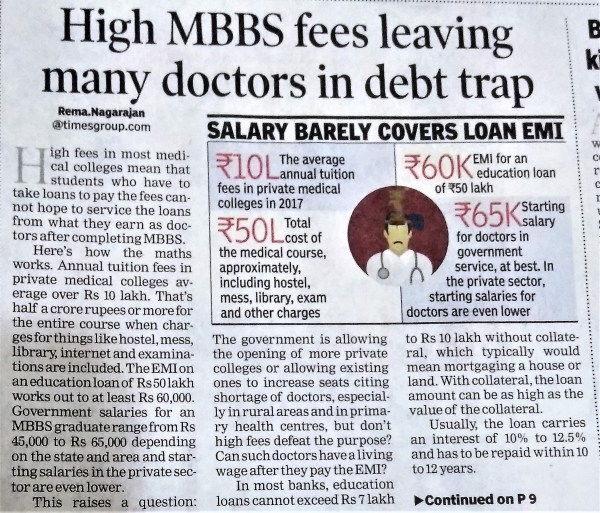
Mirroring the US situation, where medical students come out of the education system with huge loans to repay, India’s medical education is becoming a debt trap for thousands  of medical students with governments doing little to regulate medical college fees.

High fees in most medical colleges means that students who have to take loans to pay it cannot hope to service the loans from what they earn as doctors after completing MBBS. Here’s how the math works. Annual tuition fees in private medical colleges average over Rs 10 lakh. That’s half a crore rupees or more for the entire course when charges for things like hostel, mess, library, internet and examinations are included. The EMI on an education loan of Rs 50 lakh works out to at least Rs 60,000. Government salaries for an MBBS graduate range from Rs 45,000 to Rs 65,000 depending on the state and area. The private sector is even worse.

This raises a question: The government is allowing the opening of more private colleges or allowing existing ones to increase seats citing shortage of doctors, especially in rural areas and in primary health centres, but don’t high fees defeat the purpose? Can such doctors have a living wage after they pay the EMI? In most banks, education loans cannot exceed Rs 7 lakh to Rs 10 lakh without collateral, which typically would mean mortgaging a house or land. With collateral, the loan amount can be . High MBBS fees leaving many doctors in debt trap

Usually, the loan carries an interest of 10% to 12.5% and has to be repaid within 10 to 12 years. If education loans become prohibitive, it could make medical education the preserve of the rich. A TOI analysis of fees charged in 210 private medical colleges in 2017 showed that about 50 charged anything between Rs 10 lakh and Rs 15 lakh and over 30 charged even more. Several government colleges too charge high fees, especially in Gujarat and Rajasthan. After 4.5 years of MBBS, a student has to do a one-year paid internship, during which time his/her salary would be at best Rs 20,000-25,000 per month.

After MBBS, whether a student is doing three-year post-graduation or working as a resident doctor or medical officer, the salary in government service ranges from Rs 40,000 to Rs 55,000 in most states and even less in the private sector. In about three to four years, the salary rises to about Rs 70,000 at best in most places. With EMIs of Rs 45,000- 65,000 for loans ranging from Rs 30 lakh to Rs 50 lakh, doctors are left with barely enough to live on. For those who get married by this stage, the added responsibility of running a household complicates matters further. Even in states with fee regulation, the annual fees in private colleges could range from Rs 2.5 lakh to over Rs 6 lakh+ ,

For those without means, that would entail a loan of Rs 12 lakh to Rs 30 lakh and hence unaffordable EMIs.

Zero marks & still can be doctor (#NEET). Society deserves the doctors, it chooses and nurtures.


Rot of exorbitantly expensive medical education and lowered merit  has been systematic. Aspiring doctors are now forced to pay exorbitant fee,  in millions. Many go under heavy debt to pay medical colleges fee. Children with lower ranks in merit pay millions and can  become doctors. The real problem here is that real deserving will be left out.

Medical students from the very onset are victim and witness to  these practices and   exploitation. They see their parents pay this unreasonable fee through their noses or take loans. Such blatant injustice  will have an everlasting effect on the young impressionable minds. Society gives them lessons of corruption and exploitation.

Our society fails to develops a robust system of choosing and  nurturing  good doctors and therefore  itself responsible for decline in standards of medical profession.

Some MBBS students got zero or less in NEET papers

With no cut-off for individual subjects – physics, chemistry and biology—in the NEET entrance exam, at least 400 students with single-digit marks in physics and chemistry and 110 students with zero or negative marks in them have been admitted for MBBS in 2017, mostly in private colleges. This raises a question. If getting zero in these subjects doesn’t make a person ineligible for admission, why bother to test in that subject at all? Interestingly, the original notification to adopt a common entrance examination had stipulated that students should score at least 50% in individual subjects. However, the subsequent notification, which brought in the percentile system, dropped the stipulation on marks in individual subjects. TOI analysed the subject marks of 1,990 students who got admitted to MBBS with NEET scores of less than 150 out of 720 in 2017. it was found that 530 with single-digit marks, zero or less in physics or chemistry or even both.


Doctors are just as offshoots of a tree called as society. They essentially are the same as rest of the society.  It is a specialized branch of tree which helps other offshoots of tree to save others.  As  part of same tree, they resemble the parent society, of which they are part.  Society needs to choose and nurture a force of doctors carefully with an aim to combat for  safety of its own people.  

       Apple tree will have apples and musk melons plant will  grow muskmelons only.  One should not expect apples to grow on muskmelon stem. If society has failed to demand for a good and robust system, failed to save them, it should not  rue scarcity of good doctors. Merit based cheap good medical education system is the need of the society. This is in interest of society to nurture good doctors for its own safety.

What is the need to dilute and shortlist around half a million for few thousand seats. Answer to that is simple.  To select and find only those students from millions, who can pay millions to become doctors.  

      Although the whole effort and huge expenditure to become doctors in this way may be really worthless in today’s scenario, considering the difficult times and vulnerability of medical profession. By allowing a intentional dilution of quality  can be advantageous only to  few and detrimental to others. 

If the society continues to accept such below par practices, it has to introspect, whether it actually deserves to get good doctors. Paying the irrational fee of medical colleges may be unwise idea for the candidates, who are not from strong financial backgrounds. But at the same time unfortunately, it may be a compulsion and entrapment for students, who have entered the profession and there is no way  forward.  So children have to be careful while choosing medical careers from the beginning.

A famous axiom “as you sow so shall you reap” has an application to health system in this scenario, so people should not rue scarcity of good doctors.     Therefore the quality of doctors who survive and flourish in such system will be a natural consequence of  how society chooses and nurtures the best for themselves.


High court asks fixed duty hours for doctors. Can the suggestion end moral enslavement of doctors?


The Delhi High Court on Wednesday said that the standards have to be set regarding the working hours of doctors and the doctor-patient ratio in hospitals.

Although it is first of its kind of acknowledgement of the   need to improve the plight of doctors.  Despite doing all the hard work, the doctors are usually blamed, specially by media and celebrities, for the health malaise. But  the fundamental reasons and inept system remain concealed and issues are put under the carpet deliberately. Therefore this suggestion by court, although represents   tip of the iceberg, but still an important admission of problems the medical   community faces.

The suggestion came from a bench of  High Court after it was told by a private body, tasked to evaluate healthcare quality in the three hospitals in Delhi, that doctors work for excessive hours and there was no set doctor-patient ratio.

Among the numerous problems one of the issues is enslaved kind of duty hours. The   enthusiastic species of doctors   go on doing it for years,  along with never ending studies. There is no count of hours, no money or compensation in most of healthcare systems of world for these inhuman duties, exploited young energy and lives. And then comes the most painful part when they do not get the due respect in the society. Their selfless hard work goes unnoticed and unappreciated most of the time. Most people take this slave like working as guaranteed and do not feel it as any injustice to the  doctors. The  doctors,  while on duty, may be verbally abused, routinely threatened, assaulted or dragged to courts for trivial issues and that too for no faults of theirs. They just become punching bags for the inept healthcare system and invisible medical industry though lives saved by these young men are uncountable and people relieved of pain and agony innumerable.
Though some western countries of European union and NHS medical systems have realized the inhuman duties and are now following a fixed hours duty schedule, but still most of countries and health systems have kept their eyes closed regarding these slave like duty hours and poor work conditions.
A complex  job that also requires doing duties day and night, sometimes for 24 to 48 hours at a stretch without proper meals and sleep. Most of the hospitals don’t even ensure tea and food on these duties for doctors .But these young hardworking people do it gladly and enthusiastically, doing a most noble work saving innumerable lives or relieving countless people of their pain. No rights have ever been defined for the  doctors, only rules of punishment and exploitation.
This great work is not even acknowledged in any way. These duties are merely systematic exploitation of doctors because of:
– sometimes in the name of Hippocratic oath,
– sometimes in the name of morality
– because of the kindness in their hearts
– in the name of suffering and dying patients
– in name of shortage of doctors and staff.
– for fear of courts and medico-legal cases
– for fear of assaults since the number of doctors is less per patient.
– by some administrative systems who use pressure tactics and sometimes
bullying to get work done
– by similar widely prevalent culture in most hospitals
– for sake of their career and higher degrees
– for sake of employment
– in the name of training , and in many more ways.

Court has definitely noble intentions by suggesting some regulations. But   for achieving the said goal,  which looks like a  distant dream to doctors, a strong will is required from administrators. Till society understands the concealed sense of enslavement that remains hidden, while performing these duties, the suffering of the profession will not end.  A problem that is clearly visible to every one,  but not admitted till now,  is in itself an evidence for a difficult scenario to be implemented.

I wonder if this is perceived as normal and routine then what else does slavery constitute?


#NEET:Society deserves the doctors, it chooses and nurtures. Musk-melon stem will not grow apples


Doctors are just as offshoots of a tree called as society. They essentially are the same as rest of the society. It is a specialized branch of tree which helps other offshoots of tree to save others. As part of same tree, they resemble the parent society, of which they are part. Society needs to choose and nurture a force of doctors carefully with an aim to combat for safety of its own people.

Since it is a difficult path to be a good doctor, there has to be some reason why someone will choose to be a doctor. The path will require sacrificing golden years of his life in studies and working hard for the benefit of others thereafter.

Our society fails to develops a robust system of choosing and nurturing good doctors and therefore itself responsible for decline in standards of medical profession.

  1. Exorbitantly expensive medical education and lowered merit: aspiring doctors are now forced to pay exorbitant fee, in millions. Many go under heavy debt to pay medical colleges fee. Children with lower ranks in merit pay millions and can become doctors. The real problem here is that real deserving will be left out.

Medical students from the very onset are victim and witness to these practices and exploitation. They see their parents pay this unreasonable fee through their noses or take loans. Such blatant injustice will have an everlasting effect on the young impressionable minds. Society gives them lessons of corruption and exploitation.

  1. Discouragement of medical fraternity: The adage “To err is human” probably does not apply to the doctors anymore. Hence they are harassed often for any adverse clinical outcome even though it may be because of poor prognosis of patient. They work under continuous fear and stress and are punished and assaulted for each small or big error. Society has failed to support them in their difficult times. Best and talented may try to shun away from the profession.
  2. Industry earns, but blames doctor: Till now, doctor patient interaction was the central point of the health industry, a core around which medical industry revolved. But now this interaction, treatment and almost everything is controlled by industry. By provoking controversy about doctors for varied reasons, medical industry and law has positioned themselves between the doctor and patient and taken a center stage in health care. Every one associated with industry like medical education, pharmaceutical, suppliers, insurance, administrators, managers, equipment industry, insurance earn from the medical sector, but remain invisible. Blame for all the cost and sufferings is conveniently put on the doctor hence causing diminution of respect. Loss of respect for the profession is a bad advertisement for good talent to the profession.
  3. Overzealous regulation of medical profession: because of falling standards, every one is feels a need for stricter punishing regulation of medical profession. Time and resources which should have been utilized for treatment of patients, has to be used for complex documentation, frivolous medical lawsuits and communication. It is not uncommon to use doctors as scapegoats to save the weak health system causing further oppression of medical profession.
  4. Exploitation by law industry: Even in few advanced countries, one can see instigating advertisement of lawyers on zero percent fee. While doctor is paid miniscule amount of money by patients, he will be sued for millions. And lawyers change in lakhs. Money earned by medical lawsuit is divided between client (so called patient) and lawyer. Doctor will definitely divert their energies to save themselves from such practices rather than focusing on treatment of patient. In an era, where brothers and sisters fight for money, doctors are easiest target to extract money.
  5. Defining the patient as consumer has created fear in mind of doctors and deterioration of doctor patient relationship.
  6. Wrong projections by media: Painful retrospective analysis of work of doctor by media, courts and public continue. One stray incidence of even alleged or perceived negligence is projected as generalization. Whole profession is painted in poor light. Whole community looses respect because of irresponsible behavior of some people in media to earn quick money and fame. Ultimately it will help everyone except doctor and patient and discourage the excellence in medical care.
  7. Doctor’s assault: the inability and lack of support of society to prevent assault against their savior will hit the enthusiasm of doctors towards patients. It will propagate children’s unwillingness to enter the profession amidst chaotic conditions.

Apple tree will have apples and musk melons plant will grow muskmelons only. One should not expect apples to grow on muskmelon stem. If society has failed to demand for a good and robust system, failed to save them, it should not rue scarcity of good doctors. Merit based cheap good medical education system is the need of the society. This is in interest of society to nurture good doctors for its own safety.

Therefore the quality of doctors who survive and flourish in such system will be a natural consequence of how society chooses and nurtures the best for themselves.

Blog at WordPress.com.

Up ↑