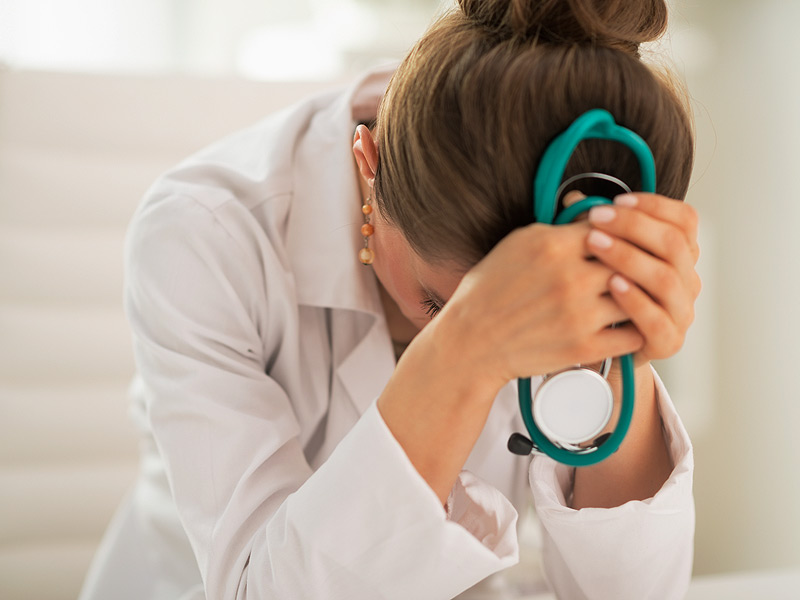
High court asks fixed duty hours for doctors. Can the suggestion end moral enslavement of doctors?


The Delhi High Court on Wednesday said that the standards have to be set regarding the working hours of doctors and the doctor-patient ratio in hospitals.

Although it is first of its kind of acknowledgement of the   need to improve the plight of doctors.  Despite doing all the hard work, the doctors are usually blamed, specially by media and celebrities, for the health malaise. But  the fundamental reasons and inept system remain concealed and issues are put under the carpet deliberately. Therefore this suggestion by court, although represents   tip of the iceberg, but still an important admission of problems the medical   community faces.

The suggestion came from a bench of  High Court after it was told by a private body, tasked to evaluate healthcare quality in the three hospitals in Delhi, that doctors work for excessive hours and there was no set doctor-patient ratio.

Among the numerous problems one of the issues is enslaved kind of duty hours. The   enthusiastic species of doctors   go on doing it for years,  along with never ending studies. There is no count of hours, no money or compensation in most of healthcare systems of world for these inhuman duties, exploited young energy and lives. And then comes the most painful part when they do not get the due respect in the society. Their selfless hard work goes unnoticed and unappreciated most of the time. Most people take this slave like working as guaranteed and do not feel it as any injustice to the  doctors. The  doctors,  while on duty, may be verbally abused, routinely threatened, assaulted or dragged to courts for trivial issues and that too for no faults of theirs. They just become punching bags for the inept healthcare system and invisible medical industry though lives saved by these young men are uncountable and people relieved of pain and agony innumerable.
Though some western countries of European union and NHS medical systems have realized the inhuman duties and are now following a fixed hours duty schedule, but still most of countries and health systems have kept their eyes closed regarding these slave like duty hours and poor work conditions.
A complex  job that also requires doing duties day and night, sometimes for 24 to 48 hours at a stretch without proper meals and sleep. Most of the hospitals don’t even ensure tea and food on these duties for doctors .But these young hardworking people do it gladly and enthusiastically, doing a most noble work saving innumerable lives or relieving countless people of their pain. No rights have ever been defined for the  doctors, only rules of punishment and exploitation.
This great work is not even acknowledged in any way. These duties are merely systematic exploitation of doctors because of:
– sometimes in the name of Hippocratic oath,
– sometimes in the name of morality
– because of the kindness in their hearts
– in the name of suffering and dying patients
– in name of shortage of doctors and staff.
– for fear of courts and medico-legal cases
– for fear of assaults since the number of doctors is less per patient.
– by some administrative systems who use pressure tactics and sometimes
bullying to get work done
– by similar widely prevalent culture in most hospitals
– for sake of their career and higher degrees
– for sake of employment
– in the name of training , and in many more ways.

Court has definitely noble intentions by suggesting some regulations. But   for achieving the said goal,  which looks like a  distant dream to doctors, a strong will is required from administrators. Till society understands the concealed sense of enslavement that remains hidden, while performing these duties, the suffering of the profession will not end.  A problem that is clearly visible to every one,  but not admitted till now,  is in itself an evidence for a difficult scenario to be implemented.

I wonder if this is perceived as normal and routine then what else does slavery constitute?


Homosexuality not a psychiatric disorder:Indian Psychiatry Society (IPS) . criminalization affects mental health: Supreme court


The Indian Psychiatry Society (IPS) said homosexuality was not a psychiatric disorder. Coming out in support of decriminalising homosexuality, the IPS said in a statement on Saturday that it recognised “same- sex sexuality as a normal variant of human sexuality much like heterosexuality and bisexuality”. “There is no scientific evidence that sexual orientation can be altered by any treatment and any such attempts may, in fact, lead to low self-esteem and stigmatisation of the person,” the society added. The IPS had, in 2017, constituted a task force on lesbian, gay, bisexual and transgender issues. The task force, now partially reconstituted, continues its work to endorse the stance that homosexuality “should not be considered a mental illness, much less a crime”. It also said its position was in line with that of the American Psychiatric Association and the International Classification of 7/12/2018 Homosexuality not a crime, says Indian Psychiatry Society . Diseases of the World Health Organisation which removed homosexuality from the list of psychiatric disorders in 1973 and 1992 respectively. In 2009, the Delhi High Court had decriminalised Section 377, an order that was set aside by the SC in 2013. In January, the apex court said it would revisit the constitutional validity of Section 377 and referred the matter to a constitution bench.


The Supreme Court said  “Once the criminality of consensual gay sex goes away, then related issues like social stigma and discrimination against the LGBTQ community will also go” . Observing that an environment has been created in the Indian society over the years that has led to deep-rooted discrimination against the community, a five-judge constitution bench, hearing petitions seeking decriminalisation of 158-year-old colonial law under Section 377 of the IPC, said discrimination against such people has also adversely impacted their mental health.

The bench then said the LGBTQ (lesbian, gay, bisexual, transgender and queer) community faced the stigma because of the criminality attached to consensual same-sex relationship. “Once the criminality (under section 377) goes, then everything will go (all the bars, social stigma and others),” the benchsaid. “Over the years, we have created an environment in the Indian society which has led to deep-rooted discrimination against people of same sex involved in a consensual relationship and this has impacted their mental health also,” the bench said on the third day of crucial hearing to decide the constitutional validity of Section 377 of the Indian Penal Code (IPC).


Section 377 refers to ‘unnatural offences’ and says whoever voluntarily has carnal intercourse against the order of nature with any man, woman or animal, shall be punished with imprisonment for life, or with imprisonment of either description for a term which may extend to 10 years, and shall also be liable to pay a fine. Referring to the provision of the Mental Health Care Act, the bench said, “it also recognises the fact that such persons cannot be discriminated against on the ground of sexual orientation”.


On Wednesday, the government had left it to the apex court to test the constitutional validity of section 377 of the IPC which criminalises “consensual acts of adults in private”, urging that issues like gay marriages, adoption and ancillary civil rights of LGBTQ should not be dealt by it.  Govt leaves it to SC’ wisdom to decriminalise gay sex Taking note of the Centre’s submission that other issues like gay marriages, adoption and ancillary civil rights of LGBTQ community should not be dealt, the court said it was not considering all these issues. The bench had said it would test the validity of the law in relation to the consensual sexual acts of two adults and if it decides to strike down the penal provision then it would remove “ancillary disqualification” of LGBTQ community members who can join services, contest elections and form associations. There are  reports of Indian and American psychiatric bodies and said homosexuality was a normal sexual orientation.


https://timesofindia.indiatimes.com/india/homosexuality-not-a-crime-says-indian-psychiatry-society/articleshow/64911235.cms

https://timesofindia.indiatimes.com/india/supreme-court-once-criminality-of-section-377-goes-stigma-against-lgbtq-will-also-end/articleshow/64959395.cms


#NEET:Society deserves the doctors, it chooses and nurtures. Musk-melon stem will not grow apples


Doctors are just as offshoots of a tree called as society. They essentially are the same as rest of the society. It is a specialized branch of tree which helps other offshoots of tree to save others. As part of same tree, they resemble the parent society, of which they are part. Society needs to choose and nurture a force of doctors carefully with an aim to combat for safety of its own people.

Since it is a difficult path to be a good doctor, there has to be some reason why someone will choose to be a doctor. The path will require sacrificing golden years of his life in studies and working hard for the benefit of others thereafter.

Our society fails to develops a robust system of choosing and nurturing good doctors and therefore itself responsible for decline in standards of medical profession.

  1. Exorbitantly expensive medical education and lowered merit: aspiring doctors are now forced to pay exorbitant fee, in millions. Many go under heavy debt to pay medical colleges fee. Children with lower ranks in merit pay millions and can become doctors. The real problem here is that real deserving will be left out.

Medical students from the very onset are victim and witness to these practices and exploitation. They see their parents pay this unreasonable fee through their noses or take loans. Such blatant injustice will have an everlasting effect on the young impressionable minds. Society gives them lessons of corruption and exploitation.

  1. Discouragement of medical fraternity: The adage “To err is human” probably does not apply to the doctors anymore. Hence they are harassed often for any adverse clinical outcome even though it may be because of poor prognosis of patient. They work under continuous fear and stress and are punished and assaulted for each small or big error. Society has failed to support them in their difficult times. Best and talented may try to shun away from the profession.
  2. Industry earns, but blames doctor: Till now, doctor patient interaction was the central point of the health industry, a core around which medical industry revolved. But now this interaction, treatment and almost everything is controlled by industry. By provoking controversy about doctors for varied reasons, medical industry and law has positioned themselves between the doctor and patient and taken a center stage in health care. Every one associated with industry like medical education, pharmaceutical, suppliers, insurance, administrators, managers, equipment industry, insurance earn from the medical sector, but remain invisible. Blame for all the cost and sufferings is conveniently put on the doctor hence causing diminution of respect. Loss of respect for the profession is a bad advertisement for good talent to the profession.
  3. Overzealous regulation of medical profession: because of falling standards, every one is feels a need for stricter punishing regulation of medical profession. Time and resources which should have been utilized for treatment of patients, has to be used for complex documentation, frivolous medical lawsuits and communication. It is not uncommon to use doctors as scapegoats to save the weak health system causing further oppression of medical profession.
  4. Exploitation by law industry: Even in few advanced countries, one can see instigating advertisement of lawyers on zero percent fee. While doctor is paid miniscule amount of money by patients, he will be sued for millions. And lawyers change in lakhs. Money earned by medical lawsuit is divided between client (so called patient) and lawyer. Doctor will definitely divert their energies to save themselves from such practices rather than focusing on treatment of patient. In an era, where brothers and sisters fight for money, doctors are easiest target to extract money.
  5. Defining the patient as consumer has created fear in mind of doctors and deterioration of doctor patient relationship.
  6. Wrong projections by media: Painful retrospective analysis of work of doctor by media, courts and public continue. One stray incidence of even alleged or perceived negligence is projected as generalization. Whole profession is painted in poor light. Whole community looses respect because of irresponsible behavior of some people in media to earn quick money and fame. Ultimately it will help everyone except doctor and patient and discourage the excellence in medical care.
  7. Doctor’s assault: the inability and lack of support of society to prevent assault against their savior will hit the enthusiasm of doctors towards patients. It will propagate children’s unwillingness to enter the profession amidst chaotic conditions.

Apple tree will have apples and musk melons plant will grow muskmelons only. One should not expect apples to grow on muskmelon stem. If society has failed to demand for a good and robust system, failed to save them, it should not rue scarcity of good doctors. Merit based cheap good medical education system is the need of the society. This is in interest of society to nurture good doctors for its own safety.

Therefore the quality of doctors who survive and flourish in such system will be a natural consequence of how society chooses and nurtures the best for themselves.

India expenditure on health 1 %, of GDP, Lower than Bhutan, Nepal, Sri Lanka


  •  India’s per capita public expenditure on health increased from Rs 621 in 2009-10 to Rs 1,112 (around $16 at current exchange rate) in 2015-16
  • According to National Health Profile (2018), around 43 crore individuals or 34% of the population were covered under any health insurance in 2016-17

It is not difficult to diagnose the ailments of health system. System that requires more input, is suffering  due to  decades of neglect.  It  reflects  a lower priority to health sector.

India’s public health expenditure — 1% of its gross domestic product (GDP) — may have witnessed a marginal improvement from 0.98% in 2014, but it is still way behind even the low-income countries that spend 1.4% on an average, shows National Health Profile 2018.

India is spending even less than some of its neighbors countries such as Bhutan (2.5%), Sri Lanka (1.6%) and Nepal (1.1%), according to the annual report released on Tuesday by the Central Bureau of Health Intelligence, the health intelligence wing of the directorate general of health services in the Union ministry of health and family welfare.

In World Health Organization’s South-East Asian Region, which includes 10 countries, India finishes second last, above only Bangladesh (0.4%), when their health expenditure is compared. Maldives spends 9.4% of its GDP to claim the top spot in the list, followed by Thailand (2.9%).

India’s National Health Policy 2017 proposes raising the public health expenditure to 2.5% of the GDP by 2025.

India currently spends a little over 1% of GDP on health, far below Singapore which has the lowest public spend on health at 2.2% of GDP among countries with significant universal health coverage (UHC) service, according latest National Health Profile (NHP) data.

India’s per capita public expenditure on health increased from Rs 621 in 2009-10 to Rs 1,112 (around $16 at current exchange rate) in 2015-16. However, it is still “nominal”, compared to other countries. Switzerland spends $6944 on health per capita, whereas the US spends $4802 and UK spends$3500.

Government  plans to launch its ambitious National Health Protection Scheme (NHPS)- Ayushman Bharat – to cover over 10 crore poor families with an annual health cover of Rs 5 lakh per family. A successful implementation may bring some positive change to the ailing system.

Real challenge is to provide basic health facilities to remote areas.  Even good preventive care and primary care to under privileged can also  bring a significant change.


Digital Gaming addiction defined as a mental disorder by World Health Organisation


  • WHO described the addiction as a “pattern of persistent or recurrent gaming behaviour” that becomes so extensive it “takes precedence over other life interests”
  • Gaming disorder can lead to disturbed sleep patterns, diet problems and deficiency in physical activities


Digital Gaming  Addiction

Although   substance addiction with  drugs or alcohol is well recognized, newer  addictive behaviors are now being realized as well. As  digital and vedio gaming has been quite popular now, compulsive gaming and  severe withdrawal symptoms in game addicts are getting commoner. A child/ adult needs more of a  game  to keep him going. If the child does not get more of the game, he becomes irritable and miserable.

If parent try to prohibit gaming, children exhibit  anger, violence, or depression. The children cry, sit in the corner and cries, refuses meals or sleep.

For  compulsive gamers, it is  the fantasy world that makes them feel better.

The lure of a fantasy world is especially pertinent to online role-playing games. These are games in which a player assumes the role of a fictional character and interacts with other players in a virtual world. As  A child can  show his dominance in the game. There fore virtual life becomes more appealing than real life.

possibility of harm: gaming addiction can ruin lives. Children who play few hours per day have  no time left for socializing, studies, or sports. Social development is poor.

In older people or adults  it can have effect on professional life and relationships.


Warning signs for  gaming  addiction include:  The important  issue here is  whether one is  able to control  gaming activity or not:

  • Playing for increasing amounts of time
  • Thinking about gaming during other activities
  • to choose gaming to escape from real-life problems, anxiety,  depression
  • Lying to friends and family to conceal gaming
  • Feeling irritable when trying to cut down on gaming

Gaming addicts tend to become isolated, giving up other hobbies and  withdrawn from other activities.

Parents need to be careful

Parents need to be careful and not take it as another routine phase of childhood.  Keep  track of  child’s gaming behavior, including:

  • for how long and frequently  the child plays.
  • Problems resulting from gaming
  • How the child reacts to time limits

to get rid of the game addiction, these children need to be taught about the advantages of real life excitement as opposed to online achievements.

Addiction to digital and video gaming has been classified as a mental health disorder by the World Health Organisation (WHO) in its new International Classification of Diseases (ICD).

The agency described the addiction as a “pattern of persistent or recurrent gaming behaviour” that becomes so extensive it “takes precedence over other life interests

The classification is aimed at alerting health professionals and systems to the existence of this condition and ensuring that people suffering from these conditions can get appropriate help.

Gaming disorder” has three main characteristics. One, that the gaming behaviour takes precedence over other activities to the extent that other activities are pushed to the periphery.


If the condition leads to significant distress and impairment in personal, familial, social, educational or occupational functioning.

Gaming disorder can lead to disturbed sleep patterns, diet problems and deficiency in physical activities.

The 11th edition of ICD covers 55,000 injuries, diseases and causes of death. Researchers across the world use it as reference for data, whereas doctors and other medical practitioners use it to diagnose disease and other conditions. The ICD is also used by health insurers in some countries to claim reimbursements based on ICD coding.

Besides, the classification is used by national health program managers; data collection specialists; and others. The new ICD-11 also reflects progress in medicine and advances in scientific understanding.

Expensive dream or a disaster self bought: Pay millions to be a doctor (#NEET)


Reluctance of candidates to wrap up  expensive medical college seats is just an indicator of aspiring medical student’s   better understanding of  the cruel reality about medical education. Becoming a doctor is not easy these days. Paying crores is like  getting into a trouble zone and getting yourself entrapped into a system of exploitation. It  may be alright for candidates who are from rich backgrounds.  But for the candidates whose families are not  strong financially, it may be self bought disaster. Steep rise in fee of medical colleges has been huge, beyond logic and is injustice to the meritorious.  One advantage of inappropriate media bashing of doctors, recent assaults against doctors has  given some wisdom to  innocent students, who  used to just enter into a system of entrapment unknowingly. Choosing medical career and then trying to place your feet into post graduation, spending crores in all these situations is akin to  falling victim to  a system of entrapment.  Some one paying for it in millions and  crores is an absurd thought  and  highly ill advised. For the candidates who are not financially strong, it may be difficult to even recover the money spent, what to say about the time and youth wasted in  getting a degree which may or may not be that worth.

Therefore it may become  dream turning into nightmare  for the people who can not afford.  Lower merits combined with not so good medical colleges   may produce thousands of degree holders but not good doctors.  Recent sporadic campaign of stray cases projected as generalization  by media has definitely diminished respect for profession. Individually most of the doctors may be working hard honestly but they are uniformly painted in the same colours due to misplaced priorities of the media. Society has already developed a prejudiced mind towards doctors.   Since these projections are created by outside agencies, doctors even with hard work and doing work honestly  may not be able to change the perception that has been created. Damage to profession has been immense and it is nearly impossible  task to reverse the mistrust generated and  undo the damage. If individually doctors are doing good and media continues the negative projection, the sad situation will persist. All efforts by doctors  in this direction are like oil  on the sand.

In  nutshell, this toil and trouble for years, buying a seat, paying millions or crores and becoming a doctor does not save you from vulnerability of court cases and wrath of public. Rather suboptimal training and capabilities makes them  more vulnerable to problems. It may be alright if some one with strong financial background  decides to be a health manager or administrator.

Real problem of mediocrity remains as such. Candidates with higher merit will be left behind as candidates who can buy and pay more will get in. This process  will be called as “lawful selection” along with diluted merit .This process makes count number of degrees distributed under various conditions attached to it other than merit.  But  just number of   degrees will not provide better doctors for future.

Quack menace: Patient killed by quack (Delhi): qualified doctors regulated strictly but not unqualified?


In an era, when even licensed and qualified doctors are finding it  difficult to practice medicine, it is strange that unqualified and unlicensed are having a field day. Why a strict regulation does not apply to them, is beyond any reasoning and logic. If a medical facility or clinic is functional, it is difficult for the patient, specially in emergency, to check or even doubt its credentials. How such facilities are open, functional and thriving, which does not have a qualified medical person is beyond logic. Sadly our regulation is trying to regulate, who are already regulated. It is trying to punish those who are qualified and licensed, but turns a blind eye towards unlicensed and unqualified doctors.

Such fake doctors own medical set ups, may conduct surgeries,  sometimes run with little help from qualified doctors,  and do procedures. Another problem is that they   promote fake rumours about genuinely qualified doctors and create a mist of mistrust to propagate their fake medical business.

If this is state of medical affairs prevalent in heart of capital and such facilities are functional and thriving, what will be state of affairs in peripheral or remote areas. Again it does not need an Einstein brain to guess.

The Delhi Medical Council (DMC) on Wednesday ordered criminal action against a quack whose “treatment” resulted in the death of a patient in November last year.

The hospital in which the patient was treated was also not registered with the Directorate of Health Services, Delhi. The patient was treated by an unqualified person in an unregistered hospital and did not receive proper treatment, which led to his death. The man, who had pretended to be a doctor, had been practising medicine for almost 12 years in Delhi and was a member of the Indian Medical Association (IMA), a pan-india representative organisation of doctors, and the Indian Academy of Paediatrics (IAP), a renowned association of paediatricians.

The 45 years old patient  had an undiagnosed liver disease. He went to a private hospital in Munirka ( New Delhi) around 2 pm on noticing blood in his vomit and stool. Within nine hours, the condition of the patient deteriorated and he was taken to Safdarjung hospital New Delhi , where he was declared dead on arrival at 2 am.

The patient was just put on a saline and given some antibiotics and pain medication. No diagnostic test was done to find the source of the bleeding, neither was any blood given to the patient. Any doctor can tell you the treatment was wrong. First he gave a DMC number, but the number corresponded to someone else. So, he provided  a registration number of the Goa Medical Council, again it belonged to someone else.


This is an  example of  how modern medicine is detrimental in unsafe hands, that are functional without proper training. How these fake doctors openly call themselves doctors, use prefix of Dr and register themselves somehow.   It is no less than fraud with lives of innocent public.

Neglect towards this sad reality  is akin to playing with health of innocent people. Medical organizations and media  has either  not taken it seriously or not able to take any constructive step  in curbing this menace by quacks.

Although genuine doctors face many problems from system of quackery. Misuse of antibiotics, local goonism and nuisance, all kinds of malpractice, misguiding the patient are few examples. But ultimately it is the society who is  the sufferer. Therefore resistance to such practices and  a wish to have good health system is  actually need of society. Unless people themselves make a true effort towards a robust health system, this menace of quackery is likely to persist, due  to prevalence  of  vested interests.

Plan to revamp the regulator for drug price regulation , National Pharmaceutical Pricing Authority (NPPA).


In an attempt to revamp drug price regulation in the country, while strengthening implementation and market monitoring, the government is set to restructure the regulator, National Pharmaceutical Pricing Authority (NPPA).

The authority, which is expected to be re-christened soon, will be replaced by a board or a council with four full-time members, including the chairman. The other three members — an economist, a costing specialist and a technology expert — will also hold a rank similar to the chairman, according to a proposal being considered at the highest level of the government.

According to another source, the new structure of the regulator, currently responsible for regulating drug prices and ensuring the availability of medicines, will be in line with the Telecom Regulatory Authority of India and Insurance Regulatory and Development Authority.

 
The role of the authority is also expected to change to become more of a regulatory body implementing and monitoring prices in the market, than fixing them.

 
At present, NPPA has the powers to cap prices of medicines according to the Drugs Price Control Order. It also gives new price approvals and looks at price revisions. Besides, the authority also enjoys powers to regulate prices of all medicines and medical devices under extraordinary circumstances in the public interest.

“NEET – NOT So NEAT” : Courtesy switch to Percentile system?


Imagine, an opportunity is available to a patient, to decide the doctor as based on his route or marks for entry into medical college. Whether patient will like to get treated by a doctor, who   secured 20% marks, 30 % marks or 60% marks or 80% marks for medical college.  Even   an illiterate person can answer that well. But strangely for selection of doctors, rules were framed so as to dilute the merit to the minimum possible. So that a candidate who scores 20 -25 % marks also becomes eligible to become a doctor. What is the need to dilute and shortlist around half a million for few thousand seats. Answer to that is simple.  To select and find only those students from millions, who can pay millions to become doctors.  

      Although the whole effort and huge expenditure to become doctors in this way may be really worthless in today’s scenario, considering the difficult times and vulnerability of medical profession. By allowing a intentional dilution of quality  can be advantageous only to  few and detrimental to others.

  • Beneficiaries are rich candidates, medical colleges who collecting fee and may be public who will get numbers of doctors. Surplus of doctors is thought to be an advantage to society. But here quality is least of the consideration.
  • Disadvantage to students, who are meritorious but can’t pay, and possibly society in long run, who is deprived of good quality doctors.


  •      A lower eligibility cut-off would mean that students with even lower percentage       of    marks will be eligible for MBBS
  • Last year, 11,114 students who scored 270 or less out of 720 got admission into medical colleges, mostly in private colleges
  • By the percentile system, last year, a student scoring 270 was within the 80th percentile

NEW DELHI: The results of the National Eligibility cum Entrance Test (NEET) for MBBS admissions for 2018 announced on Monday showed even lower cut-offs than last year. The cut-off for the unreserved category is down from 131 out of 720 marks last year to 119 this year, while the one for the reserved categories has dropped by a similar margin from 107 to 96. Over 7 lakh students from the 13 lakh plus who appeared for the exam have qualified to join medical college.

A lower eligibility cut-off for NEET would mean that students with even lower percentage of marks will be eligible to get admission for MBBS. In case you thought just being eligible would not allow those with poor scores to get admission, here’s what happened last year. Over 4,300 students who scored 180 or less in NEET actually got admission to MBBS. The overwhelming majority of them in private colleges, where high fees make it difficult for those with meagre means to join even if they have the marks.

A score of 180 out of 720 is the minimum mark a student would get if they got 40% of the answers right, even if they got all the rest wrong, with the negative marking scheme in place in NEET. Of course, 40% is the pass percentage in most exams. In terms of percentage, 180 out of 720 is a mere 25%. But going by the percentile system of NEET, 180 in 2017 meant the student was within the 64th percentile, well above the 50th percentile cut-off for the unreserved category.

Last year, 11,114 students who scored 270 or less out of 720 got admission into medical colleges, once again mostly in private colleges. If a student got half the answers right, he could not have got less than 270. Before NEET, the minimum eligibility criteria for MBBS admission was 50% through various entrance exams though the quality of some of the exams conducted by colleges themselves was dubious. By the percentile system, last year, a student scoring 270 was within the 80th percentile.
Incidentally, because there are no cut-offs specified for individual subjects within NEET, there were several cases last year of people who qualified and got admission into medical colleges with scores of zero or even negative marks in chemistry or physics. With the cut-offs dropping further this year in terms of percentage marks (though remaining the same in percentile terms), chances are we will see a repeat of worse this year.

If the society continues to accept such below par practices, it has to introspect, whether it actually deserves to get good doctors. Paying the irrational fee of medical colleges may be unwise idea for the candidates, who are not from strong financial backgrounds. But at the same time unfortunately, it may be a compulsion and entrapment for students, who have entered the profession and there is no way  forward.  So children have to be careful while choosing medical careers from the beginning.

A famous axiom “as you sow so shall you reap” has an application to health system in this scenario, so people should not rue scarcity of good doctors.  

Advantages-Disadvantage of being a doctor

25 factors- why health care is expensive

     REEL Heroes Vs Real Heroes

     21 occupational risks to doctors and nurses

     Covid paradox: salary cut for doctors other paid at home

   Medical-Consumer protection Act- Pros and Cons

Expensive Medical College  seat- Is it worth it?

New price index for pharmaceutical products likely


  • Govt plans to introduce a new price index for pharmaceutical products
  • Under the proposed mechanism, the Centre plans to link prices of all medicines with the new pharmaceutical index
  • However, it seems the government’s latest move may also not go well with drug makers

The drug pricing mechanism in the country is likely to be overhauled before the end of this month (India). Among the changes proposed by the government is the move to introduce a new price index for pharmaceutical products that will become the benchmark to determine prices of all medicines sold in the country — even those that are currently outside the drug price control order.

Even now, the government loosely regulates prices of all medicines in public interest. Prices of around 850 essential drugs are capped by the government. The drug price regulator National Pharmaceutical Pricing Authority (NPPA) revises these prices annually based on the wholesale price index (WPI). For all other medicines, companies are allowed to raise prices by no more than 10% in a year.

Under the proposed mechanism, the Centre plans to link prices of all medicines with the new pharmaceutical index. Drug makers will be allowed to revise prices annually only on the basis of movement in the index, sources said.

The proposal is in its final stages and is likely to be notified by the department of pharmaceuticals in June itself. The proposed index will not only replace the WPI for revising prices of scheduled or price-controlled drugs, it will be used to regulate prices of non-scheduled medicines.

The proposal is part of the recommendations made by the government think-tank Niti Aayog for making changes to the Drug Price Control Order, 2013.

Once in place, the new system will change the price movement of all medicines. Under the present price mechanism, only 17% of the over Rs 1 lakh crore domestic pharmaceutical market is under direct government price control. Even by volumes, the government regulates 24% of all medicines sold.

The suggestion to create a new index came in the wake of objections from the pharmaceutical industry to linking of prices with WPI. However, it seems the government’s latest move may also not go well with drug makers.
Experts who believe that linking prices to an index will be better and less discretionary than the present mechanism and may actually result in increase in prices rather than a decrease.


Blog at WordPress.com.

Up ↑